
How to Reduce Microplastic Exposure: What Actually Works
Cut microplastic exposure with science-backed steps. The Wellness Quality Institute explains what works, what doesn't, and how to start today.
Read articleThe Wellness Quality Institute cuts through the noise on nanoplastic health risks. See what science actually proves — and what you can do now.
Written by: Scott Steveson, Specialist, Wellness Quality Institute
Nanoplastics are plastic particles smaller than 1 micrometer. They have been detected in human tissue, but current evidence does not show that nanoplastic exposure causes specific diseases.
The strongest evidence focuses on chemical additives such as phthalates and bisphenols. These chemicals disrupt hormones and have decades of research behind them in animals, human clinical observation, and population studies.
Physical nanoplastic particles show plausible risk pathways in lab and animal studies, including oxidative stress and systemic inflammation. These findings have not yet been proven in humans.
Real-world human exposure levels cannot currently be measured with validated methods. This gap prevents any product from being credibly described as free of nanoplastics.
Consumers and business owners can focus on practical reduction strategies and verified information. The Wellness Quality Institute, also called WQI, supports this through its Plastic-Free Pathway Verification services.
The Wellness Quality Institute organizes nanoplastic health evidence into three tiers so readers can see what is solid, what is emerging, and what remains unknown. The research spans mature chemical data, early particle studies, and a major measurement gap.
This guide applies a three-tier framework throughout:
Tier 1 — Well Established: Backed by decades of research across animal models, human clinical observation, and epidemiology. This tier covers the chemical additives in plastics.
Tier 2 — Plausible But Unproven: Observed in laboratory and animal models, not confirmed as causal in humans. This tier covers the physical nanoplastic particles themselves.
Tier 3 — Cannot Currently Be Measured: The exposure number everyone wants, such as how much nanoplastic is inside a person, does not yet exist as a validated, reliable figure.
Each section below connects to one of these tiers. You can reuse this lens whenever you see a new nanoplastics headline to judge how much confidence a claim deserves.
Plastic breaks into smaller pieces instead of disappearing. A bottle, wrapper, or synthetic fiber degrades under sunlight, heat, and friction into tiny fragments that stay plastic even when they no longer look like the original item.

Researchers sort these particles by size. Microplastics are smaller than 5 millimeters. Nanoplastics are smaller than 1 micrometer, which sits below the reliable reach of most commercial testing tools. Primary microplastics are manufactured small, like microbeads in personal-care products. Secondary microplastics, which are far more common, come from the breakdown of everyday plastic items.
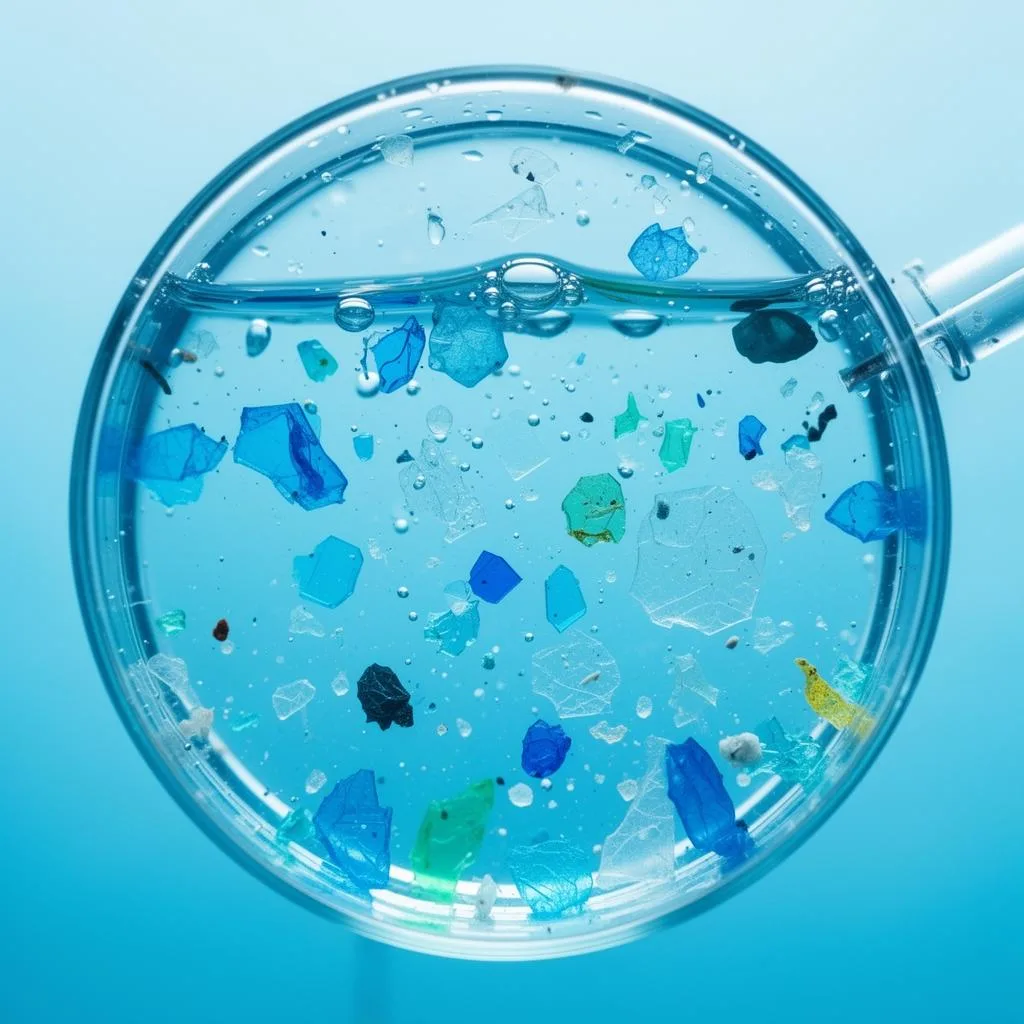
Three main routes carry these particles into the human body:
Ingestion: Food, water, and packaging that sheds particles during bottling, filling, and opening.
Inhalation: Indoor and outdoor air, with particles that can settle on food and open drinks during preparation.
Skin Contact: A smaller route for intact skin, but more relevant with cosmetics or workplace exposure.
Global plastics production roughly doubled from 234 million tonnes in 2000 to about 460 million tonnes in 2019, according to the OECD’s Global Plastics Outlook. On current paths, production may rise another 70% by 2040, and every item produced eventually breaks down somewhere.
Explore how independent verification supports plastic reduction efforts.
The table below summarizes how the three evidence tiers differ in what they cover, how confident we can be, and which sources anchor each tier.
|
Evidence Tier |
What It Covers |
Confidence Level |
Key Sources |
|---|---|---|---|
|
Tier 1 — Well Established |
Chemical additives (phthalates, bisphenols) |
High, replicated across multiple study types |
|
|
Tier 2 — Plausible But Unproven |
Physical nanoplastic particles |
Low, based on laboratory and animal models only |
Rapid systematic review, microplastic exposure and human health |
|
Tier 3 — Cannot Currently Be Measured |
Real-world human exposure levels |
None, no validated method below 20 µm |
California SWB methods SWB-MP1-rev1 and SWB-MP2-rev1 |
The most mature evidence in this field focuses on what plastics contain, not the particles themselves. Phthalates and bisphenols, used as plasticizers and stabilizers in many products, are endocrine-disrupting compounds. In plain terms, they interfere with hormone systems that guide growth, metabolism, and reproduction.
The Endocrine Society’s Scientific Statement on endocrine-disrupting chemicals offers a clear summary of this research. A 2026 review in Frontiers in Pharmacology by Halder and colleagues shows that phthalates and bisphenols are linked with thyroid problems, cardiovascular effects, and metabolic disruption across human, animal, and cell studies. The authors note that evidence for these additives is far stronger than for nanoplastic particles.
Most plasticizers are not tightly bound to the plastic itself. That means they can move into food, drinks, and the body through swallowing, breathing, and skin contact. A 2020 report from the Endocrine Society and the International Pollutants Elimination Network found that 144 chemicals or chemical groups known to harm human health are actively used in plastics. Together, these findings show why Tier 1 evidence is considered mature, replicated, and ready for action.
Evidence about the particles themselves sits at an earlier stage. Laboratory and animal studies describe realistic ways these particles might cause harm. Oxidative stress and systemic inflammation appear most often in the microplastic literature, across many studies of digestive, reproductive, and respiratory health. Some research also reports cell and DNA damage.
Detection in human tissue has advanced. Microplastics appeared in the stool of every healthy volunteer in a 2019 case series led by Philipp Schwabl in Annals of Internal Medicine. Ragusa and colleagues reported the first evidence of microplastics in human placenta in Environment International in 2021. A 2022 study led by Leslie at Vrije Universiteit Amsterdam found plastic particles in the blood of 17 of 22 healthy donors.
A 2026 systematic review by Parihar and colleagues in Cureus identified only four eligible studies on micro- and nanoplastics and neurological outcomes in humans. The review raised concern that these particles may reach the central nervous system, especially when the blood-brain barrier is weakened, but stated that a direct causal link has not been confirmed.
Finding particles in tissue does not prove they cause harm. These studies involve small groups and some have drawn criticism for their methods. They show presence and justify serious attention, but they do not prove that nanoplastics cause disease.
A 2025 study led by Alexander Nihart in Nature Medicine reported micro- and nanoplastic accumulation in human brain, liver, and kidney tissue from postmortem samples. Brain samples showed the highest levels, mainly polyethylene in nanoscale shard-like fragments. Brain concentrations were 7 to 30 times higher than matched liver and kidney samples, and brains from people with dementia had higher concentrations than those without dementia.
This study must be weighed with its critique. A Matters Arising response in Nature Medicine raised concerns about contamination controls and validation. The original authors reported about 25% variation within the same sample and noted that brain lipids can interfere with the method used. They wrote clearly that their data are associative and do not show that the particles cause health effects.
The World Health Organization’s 2019 assessment, Microplastics in Drinking-Water reviewed three possible hazard routes: the particles themselves, the chemicals they carry, and micro-organisms that may attach to them. It found low concern for each route on the limited evidence available and called for more research.
See how independent verification can help you make sense of plastic-related claims.
Given the measurement limits, a natural next step is to ask whether smaller particles pose greater danger. Current evidence does not show that nanoplastics are more harmful than microplastics.
Smaller particles cross biological barriers more easily, which is a physical property rather than a proven health outcome. A 2026 review reports that no routine technique can reliably measure sub-micrometer nanoplastics in biological tissues. It also notes that reported concentrations may underestimate the smallest particles, which are the ones most likely to cross barriers.
The smallest particles are also the hardest to detect. Nanoplastics remain less studied and less understood than larger microplastics. With current tools, scientists cannot give a firm ranking of harm between the two size ranges.
The measurement gap shapes everything we know about nanoplastics. California’s drinking-water definition of microplastics, one of the strictest public frameworks, reaches down to 1 nanometer in at least three dimensions. In practice, the best validated methods start at 20 micrometers for Raman spectroscopy under method SWB-MP2-rev1, and 50 micrometers for infrared spectroscopy under SWB-MP1-rev1. The 1–20 µm range is not validated, and everything smaller sits beyond reliable commercial testing.

The rule covers particles thousands of times smaller than any validated method can see. As the Science and Medicine Group’s review of California’s monitoring framework explains, this gap reflects a technical limit rather than a lack of effort. The EPA has stated that no single method can describe the full range of micro- and nanoplastic particles. In its proposed Sixth Unregulated Contaminant Monitoring Rule in July 2026, the agency left microplastics out entirely, concluding that a validated, standardized method was not feasible in time.
This gap has a direct consequence. No one can state your personal nanoplastic exposure level. A laboratory report that says “no microplastics detected” means none were found above that instrument’s detection floor for the polymers it checked in that batch. Detection can confirm that particles are present, but it cannot prove they are absent.
The popular claim that people ingest about 5 grams of plastic per week, often compared with a credit card, comes from a 2019 WWF-commissioned analysis based on a University of Newcastle study. The estimates range from about 0.1 to 5.5 grams depending only on assumed particle shape, and later work lands far lower. That number illustrates how a striking statistic can outrun its evidence. The Wellness Quality Institute exists to close exactly this kind of gap between claims and data.
Learn how WQI’s verification process accounts for the limits of current testing.
Plastics now appear in air, water, and soil, so complete avoidance is not realistic. A more practical goal is informed reduction that lowers higher-risk exposures where change is easy.
Several everyday steps align with current evidence:
Choose glass or stainless steel for hot or long-stored liquids. Heat speeds up how plastics break down and shed particles, so this switch can cut a major source.
Stop heating food in plastic containers for the same reason. Heat is a main driver of particle release into food.
Read labels for what they clearly state. “BPA-free” does not guarantee the absence of other bisphenols or plasticizers, so treat it as a partial step, not a full solution.
Approach absolute claims with skepticism. Statements that a product is completely plastic-free or that plastic exposure is entirely harmless both go beyond current evidence.
The Wellness Quality Institute acts as an independent verification body and does not endorse specific filtration brands. For any filter or device, look for clear, independent performance data instead of relying on marketing language.
Public coverage of nanoplastics often repeats the same errors. Understanding these patterns can help you read claims more confidently.
Treating “Detected In Tissue” As Proof Of Harm. Detection shows that particles are present. It does not show that they are causing damage at the levels found.
Assuming “BPA-free” Means Free Of All Plasticizers. A product can be labeled BPA “not intentionally added” yet still contain detectable BPA from unclear sources. Manufacturers often replace BPA with similar bisphenol analogues that may have comparable hormone-disrupting effects.
Assuming Recycled Plastic Is Automatically Safer. Recycled plastic is not automatically safer for food contact. Reprocessing can increase particle shedding, and dark colors may hide impurities in the recycled material.
Reading “None Detected” As A Guarantee. A non-detect result reflects only the instrument’s detection floor, the polymers tested, and the batch sampled. It means none found above those limits, not a complete absence of plastic.
Current evidence does not show that smaller plastic particles cause more harm. As discussed earlier, smaller particles cross biological barriers more easily, but this property has not been linked to proven health outcomes in humans. Nanoplastics also remain harder to measure, which limits direct comparisons.
Researchers have not yet reached a firm answer. Laboratory and animal studies describe plausible mechanisms, and plastic particles have been detected in human tissue. Detection alone does not prove harm, and the evidence base remains incomplete. As noted earlier, the WHO’s 2019 assessment found no indication of health risk at current levels but stressed that the evidence base is still developing.
Studies generally find more microplastic particles in bottled water than in tap water. A 2018 study led by Sherri Mason at the State University of New York at Fredonia, published in Frontiers in Chemistry, found contamination in 93% of 259 bottled water samples across eleven brands. Particle levels were about twice as high as in tap water, and polypropylene from bottle caps was the most common polymer. Tap water still contains microplastics, but bottled water adds another factor to consider.
“None detected” sounds absolute but is not. As explained earlier, it only means none were found above the instrument’s detection floor for the polymers screened in that batch. A method that works above 50 micrometers cannot see smaller particles, so a non-detect result can still coexist with plastic below that size. This is why the method behind a result matters as much as the number on the page.
A balanced level of concern supports better choices. The mature evidence about chemical additives justifies reducing unnecessary plastic contact, especially with food and hot liquids. The particle evidence is early and worth tracking, but it does not support panic. A practical approach is informed reduction: choose lower-plastic options when convenient, read labels carefully, and question absolute claims in either direction.
The three-tier framework clarifies most confusion around nanoplastics. Tier 1, which covers chemical additives such as phthalates and bisphenols, rests on mature, replicated evidence that supports action. Tier 2, which covers the particles themselves, remains plausible and early-stage without proven causation in humans. Tier 3, which covers real-world exposure levels, cannot yet be measured with validated methods. That measurement gap explains why no product can honestly claim to be free of nanoplastics.
The key distinction is simple. Evidence about plastic additives is far more developed than evidence about the particles that plastics shed. These are related but separate questions. Borrowing the confidence of the first to make strong claims about the second is the most common overreach in this area.
For primary information, the WHO’s Microplastics in Drinking-Water (2019), the OECD’s Global Plastics Outlook, and the peer-reviewed studies cited here offer a solid starting point.
WQI Plastic-Free Pathway Verification does not certify that a product contains zero plastic, microplastics, or nanoplastics. It shows that the company is on a verified pathway toward plastic-free standards. Verification applies only to the reviewed products, submitted datasets, tested ranges, polymer panels, production or sampling periods, and supporting controls. WQI verification is not a California approval, government certification, or health or safety certification.
Health Impacts

Cut microplastic exposure with science-backed steps. The Wellness Quality Institute explains what works, what doesn't, and how to start today.
Read article
BPA-free doesn't mean microplastic-free. The Wellness Quality Institute explains what the label covers and how to reduce your exposure.
Read article
The Wellness Quality Institute breaks down the real science on microplastics and brain health. Get evidence-based answers and practical steps today.
Read article