
Supplier Compliance for Plastic Content: A US Brand Guide
The Wellness Quality Institute's document-by-document guide helps US brands verify supplier plastic content claims and stay compliant. Start here.
Read articleThe Wellness Quality Institute breaks down what "no microplastics detected" really means, what science confirms, and how to choose water confidently.

Written by: Scott Steveson, Specialist, Wellness Quality Institute | Last updated: August 28, 2026
Microplastics show up in bottled water and in human tissues, but no peer-reviewed study has proven that drinking-water exposure causes specific health problems in people at real-world levels.
Current lab methods cannot prove that a product has zero plastic particles. Every “none detected” result is limited by the method’s detection floor, the plastic types it checks, and the particle sizes it can see.
Evidence about chemical additives used in plastics is stronger than evidence about the plastic particles themselves. Treating those two evidence bases as identical is a common mistake.
Independent verification programs help brands turn existing lab reports into clear, defensible claims that stay within what the data can actually support.
Microplastics are present in bottled water, as shown in multiple peer-reviewed studies, and plastic particles have been found in human tissues. Current analytical methods cannot prove absence. Every “none detected” result reflects the method’s detection floor, not a perfect product. No peer-reviewed study has shown that microplastic particles from drinking water cause specific health outcomes in humans at real-world exposure levels. This is the current state of the science and the starting point for any honest discussion.

Evidence on microplastics in bottled water and human tissues is real, but its strength varies depending on the question. Two separate questions often get merged into one, and separating them keeps the conversation accurate.
The first question focuses on chemical additives in plastics, such as phthalates and bisphenols used during manufacturing. Evidence that these chemicals disrupt hormone systems is much more developed and is supported by decades of animal studies, human clinical observation, and population research. The second question focuses on the physical microplastic particles themselves, meaning the tiny fragments that plastics break into over time. This research area is newer, uses smaller samples, and relies on methods that scientists still debate.
Borrowing the confidence from the chemical-additive question and applying it to the particle question stretches the science beyond what it supports. The topics connect, but they are not the same.
On the particle side, the documented findings matter. A 2018 study led by Sherri Mason at the State University of New York at Fredonia, published in Frontiers in Chemistry, found microplastics in 93% of 259 bottled water samples across eleven brands, at roughly twice the particle concentration found in tap water. The most common polymer identified was polypropylene, the material used in bottle caps, which points to packaging as a contamination route. A 2018 study by Kosuth, Mason, and Wattenberg in PLOS ONE found human-made particles in 81% of 159 tap water samples from five continents.
A 2024 study published in PNAS by Qian et al. at Columbia University reported about 240,000 plastic particles per liter in bottled water, with roughly 90% classified as nanoplastics smaller than 1 micrometer. This number has been widely repeated. The context matters. The study tested only three brands from one retailer and used a reference library that covered seven polymer types, which accounted for about 10% of the imaged particles. A later commentary in PNAS found that the study’s procedural blanks appeared contaminated and that quality controls were not sufficient. The work shows a promising new imaging technique. It does not provide a final particle count for all bottled water.
On human health effects, a 2024 review by Rathee et al. in Sustainability concludes that laboratory and animal studies show microplastic-induced oxidative stress and inflammation as plausible biological mechanisms. The same review notes that direct population-level evidence linking microplastic exposure to specific clinical outcomes in humans is still missing. A 2024 policy review by Fortaleza et al. in Frontiers in Environmental Science reaches the same conclusion. Biological plausibility exists, but confirmed human health outcomes from microplastic exposure do not yet appear in the evidence hierarchy. The World Health Organization’s 2019 assessment, Microplastics in Drinking-Water, found low concern across three possible hazard routes, including physical particles, associated chemicals, and attached microorganisms. The report also stressed that this conclusion rests on limited evidence and that more research is urgent. The U.S. Food and Drug Administration states that current scientific evidence does not show that levels of microplastics or nanoplastics in water pose a human health risk, and that presence alone does not equal risk.
Detection shows that particles are present. Detection does not prove that those particles cause harm. These are different claims, and the science currently supports only the first.
Given this evidence boundary, the most common consumer question becomes practical rather than theoretical.
The evidence does not support a blanket decision to stop drinking bottled water. It does support thoughtful choices about packaging and sourcing.
As noted earlier, bottled water often shows roughly twice the microplastic concentration of tap water, and packaging components such as bottle caps contribute to contamination. The Kosuth et al. 2018 study in PLOS ONE found human-made particles in 81% of tap water samples tested across five continents. Neither source is “clean” by a zero-particle standard, and current measurement methods cannot confirm that standard.
The WHO’s 2019 assessment found low concern for health risk from microplastics in drinking water based on available evidence and called for more research. That assessment covers both tap and bottled water.
Practical factors to weigh include container material and storage conditions. Glass containers tend to shed fewer plastic particles than plastic bottles, especially when bottles sit in heat, which speeds up plastic breakdown. Packaging components such as caps also matter. These are modest, real factors. They support informed decisions rather than alarm.
“No microplastics detected” sounds absolute, but it is a narrow technical statement.
“None detected” means no particles were found above the method’s detection floor, for the plastic types the method checks, in the production lot that was sampled. It describes what one instrument found in one test. It does not guarantee anything about the entire product line.
One state water board’s drinking-water microplastics framework, often treated as the strictest public reference for this testing, shows this gap clearly. That framework defines microplastics as particles from 1 nanometer up to 5,000 micrometers. The two validated analytical methods it has published reach only part of that range, and the gap between what the definition covers and what the methods can actually detect explains why “none detected” is such a limited claim:
|
Method |
Technique |
Validated Detection Range |
Gap vs. Definition |
|---|---|---|---|
|
SWB-MP1-rev1 |
Infrared spectroscopy |
>50 µm through 5,000 µm |
Cannot detect particles below 50 µm, while the definition reaches to 1 nm |
|
Raman spectroscopy |
>20 µm through 5,000 µm |
Cannot detect particles below 20 µm, so the 1–20 µm fraction remains unvalidated under either method |
|
|
Regulatory definition |
N/A (definitional) |
>1 nm to <5,000 µm |
Best validated methods begin thousands of times above the lower bound in the definition |
|
Nanoplastic range |
Not reliably measurable by commercial methods |
<1 µm |
Outside the validated range of both methods and beyond reliable commercial measurement |
A non-detect result using SWB-MP1-rev1 means no particles were found above 50 micrometers using infrared spectroscopy on that sample. It says nothing about particles below 50 micrometers, about plastic types outside the tested panel, or about other production lots. As a review of current microplastic analytical workflows confirms, apparent absence of particles reflects the chosen technique, size range, plastic library, and sample type. It does not prove zero contamination everywhere.
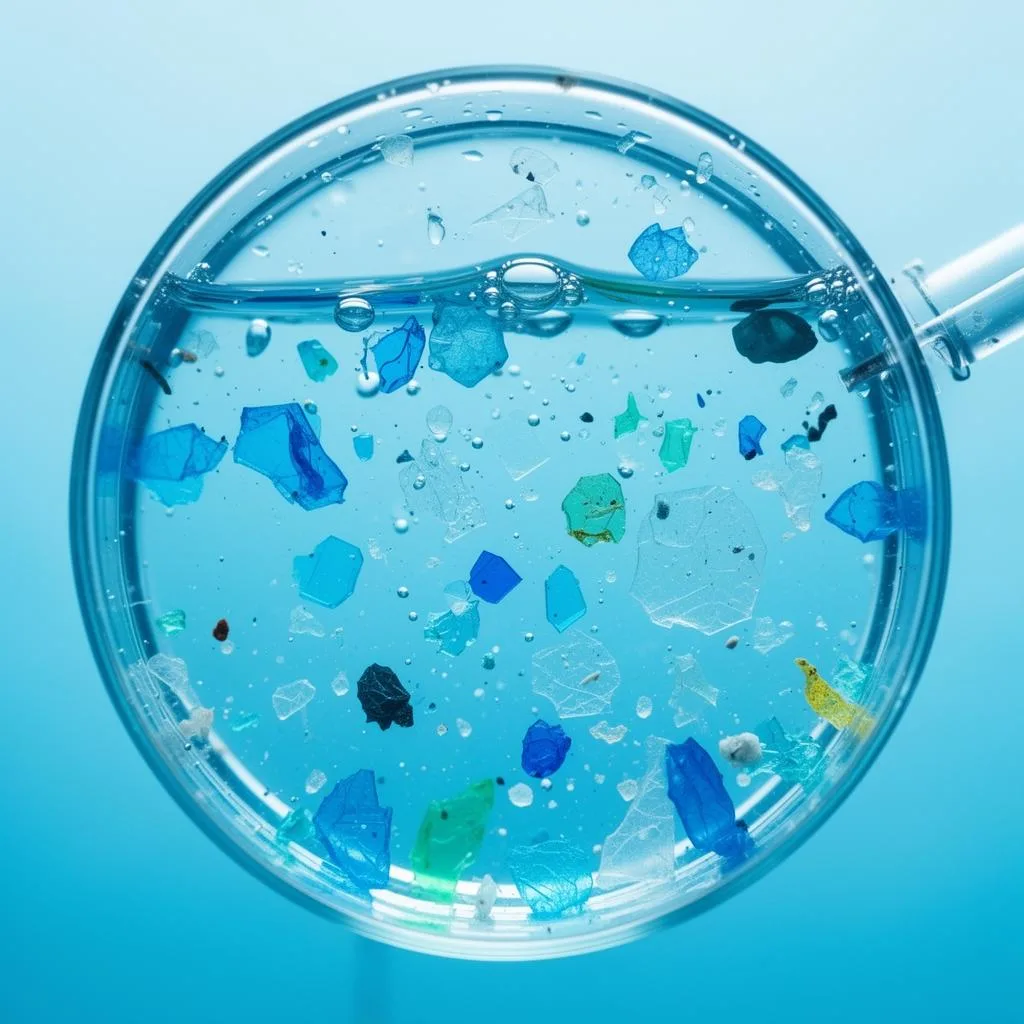
This limit is not a flaw in any particular brand’s testing. It reflects the current technical ceiling of the field.
Some filtration systems reduce particle counts in water. Performance of certified filters varies with the technology, pore size, and the particle sizes targeted. Reverse osmosis systems and some activated carbon block filters have shown meaningful reductions in microplastic particle counts in independent testing. Results depend heavily on the specific filter, flow conditions, and the particle characteristics measured.
No filtration method can prove complete removal of plastic particles across all sizes and plastic types. The same detection-floor limits that apply to bottled water testing also apply to filtered water. A filter that removes particles above a certain size cannot make claims about particles below its validated removal range. Any claim of total removal deserves the same skepticism as any other absolute plastic claim.
For consumers choosing between water sources, the practical goal is proportional, informed decisions rather than chasing an impossible zero.
For U.S. brands that make or plan to make plastic-related claims, the gap between holding a lab report and making a defensible market claim is the central challenge. A lab report that reads “no microplastics detected” is a bounded finding. It reflects what one instrument found above its detection floor, for the plastics it checked, in the lot it tested. Without independent review of the method, blanks and contamination controls, plastic panel, and reporting limits, that finding cannot safely become approved claim language that will stand up to retailer review, legal scrutiny, or public questions.
The Wellness Quality Institute’s core program, Plastic-Free Pathway Verification, governed by the standard WQI-CS-01, independently reviews a company’s existing third-party lab dataset against defined criteria. These criteria align with a state water board’s drinking-water microplastics reference framework as a technical reference point and are available to U.S. brands nationally. The Wellness Quality Institute does not run laboratory tests. Instead, it reviews the data a company already holds, or data the company commissions from a qualified independent laboratory, to see whether that dataset can support a defensible claim. This review checks that the laboratory meets qualification standards, that the analytical method fits the product type, that the tested particle-size range and plastic panel match the claim scope, that reporting limits are documented, that blanks and contamination controls were in place, that chain of custody was maintained, and that the data is recent enough to represent current production.
A review produces one of two outcomes. A Standard Met outcome carries a verification decision, a scope-locked license to use the WQI mark, a public registry listing, and approved claim language. A Standard Not Met outcome remains private, is never described as a failed product, and can be resubmitted with updated information. Verification stays locked to the reviewed product, dataset, tested particle-size range, plastic panel, and production period. A company cannot extend a single dataset to a company-wide or product-line claim.
A single assessment fee covers review, verification decision, and registry listing. There is no separate mark-license or registry fee. Independent lab testing is arranged and billed separately by a qualified independent laboratory. Payment of the assessment fee does not guarantee a verification decision.
The Wellness Quality Institute’s Plastic-Free Pathway Verification does not certify that a product contains zero plastic, microplastics, or nanoplastics. It shows that the company is on a verified pathway toward plastic-free standards. Verification applies only to the reviewed products, submitted datasets, tested ranges, plastic panels, production or sampling periods, and supporting controls. The Wellness Quality Institute verification is not a government approval or a health or safety certification.
No. “No microplastics detected” is a bounded statement, not a guarantee. It means no particles were found above the method’s detection floor, for the plastic types the method checked, in the production lot that was sampled. The two most widely used validated methods for drinking water, infrared spectroscopy and Raman spectroscopy, begin detecting particles at 50 micrometers and 20 micrometers respectively. Anything smaller was never in scope. The nanoplastic range, below 1 micrometer, sits outside the reliable reach of commercially available analytical methods. A product can carry a “none detected” result and still contain particles the method could never find. No laboratory today can confirm complete absence of plastic across every particle size, plastic type, and production lot. Any claim that suggests otherwise goes beyond what the science supports.
No. Treating them as identical overstates the science. Evidence that chemical additives used in plastic manufacturing, including phthalates and bisphenols, act as endocrine-disrupting chemicals is considerably more mature. It is supported by decades of animal studies, human clinical observation, and population research. Evidence about the physical microplastic particles themselves, the fragments plastics break into over time, is newer, relies on smaller samples, and uses methods that scientists still debate. These are related but distinct questions. One focuses on what plastics are made with. The other focuses on the particles they break into. The strong evidence base for plastic additives does not automatically transfer to the particle question. Both deserve serious attention, and neither should be used to inflate certainty about the other.
The current consensus, reflected across the World Health Organization, the U.S. Food and Drug Administration, and recent systematic reviews, is cautious. Microplastic particles have been detected in drinking water and in human tissues. No peer-reviewed study has shown that microplastic exposure from drinking water causes specific health outcomes in humans at real-world exposure levels. The WHO’s 2019 assessment found low concern for health risk based on available evidence and stressed that this conclusion rests on limited information and that more research is urgent. The FDA states that current scientific evidence does not show that levels of microplastics or nanoplastics in water pose a human health risk and that presence alone does not indicate risk. Laboratory and animal studies suggest plausible biological mechanisms, with oxidative stress and inflammation described most often. Mechanistic evidence from controlled lab conditions is not the same as demonstrated harm in humans at the concentrations found in drinking water. The honest summary is that this remains a serious area of active research, not a settled question in either direction.
Certification
The Wellness Quality Institute's document-by-document guide helps US brands verify supplier plastic content claims and stay compliant. Start here.
Read articleThe Wellness Quality Institute's document-by-document guide helps US brands verify supplier plastic content claims and stay compliant. Start here.
Read article
The Wellness Quality Institute's document-by-document guide helps US brands verify supplier plastic content claims and stay compliant. Start here.
Read article