
Supplier Compliance for Plastic Content: A US Brand Guide
The Wellness Quality Institute's document-by-document guide helps US brands verify supplier plastic content claims and stay compliant. Start here.
Read articleNo federal plastic-free cert exists. The Wellness Quality Institute explains certifications, verification & lab data so your claims hold up.

Written by: Scott Steveson, Specialist, Wellness Quality Institute
No US federal plastic-free certification exists, so brands rely on private schemes or independent verification programs to support claims under the FTC Green Guides.
Four main types of programs operate in this space: product certification, management system certification, microplastic-free testing, and event certification, each with specific scopes and limits.
Even the most rigorous lab tests cannot prove a product is entirely free of plastic, because results are always bounded by detection limits, polymer panels, and lot-to-lot variability.
Certification schemes, verification programs, and self-reported lab data serve different purposes, and only independent verification of third-party data produces a defensible, scope-locked claim.
No US federal plastic-free certification exists, and no US federal standard defines what “plastic-free” means for consumer products. The FTC Green Guides (16 CFR Part 260) govern how environmental marketing claims, including plastic-related claims, must be supported in the United States. The Green Guides require claims to be truthful, not misleading, and backed by competent and reliable evidence, which means objective tests, analyses, research, or studies by qualified people using accepted methods.
The Green Guides do not create a plastic-free certification or a testing standard. They create a substantiation obligation. A brand making a plastic-related claim on US packaging must hold that evidence before it makes the claim. Under § 260.6, third-party certification does not remove a marketer’s duty to substantiate every claim that certification reasonably communicates. The credential and the underlying evidence remain separate.
The FTC has brought enforcement actions against companies making unsubstantiated environmental claims. Civil penalties can reach $50,120 per violation per day. A single misleading claim on a product listing can count as a separate violation for each day it appears.
Most major programs in this space are European-run, which adds to the confusion for US buyers. Four broad categories cover most options on the market.
Product certification schemes apply to a specific product or product line. They assess a defined set of criteria against a single item or range. They do not extend to a company’s wider operations or to products outside the certified scope.
Management system certification schemes apply to a company’s processes rather than to a product. They audit how a business manages plastic use, reduction planning, and single-use plastic elimination across operations. They do not certify that any individual product is free of plastic.
Microplastic-free testing schemes center on laboratory analysis of a product or formulation. They confirm through lab work that a product meets a defined threshold for microplastic content. They are limited by the detection limits of the method used and by the specific matrix, meaning the substance or material tested.
Event certification schemes apply to events rather than products. They provide rules for running zero-waste or sustainable public or corporate gatherings. They do not transfer to products or to ongoing business operations. Understanding these four categories is the starting point. The next question is what any of them can actually prove about a product’s plastic content.
Detection can establish presence, but it cannot establish absence. This technical reality rarely appears on certifier pages, yet it drives what any claim can honestly say.

Finding a plastic particle is comparatively straightforward. A lab isolates it, confirms chemically that it is a polymer, and reports it. Proving that no plastic is present is a different type of claim. That claim would require ruling out everything the method cannot see, including particles below the detection floor, polymers outside the tested panel, and production lots that were never sampled.
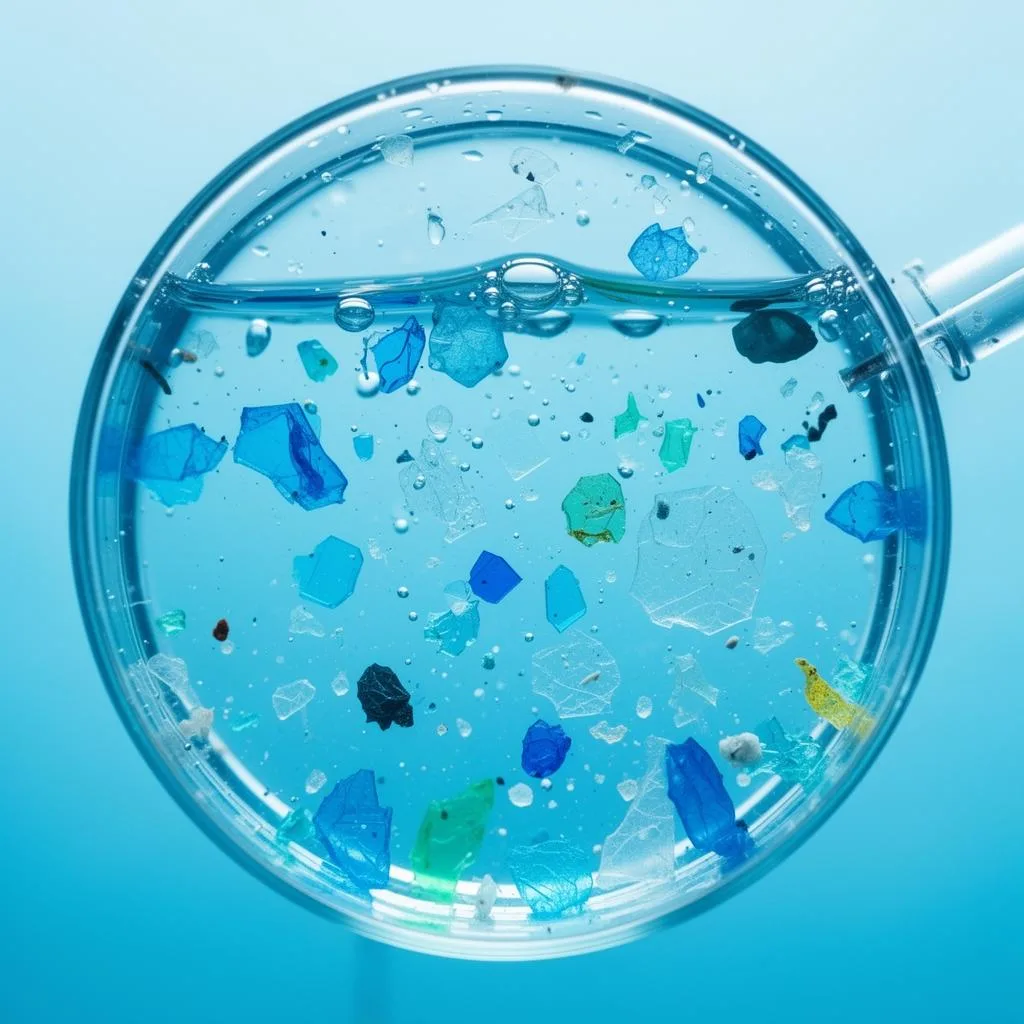
Three hard limits define what any test result can support:
Particle-size limits. No method detects every particle size. The California State Water Board defines microplastics in drinking water as solid polymeric material with particles that have at least three dimensions greater than 1 nanometer and less than 5,000 micrometers. The two published analytical methods reach nowhere near that lower boundary. SWB-MP1-rev1 (infrared spectroscopy) is validated above 50 µm through 5,000 µm. SWB-MP2-rev1 (Raman spectroscopy) is validated above 20 µm through 5,000 µm. The 1–20 µm fraction is not validated under either method, and particles below that range, including nanoplastics, are currently beyond reliable commercial measurement. California serves here as a technical reference point, not a geographic boundary, and it did not create, approve, authorize, or endorse the Wellness Quality Institute or its standard.
Polymer diversity. No single test screens every polymer type across every product format. A result is limited to the specific polymers the method was designed to detect.
Lot-to-lot variability. A clean result on one production lot does not guarantee the next lot. Contamination routes such as packaging, processing equipment, and ambient air can shift with each production run.
A result reading “none detected” means none were found above that instrument’s detection floor, for the polymers it screened, in the lot it tested. It does not guarantee that no plastic is present. The WHO’s 2019 assessment, Microplastics in Drinking-Water, remains a clear summary of the current evidence. It finds low concern on limited evidence, while stressing that this conclusion rests on incomplete information and that more research is urgently needed.
Three main routes exist for a US brand making a plastic-related claim. The table below compares them across what each covers, who reviews the evidence, and what type of claim each route can support, so you can see why independent verification is the only path to a defensible, scope-locked claim.
|
Route |
What It Covers |
Who Reviews The Evidence |
What Claim It Supports |
|---|---|---|---|
|
Certification scheme |
A specific product, management system, or event against a program’s own criteria |
The certification body, against its published standard |
A badge or mark under that program’s criteria |
|
Verification program |
A company’s existing laboratory dataset against a published standard |
An independent verification body with no role in testing |
A scope-locked finding with approved claim language |
|
Self-reported lab data |
A company’s own or its supplier’s test results |
No independent review |
A claim the company asserts without independent substantiation |
A certification scheme issues a badge under a program’s own criteria. The program defines the standard, audits against it, and grants the mark. A verification program independently reviews a company’s existing laboratory data against a published standard and issues a scope-locked finding. Scope-locked means the finding applies only to the specific product, dataset, tested range, and production period reviewed. The company brings the data, and the verifier reviews it. Self-reported lab data means a company publishes its own or its supplier’s test results directly. The company grades its own homework, and the market treats the result as marketing, even when the underlying testing is rigorous.
This is where the Wellness Quality Institute fits. The Wellness Quality Institute’s Plastic-Free Pathway Verification (PFPV), governed by the standard WQI-CS-01, is an independent verification program for US companies that already hold independent laboratory data. The Wellness Quality Institute reviews existing third-party laboratory data on plastic and microplastic content against defined criteria. It does not run laboratory tests. Independent laboratory testing is arranged and billed separately by a qualified independent laboratory. A single assessment fee covers review, verification decision, and registry listing, with no separate mark-license or registry fee. Paying the assessment fee does not guarantee a verification decision.

Every review produces one of two outcomes. Standard Met carries a verification decision, a scope-locked license to use the WQI logo, a public registry listing, and approved claim language. Standard Not Met is a private outcome, never described as a failed product, and open to resubmission with updated information. Verification is locked to the reviewed product, dataset, tested particle-size range, polymer panel, and production period. The verification period is 24 months from the sampling date of the most recent accepted dataset.
The Wellness Quality Institute Plastic-Free Pathway Verification does not certify that a product contains zero plastic, microplastics, or nanoplastics. It shows that the company is on a verified pathway toward plastic-free standards. Verification applies only to the reviewed products, submitted datasets, tested ranges, polymer panels, production or sampling periods, and supporting controls. The Wellness Quality Institute verification is not a California approval, government certification, or health or safety certification.
Ready to see whether your existing lab data can support a verified claim? Start a conversation with the Wellness Quality Institute about Plastic-Free Pathway Verification.
Costs in this category come from structure, not from a single universal price. Three main components usually make up the total.
Independent laboratory testing is the largest and most variable cost. It is arranged and billed separately by a qualified independent laboratory. Microplastics testing capability is genuinely scarce. The instrumentation is expensive, and capability varies not only between laboratories but also within a single laboratory depending on the instrument and method used. Laboratory testing can become expensive quickly.
Review or assessment fees cover the independent evaluation of the submitted dataset against a published standard.
Mark licensing or registry fees vary by program. Some programs charge separately for logo use or registry listing. Others bundle these into a single fee.
One practical step reduces cost risk. Confirm before commissioning testing whether the intended laboratory will produce a reviewable dataset. The Wellness Quality Institute, for example, qualifies laboratories by accreditation tier rather than by name. It prefers California ELAP-accredited laboratories for the applicable method, accepts ISO/IEC 17025-accredited laboratories with the microplastics method and matrix explicitly within the accredited scope, and can conditionally accept other qualified independent laboratories through documented method-equivalence review. No laboratory is named as a Wellness Quality Institute-endorsed or preferred vendor, and no commercial relationship exists between the Wellness Quality Institute and any laboratory.
The FTC Green Guides (16 CFR Part 260) require that environmental claims do not overstate an environmental attribute or benefit, directly or by implication. A single strong test result cannot stretch into a claim about an entire brand or product line. That stretch is how credible data turns into greenwashing, and it is the most common failure pattern in this category.
Under § 260.9, a “free of” claim can be appropriate even when a product contains a trace amount of a substance, but only if three conditions are met. The level must be no more than an acknowledged trace contaminant or background level. The substance’s presence must not cause material harm that consumers typically associate with it. The substance must not have been added intentionally. For plastic and microplastic claims, the technical limits described earlier make an unqualified “free of” claim very difficult to support.
Companies remain responsible for ensuring all product, packaging, and marketing claims are accurate and properly substantiated. The Wellness Quality Institute verification is not legal, regulatory, or advertising-claims counsel and does not replace it. WQI-CS-01 defines prohibited claims explicitly, so a brand can see the boundary before it publishes.
Two adjacent government-backed programs often get confused with plastic-free claims. The USDA BioPreferred Program certifies the verified amount of biobased content in a product. It addresses renewable material origin, not plastic content. The EPA Safer Choice program certifies that product ingredients meet safety criteria. It addresses chemical safety, not plastic content. Neither program is a plastic-free certification.
The right route depends on the goal. The examples below are optional decision points that organizations may choose to consider.
If the goal is a single product with existing independent laboratory data, independent verification usually fits best. The company brings its dataset, and the verifier reviews it against a published standard and issues a scope-locked finding.
If the goal is a whole-business or management-system claim, a management system scheme is the relevant category. It audits processes, not products.
If the goal is an event, event schemes apply. They do not transfer to products or ongoing operations.
If the goal is a claim with no independent review, exposure is significant. Self-reported results are discounted as marketing, and unsubstantiated claims carry FTC and litigation risk. As noted earlier, FTC penalties can reach $50,120 per violation per day, and a growing ecosystem of class-action litigation is pursuing companies whose plastic-free claims lack support.
If your goal is a claim that can withstand retailer and legal scrutiny, independent verification offers the most defensible path. Explore how the Wellness Quality Institute can support your next plastic-related claim.
No US federal plastic-free certification exists, and no federal standard defines what “plastic-free” means for consumer products. What exists are private certification schemes and independent verification programs, many of them European-run. The FTC Green Guides (16 CFR Part 260) govern how plastic-related claims must be substantiated in the US. They do not create a certification or a testing standard. They set a substantiation obligation that brands must meet before making a claim.
Costs usually come from three components. Independent laboratory testing is the largest and most variable cost and is billed separately by a qualified lab. A review or assessment fee covers independent evaluation of the dataset. Mark licensing or registry fees vary by program. No single dollar figure applies across the market. Confirming laboratory qualification before commissioning testing helps avoid paying for data that cannot support a verification decision.
A certification scheme issues a badge under a program’s own criteria. The program defines the standard, audits against it, and grants the mark. A verification program independently reviews a company’s existing laboratory data against a published standard and issues a scope-locked finding. The company brings the data, and the verifier reviews it. The key distinction is independence. A verifier has no role in the testing it reviews, which gives the finding more weight than self-reporting.
No laboratory can currently prove a product is free of plastic. Detection can show that plastic is present, but it cannot prove that none exists. A result is always bounded by the instrument’s detection floor, the polymers it screened, and the lot it tested. Programs can review specific evidence against defined criteria and issue a finding scoped to what the data supports. An honest claim describes progress toward plastic-free standards, rather than an absolute state that current science cannot confirm.
No. The USDA BioPreferred Program certifies the verified amount of biobased content in a product. It focuses on renewable material origin, not plastic content. The EPA Safer Choice program certifies that product ingredients meet safety criteria. It focuses on chemical safety, not the presence or absence of plastic. Both programs have real value in their domains, but neither is a plastic-free certification and neither should be presented as one.
As explained earlier, “none detected” means none were found above the detection floor for the screened polymers in the tested lot. A method validated above a certain particle size cannot see anything smaller, so “none detected” can coexist with smaller particles being present. The 1–20 µm fraction is not validated under either of the California State Water Board’s published analytical methods, and particles below that range, including nanoplastics, are currently beyond reliable commercial measurement. The result is a bounded statement rather than a guarantee of absence.
Under the Wellness Quality Institute’s Plastic-Free Pathway Verification, the verification period is 24 months from the sampling date of the most recent accepted dataset. Continued claim use after expiration requires re-verification using current data. This reflects lot-to-lot variability. A result reflects the production it was drawn from, not all future production.
Because no US federal plastic-free certification exists and no laboratory can prove complete absence of plastic, the real decision centers on which claim you can substantiate. Global plastics production roughly doubled from 234 million tonnes in 2000 to approximately 460 million tonnes in 2019, and pressure on brands to respond with credible claims continues to grow. A claim that sounds strong but cannot survive a retailer’s diligence or a legal challenge becomes a liability. A defensible claim, tied to reviewed evidence, scoped to what the data supports, and independently checkable, carries more long-term value.
If you already hold lab data and want to translate it into a claim that can withstand scrutiny, connect with the Wellness Quality Institute about Plastic-Free Pathway Verification.
Certification
The Wellness Quality Institute's document-by-document guide helps US brands verify supplier plastic content claims and stay compliant. Start here.
Read article
The Wellness Quality Institute's document-by-document guide helps US brands verify supplier plastic content claims and stay compliant. Start here.
Read articleThe Wellness Quality Institute's document-by-document guide helps US brands verify supplier plastic content claims and stay compliant. Start here.
Read article