
Supplier Compliance for Plastic Content: A US Brand Guide
The Wellness Quality Institute's document-by-document guide helps US brands verify supplier plastic content claims and stay compliant. Start here.
Read articleThe Wellness Quality Institute's document-by-document guide helps US brands verify supplier plastic content claims and stay compliant. Start here.
Written by: Scott Steveson, Specialist, Wellness Quality Institute
See how Plastic-Free Pathway Verification turns your lab reports into defensible claims.
This four-part lens helps you evaluate any supplier document before you rely on it. Apply these questions to every item in a supplier compliance file:
These four questions form the backbone of the document-by-document analysis that follows.
These definitions use common regulatory and scientific language, translated into everyday terms for brands and business owners.
Post-consumer recycled (PCR) content is material that a consumer used and discarded, which was then collected, processed, and turned back into manufacturing feedstock. Most state recycled-content laws measure this category.
Post-industrial recycled (PIR) content, also called pre-consumer recycled content, is manufacturing scrap or trim waste that gets reprocessed before it ever reaches a consumer. Under the EU PPWR, PIR content does not count toward PCR thresholds, which are limited to post-consumer recycled content.
Recycled content is a broad term that can include both PCR and PIR. When a regulation specifies “post-consumer recycled,” PIR cannot substitute for PCR.
Plastic content means the presence of plastic polymers such as polyethylene (PE), polypropylene (PP), polyethylene terephthalate (PET), polystyrene (PS), PVC, nylon, and similar materials in a product or package.
Microplastics are plastic particles smaller than 5 millimeters. They are large enough at the upper end of that range for current lab methods to count and chemically identify them.
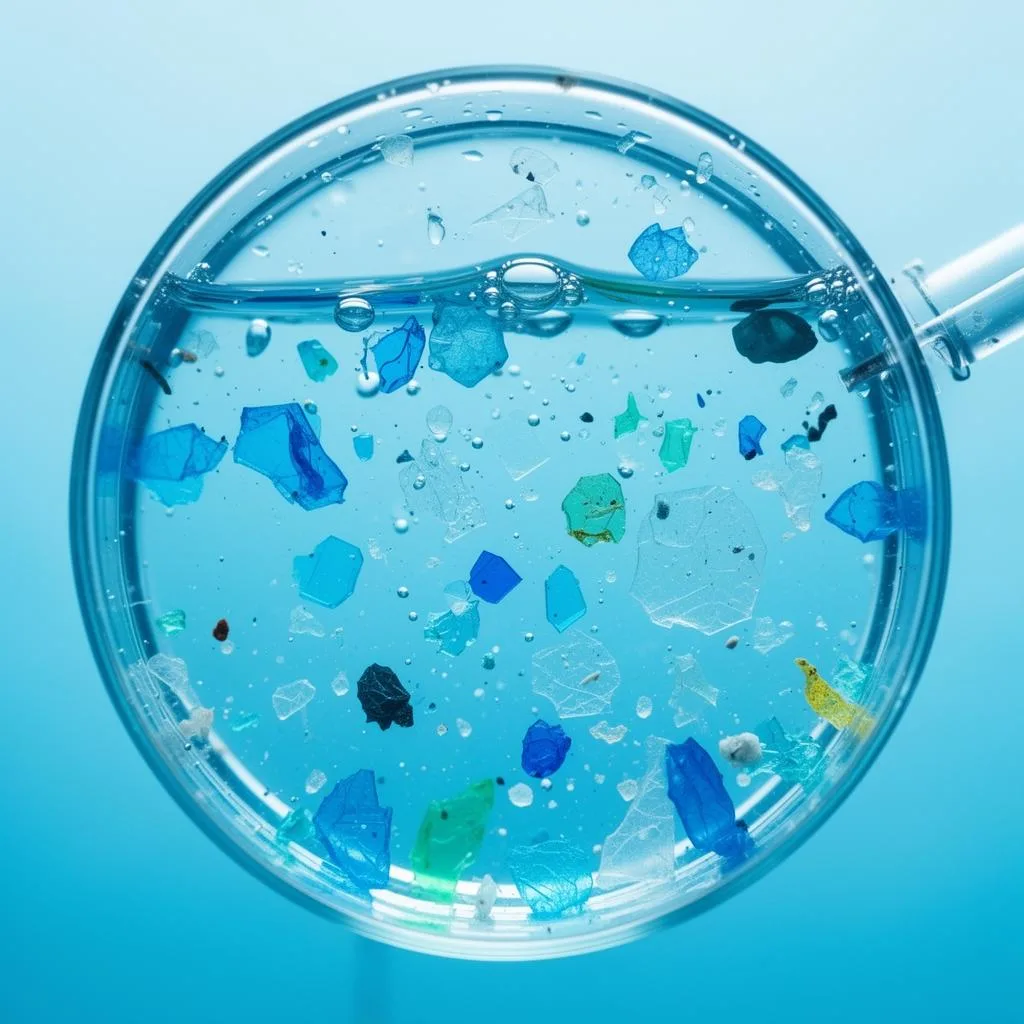
Nanoplastics are particles smaller than 1 micrometer. Current commercial lab methods cannot reliably measure them.
Detection floor, also called reporting limit or limit of detection, is the lowest concentration or particle size a method can reliably detect and report. A “none detected” result means nothing was found above this floor.
Chain of custody is the documented trail that shows how a material moved from its source through processing to the final product. It allows auditors to trace and verify claimed recycled content.
Those definitions matter because the compliance landscape has shifted from voluntary sustainability reporting toward mandatory recycled-content thresholds and substance restrictions. EN 15343 provides a traceability and conformity assessment standard for recycled plastics, and ISO/IEC 17025 sets requirements for laboratory competence. These standards act as reference points. US state-level recycled-content laws add an emerging and fragmented layer, with no federal US standard for plastic content claims and no single gold standard for microplastic content verification.
The table below maps major regulations to their jurisdiction, core requirement, and the supplier documentation that addresses each. California’s framework serves as a technical reference point for many programs. Read across the “Required Supplier Document” column and you will see that no single document type satisfies every jurisdiction, so mapping requirements to documents remains a separate compliance task.
| Regulation | Jurisdiction | Key Requirement | Required Supplier Document |
|---|---|---|---|
| California SB 54 (effective May 1, 2026) | California (EPR framework; technical reference nationally) | Single-use packaging must be recyclable or compostable by 2032. Target plastic recycling rate is 65 percent. Source reduction target is 25 percent by 2032. Interim milestones apply from 2027 through 2030. | Producer registration with CAA or CalRecycle, annual supply and source reduction reports, and packaging composition data by weight and component. |
| California AB 793 (25% PCR from Jan 1, 2025; 50% by Jan 1, 2030) | California (beverage containers subject to California Redemption Value) | Minimum post-consumer recycled plastic content in plastic beverage containers with annual reporting by March 1 and third-party validation of PCR content required by March 1, 2028 under SB 633. | Annual report listing pounds of virgin and PCR plastic by resin type, accredited third-party PCR content validation from 2028, and supplier PCR resin certifications. |
| State Recycled-Content Laws (NJ, WA, ME, CT, CO, MN) | Multiple US states | Escalating PCR minimums for plastic beverage containers and packaging, such as WA: 25% by 2026, 50% by 2031, NJ: 15% beverage containers from 2024, and CT: 25% by Jan 1, 2027, plus annual registration and reporting. | Annual PCR reports by resin type and weight, supplier PCR resin certifications or declarations, methodology documentation for state-specific allocation, and chain-of-custody certificates where required. |
| Canada Federal Plastics Registry (2025 data due Sept 29, 2026) | Canada (federal; producers placing ≥1,000 kg plastic on Canadian market) | Report resin type, resin source such as virgin fossil-based, virgin bio-based, PCR, or PIR, and quantities manufactured or imported and placed on market by province, and retain records three years. | Supplier material declarations specifying resin type (NAPCS code) and resin source, weight data by component, provincial allocation methodology, and supporting calculations. |
| EU PPWR (Regulation (EU) 2025/40, general application Aug 12, 2026) — context for US brands with EU exposure | EU (all member states; applies to importers placing packaging on EU market) | PCR content minimums from 2030, such as 30% for single-use PET bottles, a PFAS ban in food-contact packaging from Aug 12, 2026, Declaration of Conformity per packaging type, and technical file retention for five to ten years. | EN 15343 chain-of-custody certificates or equivalent, accredited lab Certificates of Analysis for PFAS and heavy metals, Declaration of Conformity, recyclability assessment, and supplier material composition declarations with CAS numbers. |
A supplier self-declaration is a written statement from a supplier that a material meets a specified requirement, such as a resin containing 25 percent PCR content. Self-declarations appear in almost every supplier file and provide the least reliable evidence.
A self-declaration proves only that the supplier made the claim. It does not verify the underlying data, testing method, chain of custody, or calculation method. A 23 percent non-compliance rate in a regulatory pilot project came from manufacturers trusting supplier declarations without verification.
Regulators and standards bodies now treat self-declarations as a starting point. California’s SB 633 requires beverage manufacturers to provide CalRecycle with third-party validation of PCR content beginning March 1, 2028, and Connecticut’s HB 6664 already requires independent third-party certification of PCR content claims. Across jurisdictions, the direction of travel is toward independent validation.
A Certificate of Analysis is a document from a laboratory that reports test results for a specific sample. It carries more weight than a self-declaration because it reflects actual lab work, yet it still has limits.
A CoA reports what a lab found using a particular method on a particular sample at a particular time. It does not confirm that the method fits the product matrix, that blank controls ruled out contamination, that reporting limits match the claim, or that the result applies beyond the tested lot. A valid CoA must name the test method, state the result against the applicable limit, and identify an ISO/IEC 17025-accredited laboratory; missing any of these elements weakens the proof.
For microplastics, the California State Water Board’s infrared method (SWB-MP1-rev1) detects particles greater than 50 µm through 5,000 µm, and the Raman method (SWB-MP2-rev1) detects particles greater than 20 µm through 5,000 µm. A “none detected” result under either method means no particles were found above those size thresholds, for the polymers screened, in the lot tested. The 1–20 µm fraction is not validated under either method, and everything below 20 µm sits beyond reliable commercial measurement.

An accredited laboratory report is a CoA issued by a lab whose competence has been independently assessed. Preferred options include California ELAP accreditation for the applicable State Water Board microplastics method or ISO/IEC 17025 accreditation with the specific method and matrix listed in scope.

Accreditation confirms that the lab follows defined quality and competence standards. It does not guarantee that the chosen method fits your product or that reporting limits align with the regulatory threshold you must meet.
Chain-of-custody documentation traces a material from its source through processing to the final product. For recycled-content claims, this documentation makes a PCR percentage auditable.
EN 15343 sets requirements for traceability of recycled plastics, including volume reconciliation, production records, and supplier documentation. Without chain-of-custody documentation, a claimed PCR percentage rests entirely on the supplier’s word.
Each jurisdiction sets its own evidence rules, so a document that satisfies one requirement may fall short elsewhere. A supplier declaration that works for Canada’s Federal Plastics Registry may not meet California AB 793’s third-party validation rule. A CoA that satisfies Washington’s annual PCR report may not meet the EU PPWR chain-of-custody expectations.
Jurisdiction mapping means identifying which document satisfies each specific requirement. Many brands have not yet completed this mapping, which leaves gaps in their compliance story.
Not sure which document satisfies which jurisdiction? Get your evidence mapped.
A supplier declaration for plastic content must include specific data fields before it can support regulatory claims. Generic “compliant” statements do not meet that bar. At minimum, a useful declaration should include:
Evidence needs and risk levels vary by product category, so brands should focus first where exposure is highest.
Food-contact packaging carries the heaviest evidence burden. PFAS restrictions apply from August 12, 2026 under the EU PPWR for brands with EU exposure, and several US states already restrict intentionally added PFAS in food packaging. A supplier’s “PFAS-free” claim requires lab testing from an ISO/IEC 17025-accredited laboratory to be credible. For recycled-content claims in food-contact applications, chemical contamination risks from recycled feedstocks add a separate verification layer beyond the PCR percentage.
Plastic beverage containers sit at the center of US state PCR laws. California AB 793, Washington’s law, New Jersey’s law, Maine LD 1467, and Connecticut HB 6664 all impose PCR thresholds and annual reporting on beverage container producers. As noted with SB 633 and Connecticut’s rule, the trend moves toward third-party validation of PCR content.
General CPG packaging faces a growing but somewhat lower evidence burden. SB 54’s EPR framework covers a wide range of single-use packaging, and state recycled-content laws keep expanding. The main risk for general CPG brands comes from stretching a single product’s recycled-content result across a full product line without matching scope documentation.
Several technical ideas determine whether supplier documentation can support a regulatory claim. Clear understanding of these ideas separates a file that survives scrutiny from one that fails.
Detection floor versus absence. Finding a substance involves isolating it, confirming its identity, and reporting it. Proving that no substance is present requires ruling out everything the method cannot see, including particles below the detection floor, polymers outside the tested panel, and production lots that were never sampled. A 2026 study in Nature Communications Engineering reports that no existing analytical technique can accurately determine the percentage of recycled plastic content in a finished plastic product. A “none detected” result always sits within the bounds of the method, polymer panel, and lot tested.
Polymer panel. A polymer panel lists the plastic types a lab screens for in a test. A “none detected” result applies only to polymers on that list. Polymers outside the panel remain unreported because the lab did not test for them.
Blank controls. Blank controls are samples that run through the same procedure without the test material. They reveal contamination from the lab environment or equipment. Without documented blanks, a lab report cannot rule out contamination as the source of a result.
Method suitability for matrix. A method validated for drinking water may not suit a food product, a beverage with solids, or a packaging material. Using a method outside its validated matrix produces results that are hard to interpret reliably.
Lot-to-lot variability. A clean result on one production lot does not guarantee the next lot. Recycled feedstocks and manufacturing conditions change, so a single test result functions as a snapshot rather than a standing guarantee.
This checklist helps you review any supplier’s plastic-content documentation in a structured way.
The checklist above describes what to look for, and current practice shows how often suppliers actually provide it. Current best practice in supplier documentation comes down to four moves. Request accredited lab data, specify the testing method and reporting limits in supplier agreements, require chain-of-custody documentation, and prioritize high-risk vendors such as food-contact and single-use components first.
Many brands already hold useful lab data yet lack a trusted way to translate it into claims they can defend. Self-reported results often get dismissed as marketing, while brands sit on reports they do not fully understand. A result that reads “no microplastics detected,” for example, reflects the detection-floor limitation described earlier, and most teams have never reviewed that method detail.
The Wellness Quality Institute operates a program called Plastic-Free Pathway Verification (PFPV), governed by the standard WQI-CS-01, that independently reviews a company’s existing lab dataset, testing methodology, product scope, and controls against defined criteria aligned with the California State Water Board’s drinking-water microplastics framework. The Wellness Quality Institute does not run lab tests and does not certify that any product is free of plastic.
Every review produces one of two outcomes. Standard Met carries a verification decision, a scope-locked license to use the WQI mark, a public registry listing, and approved claim language. Standard Not Met is a private outcome that a company can resubmit with updated information. Verification applies only to the reviewed product, dataset, tested particle-size range, polymer panel, and production period.
A single assessment fee covers review, verification decision, and registry listing, while laboratory testing is arranged and billed separately by a qualified independent lab.
These recurring errors appear in supplier compliance files and in the claims brands make based on them.
Avoid the “none detected” trap — have your data independently reviewed.
For a plastic beverage container, start with supplier PCR resin certifications, an accredited lab report or CoA that states method and reporting limits, and any chain-of-custody documentation. For a food-contact wrapper or package, begin with PFAS and additive test reports from an accredited lab, then gather recycled-content documentation.
Use the requirement-to-document table as a checklist, then build a simple map that lists each jurisdiction, its threshold, and the document that supports it. Where one document does not satisfy all needs, flag that gap and request additional evidence from the supplier.
Consider independent verification when a claim appears on-pack, in marketing, or in retailer submissions, or when a jurisdiction such as California or Connecticut explicitly requires third-party validation. As with the direction signaled by SB 633, the market is moving toward verified claims for higher-risk categories.
Certification

The Wellness Quality Institute's document-by-document guide helps US brands verify supplier plastic content claims and stay compliant. Start here.
Read articleThe Wellness Quality Institute's document-by-document guide helps US brands verify supplier plastic content claims and stay compliant. Start here.
Read article
Learn how to back plastic reduction claims with evidence. The Wellness Quality Institute verifies your substantiation file. Get certified today.
Read article