
Supplier Compliance for Plastic Content: A US Brand Guide
The Wellness Quality Institute's document-by-document guide helps US brands verify supplier plastic content claims and stay compliant. Start here.
Read articleVerify recycled, compostable & plastic-free claims with confidence. The Wellness Quality Institute's checklist covers docs, certs & red flags.

Written by: Scott Steveson, Specialist, Wellness Quality Institute
Plastic claims fall into three distinct categories. Each category carries its own evidentiary burden, and confusing them is one of the most common compliance mistakes brands make.
Recycled content claims (for example, “made with 30% recycled plastic”) state that a product or package contains material recovered from the waste stream. These claims require chain-of-custody documentation, which is a paper trail that connects the recycled material from its source through every step of the supply chain to the finished product. They also need third-party certifications and transaction certificates for each shipment.
Compostability claims (for example, “compostable packaging”) state that a product will break down into usable compost under defined conditions. These claims require testing against recognized standards and certification from an accredited body confirming that the product meets those standards.
Absence claims (for example, “plastic-free” or “microplastic-free”) work differently from the first two categories. They state that something is not present. No laboratory can prove absence. A result of “none detected” is always bounded by three factors: the method’s detection floor, which is the smallest particle size the instrument can see; the polymer panel screened, which is the specific plastic types the test looked for; and the specific production lot tested. This limit reflects current science and instrumentation.

This distinction shapes the evidence you must collect, the standards that apply, and whether your claim can withstand regulatory or legal scrutiny.
Recycled content claims depend on a clear chain-of-custody record that traces recycled material from its source through every facility in the supply chain to the finished product.
Third-party certification programs such as the Global Recycled Standard (GRS) or Recycled Claim Standard (RCS), both administered by Textile Exchange, provide frameworks that verify recycled content and chain of custody. Under GRS, every entity in the supply chain that takes legal ownership of the product must be individually certified. Each material transfer between certified entities is documented with a transaction certificate, which is a shipment-level record of the quantity and recycled content percentage transferred.
Mass-balance documentation also plays a central role in recycled content verification. Mass balance is an accounting method. Certified recycled feedstock enters a production system and may mix with conventional material, but the total recycled content claimed in outputs cannot exceed the certified recycled input. ISO 22095-2:2026 is the international standard that sets requirements for running a mass balance chain-of-custody system. It turns the mass balance model into a consistent rulebook so that a mass balance claim means the same thing across companies and sectors.
One distinction carries particular legal weight: the difference between post-consumer and pre-consumer recycled content. Post-consumer material is recovered after a product has been used by a consumer. Pre-consumer material is manufacturing waste diverted before it ever reached a consumer. Under 16 CFR 260.13, if a marketer distinguishes between pre-consumer and post-consumer materials, it must have substantiation for any express or implied claim about the percentage of each type. Misrepresenting pre-consumer material as post-consumer is a common violation.
The FTC Green Guides also state that unqualified recycled content claims, which are claims without a stated percentage, can be used only when the entire product or package, excluding minor incidental components, is made from recycled material. Partial recycled content requires a clearly qualified claim that states the percentage.
Compostability claims must align with recognized testing standards and valid certifications. In the US, ASTM D6400 is the standard specification for compostable plastics. In the EU, EN 13432 covers compostable packaging. Certification bodies such as the Biodegradable Products Institute (BPI) or TÜV Austria issue certificates confirming that products meet these standards under defined composting conditions.
When you request compostability documentation from a supplier, verify the certificate number and expiration date against the issuing body’s public registry. The FTC Green Guides require that compostable claims identify the applicable composting conditions, such as industrial versus home composting, and must not imply broader disposability than the evidence supports.
A key limitation applies here. A compostability claim addresses end-of-life behavior only. It does not address whether the product contains plastic, recycled or otherwise. A product can be certified compostable and still contain conventional plastic polymers that break down under industrial composting conditions. Compostability and absence of plastic are separate questions that require separate evidence.
Absence claims carry the highest legal exposure and the toughest substantiation burden, and they are often misunderstood.
When a laboratory reports “none detected” for microplastics, that result is bounded by three factors simultaneously. The method’s detection floor sets the smallest particle size the instrument can see. Micro-FTIR has a practical lower size limit of approximately 10 micrometers for identifying microplastic particles, while micro-Raman can reach roughly 0.5–1 micrometer, so anything smaller is invisible to both methods. The polymer panel defines which plastic types the test screens for, so polymers outside that panel are not reported. Lot coverage means a clean result on one production batch does not guarantee the next.
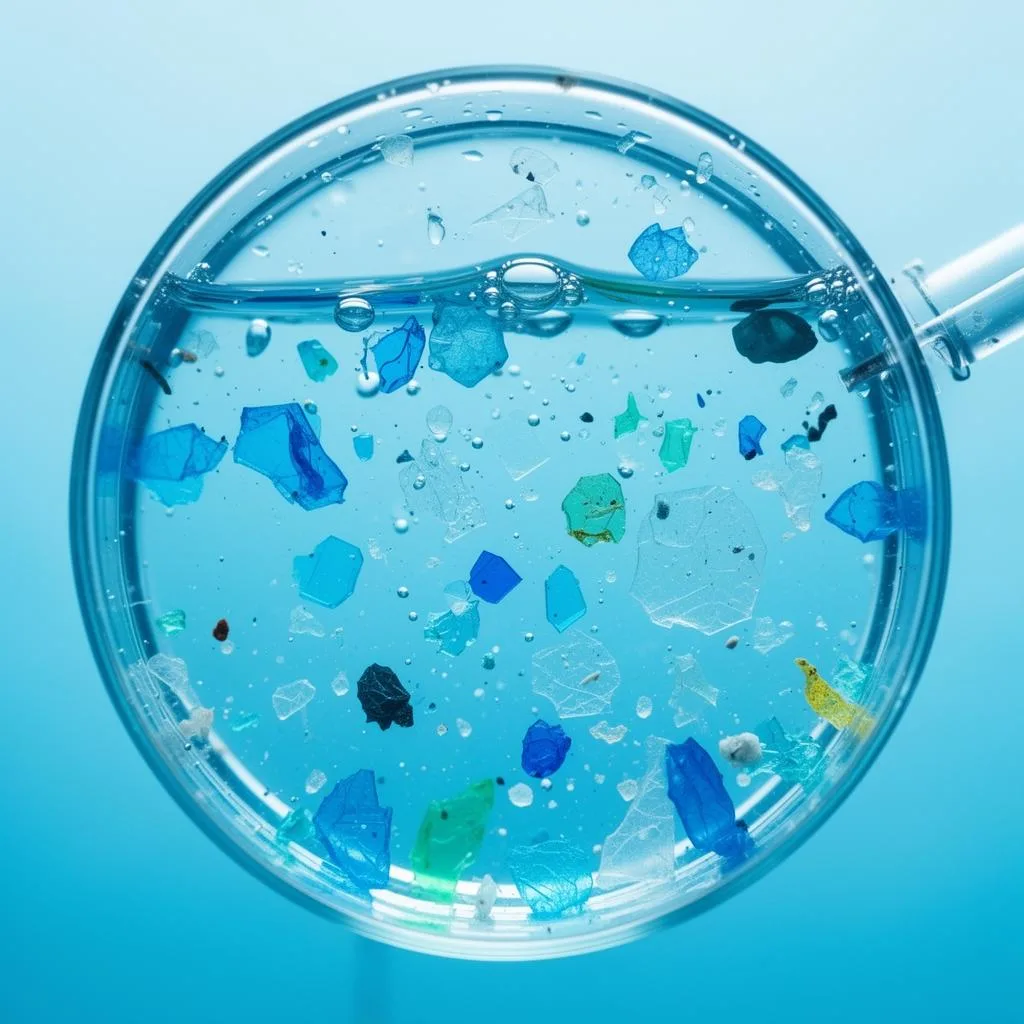
The California State Water Board’s drinking-water microplastics framework illustrates this gap clearly. It is the most stringent public reference available for this type of testing. Its validated methods begin at 20 micrometers for Raman spectroscopy or 50 micrometers for infrared spectroscopy, while California’s regulatory definition of microplastics reaches down to 1 nanometer. The 1–20 micrometer fraction is not validated under either method. A 2026 review published by the American Chemical Society confirms that analytical results are constrained by the method’s size floor and sample-matrix interference, so “not detected” cannot be treated as “does not exist.”
No laboratory can certify that a product is free of plastic. This limit reflects the current capabilities of analytical methods.
For absence-type claims, the Wellness Quality Institute offers Plastic-Free Pathway Verification, often shortened to PFPV, as the recommended approach. The Wellness Quality Institute is an independent verification body that reviews a company’s existing third-party laboratory data against a defined standard called WQI-CS-01. This standard aligns with the California State Water Board’s drinking-water microplastics reference framework. The Wellness Quality Institute does not run laboratory tests and does not certify that any product is free of plastic. Every review produces one of two outcomes. A Standard Met decision carries a scope-locked verification, approved claim language, and a public registry listing. A Standard Not Met decision remains private and can be resubmitted with updated information. The Wellness Quality Institute’s independence, because it does not run the tests it reviews, supports the credibility of the verification.

For absence claims, if you need help turning lab reports into defensible language, contact the Wellness Quality Institute about Plastic-Free Pathway Verification.
Chain-of-custody documentation is the paper trail that keeps a claim attached to the material it describes. ISO 22095 defines five chain-of-custody models: identity preserved, segregated, controlled blending, mass balance, and book and claim. These models differ in how much physical link they maintain between the claimed material and the finished product.
Identity preserved and segregated models maintain the strongest physical link. They keep the claimed material separate from unclaimed material throughout the supply chain. Mass balance is an accounting model. Certified recycled input is tracked by volume, and an equal quantity of output can carry the claim even when physical materials are mixed. Book and claim trades certificates independently of the material and breaks the physical link entirely.
When you review supplier documentation for recycled content, ask which chain-of-custody model the supplier uses and verify that the documentation matches the claim type. For recycled content claims, request transaction certificates for each shipment, mass-balance records showing that claimed recycled content does not exceed certified recycled input, and supplier declarations. A supplier’s refusal to share transaction certificate numbers is a red flag.
The FTC Green Guides (16 CFR Part 260) set the legal framework for environmental marketing claims in the United States. They require that environmental claims be truthful, not misleading, and supported by competent and reliable scientific evidence. The Guides define this evidence as tests, analyses, research, or studies conducted and evaluated in an objective manner by qualified persons.
A claim that is literally true can still be deceptive if it conveys a misleading implied meaning. The FTC evaluates both the express claim and any reasonable interpretation a consumer might take from it, and Section 260.2 requires that marketers ensure all reasonable interpretations of their claims are truthful and supported before the claims are made.
For absence claims, the substantiation burden is extremely high. No laboratory can provide competent and reliable evidence that a product contains zero plastic across every particle size, polymer type, and production lot. Section 260.6(c) of the Green Guides also states that third-party certification does not eliminate a marketer’s obligation to substantiate all claims reasonably communicated by the certification. Class-action litigation against unsubstantiated plastic claims continues to grow as a legal risk.
| Claim Type | Example | Required Evidence | Key Limitation |
|---|---|---|---|
| Recycled Content | “100% recycled plastic” | GRS or RCS certification, transaction certificates per shipment, mass-balance documentation per ISO 22095-2:2026 | Mass balance is an accounting method, not physical proof that every unit contains recycled material |
| Compostable | “Compostable packaging” | ASTM D6400 or EN 13432 certification from an accredited body, certificate validity verified in issuing body’s registry | Addresses end-of-life behavior only and does not address plastic content |
| Absence | “Plastic-free,” “microplastic-free” | Laboratory test reports with stated method detection limits, polymer panel, and lot coverage, plus independent review of data against a defined standard | No laboratory can prove absence; “none detected” is bounded by method floor, polymer panel, and lot tested |
Compliance, quality, and sustainability professionals encounter a recurring set of errors when they review supplier plastic claims.
Verification requirements for plastic claims depend entirely on the claim type. Recycled content claims require chain-of-custody documentation, transaction certificates, and third-party certifications. Compostability claims require standards-based testing and certification from an accredited body. Absence claims such as “plastic-free” and “microplastic-free” face a hard scientific limit that current laboratories cannot overcome. As noted earlier, “none detected” is always bounded by the method’s detection floor, the polymer panel screened, and the specific lot tested.
For absence-type claims, independent review of laboratory data against a defined standard is the most defensible path available to US brands today. The Wellness Quality Institute’s Plastic-Free Pathway Verification provides this review. It evaluates a company’s existing third-party laboratory data against WQI-CS-01, which aligns with the California State Water Board’s drinking-water microplastics reference framework. The process produces scope-locked verification with approved claim language and a public registry entry that any buyer, retailer, or journalist can check.
If your team needs support translating lab reports into compliant absence claims, reach out to the Wellness Quality Institute about Plastic-Free Pathway Verification.
A recycled content claim states that a product or package contains material recovered from the waste stream. It is a positive claim about what is present. An absence claim, such as “plastic-free” or “microplastic-free,” states that something is not present. These are different claim types with different evidentiary requirements. Recycled content claims can be verified through chain-of-custody documentation, transaction certificates, and third-party certifications that trace material from source to finished product. Absence claims cannot be verified the same way, because no laboratory method can confirm the complete absence of plastic across every particle size, polymer type, and production lot. The detection floor of the best available methods leaves a significant fraction of the particle-size range unvalidated. Treating these two claim types as equivalent, or applying recycled content verification logic to an absence claim, creates significant legal risk for a brand.
“None detected” means no particles were found above the instrument’s detection floor, for the polymer types the test screened, in the specific production lot that was sampled. It is a bounded statement rather than a guarantee of absence. Three factors define that boundary simultaneously. The method’s detection floor sets the smallest particle size the instrument can reliably identify. The polymer panel defines the specific plastic types the test was designed to look for. Lot coverage reflects whether the tested batch is representative of ongoing production. A method that begins at 50 micrometers cannot see anything smaller, and particles below that size may still be present. A test that screens eight polymer types cannot report on polymers outside that panel. A result from one production lot does not guarantee the next. For these reasons, “none detected” always describes what the method could see, rather than what is present in the product.
A robust documentation package for a recycled content claim includes several elements. First, request a valid scope certificate from a recognized third-party certification program, with the certificate number, expiration date, and certified product categories verifiable in the certifying organization’s public registry. Second, obtain transaction certificates for each shipment of certified recycled material, documenting the quantity and recycled content percentage transferred at each step of the supply chain. Third, review mass-balance records showing that the total recycled content claimed in outputs does not exceed the total certified recycled input. This control prevents double-counting and supports mass-balance claims. Fourth, confirm whether the recycled content is post-consumer or pre-consumer, since these are distinct categories with different substantiation requirements under the FTC Green Guides. Fifth, request the supplier’s recycled material source list, including facility names and locations. A supplier’s refusal to share transaction certificate numbers or mass-balance records is a red flag that warrants further scrutiny before you accept the claim.
Third-party certification does not remove a marketer’s obligation under the FTC Green Guides. A brand must still ensure it has substantiation for all claims reasonably communicated by the certification. The brand remains responsible for the accuracy of every claim on its packaging and marketing materials, including any implied meaning a reasonable consumer might take from a certification mark or label. This means that even a legitimately certified product can expose a brand to legal risk if the certification is used in a way that conveys a broader or different meaning than the certification actually supports. For example, a compostability certification addresses end-of-life behavior only. Using it in a context that implies the product is free of plastic would convey a meaning the certification does not support. Brands should review all claims, including those derived from third-party certifications, against the FTC’s standard that all reasonable consumer interpretations be truthful and substantiated.
The Wellness Quality Institute’s Plastic-Free Pathway Verification is an independent review of a company’s existing third-party laboratory data against a defined standard called WQI-CS-01. This standard aligns with the California State Water Board’s drinking-water microplastics reference framework. The Wellness Quality Institute does not perform laboratory testing. It reviews data that a company has already obtained from a qualified independent laboratory. The Wellness Quality Institute also does not certify that any product is free of plastic, because current detection methods cannot support that type of claim. The Institute provides an independent assessment of whether a company’s laboratory dataset, methodology, product scope, and supporting controls meet defined criteria. It then issues a scope-locked verification decision with approved claim language tied to the specific reviewed evidence. Every verified product receives a public registry entry that any buyer, retailer, or journalist can check. The verification period is 24 months from the sampling date of the most recent accepted dataset. After that period, continued claim use requires re-verification with current data. A Standard Not Met outcome is private and can be resubmitted, and the product is never described as failed.
Certification
The Wellness Quality Institute's document-by-document guide helps US brands verify supplier plastic content claims and stay compliant. Start here.
Read article
The Wellness Quality Institute's document-by-document guide helps US brands verify supplier plastic content claims and stay compliant. Start here.
Read articleThe Wellness Quality Institute's document-by-document guide helps US brands verify supplier plastic content claims and stay compliant. Start here.
Read article