
Microplastics Analysis Techniques: What Each Method Proves
Not all microplastics tests are equal. The Wellness Quality Institute breaks down FTIR, Raman, and more — so you choose the right method.
Read articleBrain microplastics found — but what does it mean? The Wellness Quality Institute breaks down the science and steps to reduce your exposure.

Written by: Scott Steveson, Specialist, Wellness Quality Institute
The Nihart et al. study analyzed brain (frontal cortex), liver, and kidney tissue from people who had died. The team used pyrolysis gas chromatography–mass spectrometry (Py-GC/MS, a method that vaporizes tissue to identify plastic types by mass), scanning electron microscopy, and attenuated total reflectance Fourier-transform infrared spectroscopy. Brain tissue carried the highest microplastic and nanoplastic concentrations of the three organs, with polyethylene (PE) making up to 75% of the total plastic load, mostly as nanoscale, shard-like fragments.
The study also documented a time trend. Brain plastic concentrations rose by nearly 50% over the eight years from 2016 to 2024. The authors attributed this to rising environmental pollution rather than age-related buildup, because they found no link between age and total plastic load. People with documented dementia diagnoses carried the heaviest brain plastic burden, which drew major media attention.
Those are the facts the study produced, and they are worth taking seriously. But they do not, on their own, prove that microplastics cause dementia or other brain diseases.
The “microplastics brain study debunked” search phrase reflects a real tension in the science. It signals a methodological debate rather than a dismissal of the finding. A 2025 commentary in Nature Medicine raised concerns about contamination controls and analytical validation in brain-tissue microplastics research. Brain tissue is one of the most analytically demanding materials. Its fat-rich composition interferes with several digestion protocols. Procedural blank corrections, which are controls that subtract background contamination from the lab environment, can also materially shift measured concentrations.

A 2026 systematic review by Parihar et al. in Cureus screened 266 manuscripts and found only four qualifying human studies on microplastic and nanoplastic exposure and neurological outcomes. Its conclusion was clear. A direct causal relationship between microplastic or nanoplastic exposure and neurodegeneration in humans cannot yet be confirmed. The review also noted that missing or inconsistent protocols for tissue digestion and blank control methods across studies raise the risk of reporting bias or environmental contamination.
The dementia association in the Nihart study is an association. It does not prove cause. People with dementia may accumulate more particles because a damaged blood-brain barrier, the brain’s protective filter, allows more material through. That pattern reflects reverse causation. The disease state may enable accumulation, rather than the accumulation causing the disease. A cross-sectional autopsy design cannot separate these possibilities.
A 2026 narrative review by Alotaishan et al. in Nutrition and Metabolic Insights offers a helpful three-part distinction. It separates detection of plastics in tissue, biological plausibility of harm, and proven causation. Most human data currently support detection, suggest plausibility, and remain too limited for causation. Certainty of causation for neurological outcomes is graded as “very low” under standard evidence-grading systems.
The detection finding is real. The size of the effect is contested. The dementia link remains a hypothesis that still requires proof.
Turn real lab data into a claim you can support. See how The Wellness Quality Institute (WQI) reviews and verifies plastic-related claims.
Two terms appear throughout this research and often get blurred in media coverage. They describe different particle sizes and behaviors.
Microplastics are plastic particles smaller than 5 millimeters. They range from visible fragments down to particles a fraction of a millimeter across. Nanoplastics are particles smaller than 1 micrometer, which is one-thousandth of a millimeter. They are far too small to see and behave differently in the body.
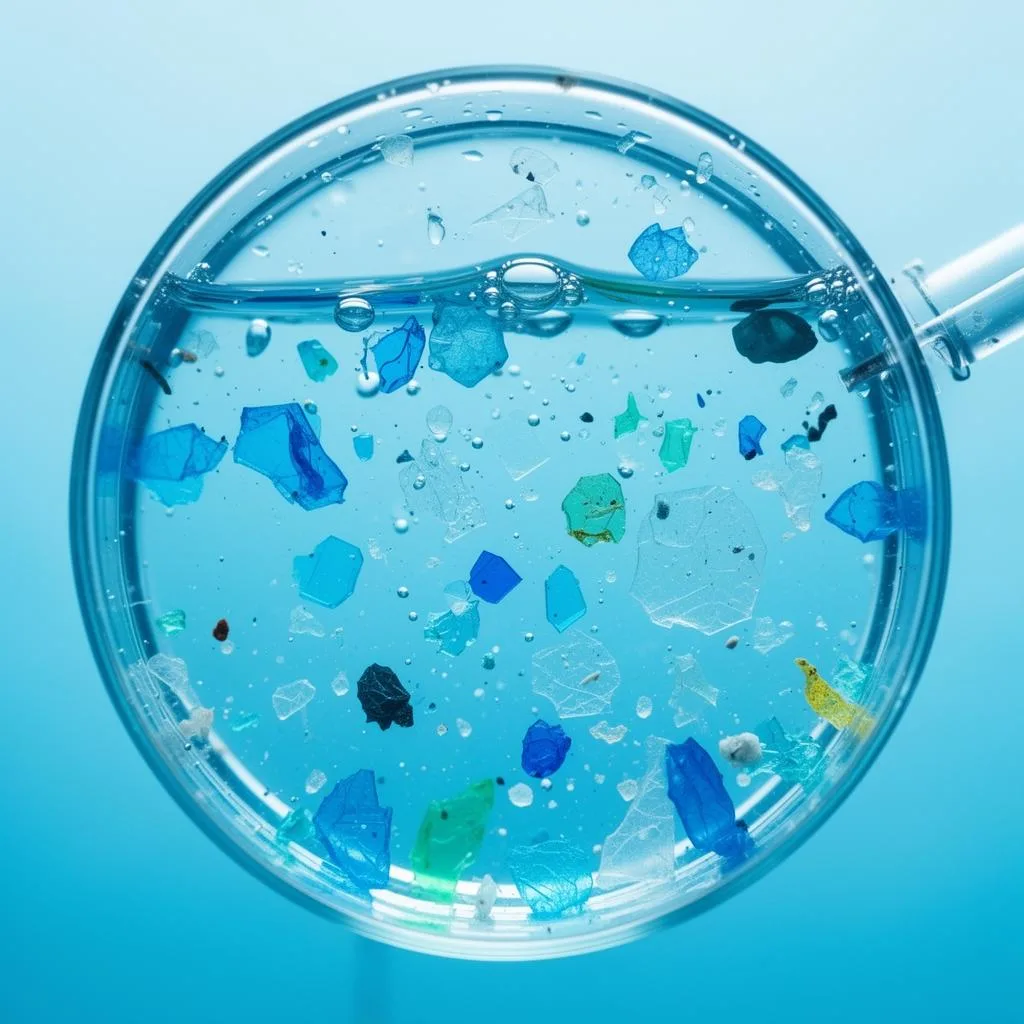
The blood-brain barrier is the brain’s main defense against substances in the bloodstream. Particle size is the key variable for crossing it. A 2026 review by Roamcharern and Yubolphan in Frontiers in Neuroscience states that particles under roughly 200 nanometers show the highest blood-brain barrier penetration. Particles larger than 200 nanometers show much lower permeability.
The same small size that lets nanoplastics cross the blood-brain barrier also places them below the reliable reach of current lab methods. A method cannot confirm what it cannot detect. That limitation drives the methodological critique and explains why no one can currently tell you your personal plastic burden in the brain. The table below summarizes how particle size shapes both brain entry and today’s measurement limits.
| Particle Size | Can Cross The Blood-Brain Barrier? | Reliably Measurable Today? |
|---|---|---|
| Under 200 nm (nanoplastics) | Yes, sub-200-nm particles show the highest blood-brain barrier penetration (Roamcharern & Yubolphan, Frontiers in Neuroscience, 2026) | No, below the reliable reach of current methods |
| 1–20 µm | Limited | No, not validated under reference methods such as those used by the California State Water Board |
| Above 20 µm | No | Yes, Raman spectroscopy above 20 µm and infrared spectroscopy above 50 µm (California State Water Board methods) |
No proven removal method exists. This is the direct answer that most supplement lists, detox protocols, and “what fruit removes microplastics” content do not give.
Popular detox approaches such as sauna routines, fasting-driven autophagy, and bile acid sequestrants assume a mechanism that has not been shown in humans. The Alotaishan et al. review in Nutrition and Metabolic Insights addresses this directly. Sweat studies that show elimination of certain plastic-related chemicals such as BPA cannot be extended to removal of plastic particles. Autophagy markers also do not prove clearance of plastic fragments from the body. The blood-brain barrier behaves asymmetrically. Animal models show that nanoscale particles can enter the brain within hours of oral exposure, yet their exit routes in humans remain unmapped.
The natural course of microplastic elimination from the body is still poorly quantified. Most larger particles that people swallow likely pass through the gut and leave in stool. For particles that have crossed into brain tissue, no clinical removal method has been validated.
Today, individuals cannot reliably check their personal microplastic burden. A 2026 Perspective in Brain Health by Licinio et al., involving researchers from Technische Universität Dresden, University of Ottawa, King’s College London, and University of Zurich, states that there is no validated routine clinical test, blood test, imaging study, or MRI-based method that can confirm microplastics in a person’s brain.
On MRI specifically, MRI spatial resolution typically operates at the millimeter scale. In-plane resolutions are below 1 mm, and slice thicknesses are several millimeters. The particles detected in the Nihart study are nanoscale, mainly fragments well under one micrometer. That size is thousands of times smaller than what any clinical MRI can resolve. Search phrases such as “microplastics detected in brain tissue MRI” rest on a misunderstanding of both MRI and these particles. MRI cannot detect particles this small, and no clinical imaging technology can do so today.
No agreed symptom pattern uniquely identifies microplastic or nanoplastic exposure. Standardized clinical diagnostic tests for microplastics and nanoplastics are currently unavailable. Current concern rests on exposure science and observational evidence, not on a defined clinical syndrome.
Ingestion and inhalation drive most human exposure. Understanding how each route works is more useful than a generic “avoid everything” list.
Ingestion is the main route. The leading contributors are food contact materials, bottled water, and highly processed foods that undergo extensive plastic contact during manufacturing. The Alotaishan et al. review highlights food contact materials, bottled water, and infant formula preparation as key ingestion sources. Heat is a major driver. Heating food or liquid in plastic containers sharply increases particle release. A widely cited experimental study found that standard infant formula preparation using polypropylene bottles generated microplastic particles in the prepared liquid.

Inhalation is the second major route. Indoor air often contains higher concentrations of microplastic fragments than outdoor air. Synthetic textiles, carpets, and furniture shed fibers into indoor dust. Tire-wear particles from road surfaces are a major outdoor source and can be carried by runoff and resuspended in air. Inhaled particles cleared by the mucociliary system, the hair-like structures lining the airways, are often swallowed. That process turns inhalation into an indirect ingestion route.
Dermal exposure through intact skin appears minor and does not represent a primary concern for most people.
Polyethylene and polypropylene are among the plastics most often found in human tissue studies. These same materials are widely used in packaging and food contact applications, which points to those uses as likely sources of systemic exposure.
The following framework ranks actions by the strength of the underlying mechanism. It focuses on what the science supports, rather than on what sounds most dramatic.
Highest confidence, validated experimentally:
Moderate confidence, plausible mechanism and system-dependent:
Lower confidence, mechanistically plausible but not proven in humans:
Symbolic choices, such as swapping one type of plastic for another without changing heat or fat contact, or buying “BPA-free” products without understanding what that label covers, rank below all of the above. They do not address the core mechanisms that drive particle release.
Learn more about reducing plastic exposure and earning credible recognition for your efforts. Explore how The Wellness Quality Institute (WQI) evaluates Plastic-Free Pathway Verification.
The “credit card a week” claim, which states that people ingest about 5 grams of plastic weekly, shows how a viral number can outrun its evidence. It traces back to a 2019 analysis commissioned by WWF and based on a University of Newcastle study. The underlying estimates range from about 0.1 to 5.5 grams per week, depending heavily on an assumption about particle shape. Later research lands orders of magnitude lower. The figure reflects a model output that is highly sensitive to one variable, not a direct measurement.
The same principle applies to the Nihart brain-tissue numbers. The reported concentrations and the 50% rise over eight years are real outputs of a real study using real tissue. They are also outputs of a specific analytical method, Py-GC/MS, applied to a fat-rich matrix where contamination controls are difficult and blank correction can shift results. Reported concentrations vary by one to three orders of magnitude between laboratories analyzing similar materials, and procedural blanks often account for a large share of the apparent sample signal.
A number without its analytical context tells only half the story. That gap, between a real finding and a defensible claim about what it means, is the measurement problem at the center of this field. It is also the problem that The Wellness Quality Institute exists to solve for brands making plastic-related claims. WQI focuses on closing the distance between data a company holds and the claims that data can genuinely support.
Proportionate concern makes sense. Panic does not. The World Health Organization’s 2019 assessment found low concern on limited evidence and called for more research. The Nihart et al. finding is real and deserves serious attention. Current evidence does not show that microplastics are causing brain disease. A balanced response focuses on informed exposure reduction instead of fear.
Ingestion and inhalation are the dominant routes. Ingestion carries the strongest evidence as the primary pathway, especially from food contact materials, bottled water, and highly processed foods. Within ingestion, heat is the key driver. Heating food or liquid in plastic containers substantially increases particle release. Bottled water also contributes meaningfully, with research consistently finding higher particle concentrations than in tap water. Inhalation of indoor dust and airborne fibers from synthetic textiles is the second major route, and many inhaled particles are later swallowed.
The study holds up as a detection finding. The size of the reported effect remains under debate. The 2025 Nature Medicine commentary raises valid questions about contamination controls and analytical validation in fat-rich brain tissue, where blank correction can shift results. The 2026 Parihar et al. systematic review in Cureus, which identified only four qualifying human studies, concludes that causality cannot be established from the current evidence base. The study is an important signal, but not a final verdict on harm.
No. Clinical MRI spatial resolution typically operates at the millimeter scale. In-plane resolutions are below 1 mm, and slice thicknesses are several millimeters. The particles detected in the Nihart et al. study are nanoscale, mainly fragments well under one micrometer. That size is thousands of times smaller than what any clinical MRI can resolve. No imaging technology currently available to clinicians can detect particles of this size in tissue.
The 2025 Nihart et al. study in Nature Medicine produced a real signal. Microplastics and nanoplastics appear to accumulate in human brain tissue at higher concentrations than in liver or kidney, with polyethylene predominating and concentrations rising over the study period. The dementia association is a documented observation. The size of the effect and any causal link to neurodegeneration remain unproven, and the methodological critique from within the same journal forms a legitimate part of the scientific record.
A proportionate response focuses on informed reduction rather than panic or unproven detox strategies. Avoid heating food in plastic. Prefer glass or stainless steel for hot or long-stored liquids. Reduce reliance on bottled water and highly processed foods. Improve indoor ventilation and dust control. Treat absolute claims, in either direction, with healthy skepticism.
For brands, the same measurement gap that makes personal burden unknowable also makes plastic-related claims hard to substantiate. A lab report alone does not create a defensible market claim. Independent review of what the data actually supports, within the tested particle-size range, using a validated method and a defined standard, closes that gap.
The Wellness Quality Institute (WQI) Plastic-Free Pathway Verification does not certify that a product contains zero plastic, microplastics, or nanoplastics. It shows that the company is on a verified pathway toward plastic-free standards. Verification applies only to the reviewed products, submitted datasets, tested ranges, polymer panels, production or sampling periods, and supporting controls. WQI verification is not a government certification or a health or safety certification.
Turn real lab data into a claim you can stand behind. Discover how The Wellness Quality Institute (WQI) supports credible plastic-free pathway claims.
Research
Not all microplastics tests are equal. The Wellness Quality Institute breaks down FTIR, Raman, and more — so you choose the right method.
Read article
Match your microplastic test method to your matrix and claim. The Wellness Quality Institute guides you from detection to plastic-free verification.
Read article
Microplastics are accumulating in human brain tissue. The Wellness Quality Institute breaks down what science confirms—and where the gaps remain.
Read article