
Supplier Compliance for Plastic Content: A US Brand Guide
The Wellness Quality Institute's document-by-document guide helps US brands verify supplier plastic content claims and stay compliant. Start here.
Read articleThe Wellness Quality Institute helps teams verify microplastics claims with independent lab review. Stop trusting self-reported vendor data — act now.

Written by: Scott Steveson, Specialist, Wellness Quality Institute | Last updated: August 27, 2026
The core problem with self-reported lab data is structural, not a matter of vendor intent. When a brand publishes its own test results, or accepts a vendor’s, the market reads it as marketing because the party with a financial stake in the outcome is also interpreting the data. That perception carries real consequences.
Retailer scrutiny of plastic-related claims is intensifying. A growing ecosystem of class-action litigation targets brands whose plastic-free or microplastic-free claims lack independent support. Greenwashing exposure under FTC Green Guides also applies to claims that are technically accurate but presented in a misleading way, including claims that omit the method limits that define what a “none detected” result actually means.
The detection problem compounds the legal one. A 2018 peer-reviewed study by Kosuth, Mason, and Wattenberg in PLOS ONE found anthropogenic particles in 81% of 159 tap water samples drawn from five continents. The OECD’s Global Plastics Outlook reports that global plastics production roughly doubled from 234 million tonnes in 2000 to approximately 460 million tonnes in 2019, with production, use, and waste projected to rise a further 70% by 2040. Detection can show presence. It cannot prove absence.

Finding a particle requires one confirmed result. Proving no plastic is present would require certainty about everything a method cannot see, including particles below the detection floor, polymers outside the tested panel, and production lots not sampled. A vendor’s self-reported “none detected” result is bounded entirely by that instrument’s detection floor and scope, not by the product itself.
The five steps below address this gap in a structured, contract-ready way.
Procurement teams need a defined testing standard before any samples go to a lab. Without clear specifications, vendors can meet a testing requirement with a method that does not fit the water product, covers too narrow a particle-size range, or screens too few polymer types to support a meaningful claim.
A defensible procurement standard for water products should specify at minimum the target particle-size range, the polymer panel to be screened, the required reporting limits, and the analytical method acceptable for the product type. As a technical reference point, the California State Water Board’s drinking-water microplastics framework provides one example of publicly available guidance. California’s SWB-MP1-rev1 (infrared spectroscopy) is validated for particles greater than 50 µm through 5,000 µm, and SWB-MP2-rev1 (Raman spectroscopy) is validated for particles greater than 20 µm through 5,000 µm. The 1–20 µm fraction is not validated under either method. ISO 16094-2:2025 may serve as an additional analytical reference where method, matrix, and laboratory validation are reviewed and confirmed as equivalent. It is not automatically interchangeable with the California methods.
Beyond particle-size range and analytical method, the procurement standard must also specify which polymer types the laboratory will screen for. A minimum polymer panel for water-product testing should cover polyethylene (PE), polypropylene (PP), polyethylene terephthalate (PET), polystyrene (PS), polyvinyl chloride (PVC), polyamide (PA), polycarbonate (PC), and polymethyl methacrylate (PMMA). The standard should also require reporting categories for any other confirmed polymers and for unidentified particles with no spectral match. Visual identification alone never suffices, because counted particles must be chemically confirmed by spectroscopy.
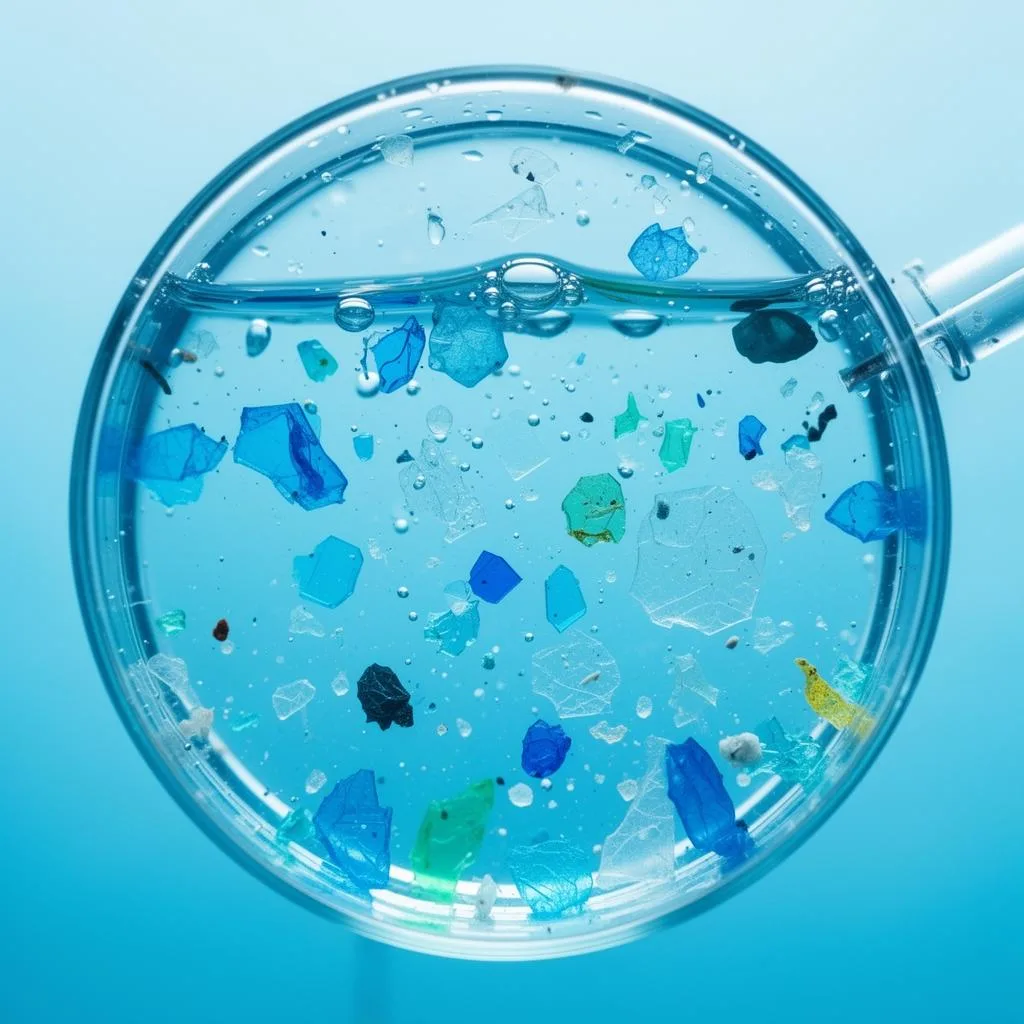
Cost and timeline considerations sit alongside these technical choices. Method selection affects both. Raman spectroscopy reaches a lower particle-size floor, greater than 20 µm, than infrared, greater than 50 µm, and is generally more expensive. Pyrolysis GC/MS provides polymer-mass data but does not produce particle counts or size distributions. Buyers should confirm method suitability for the specific water matrix before locking it into contract language.
The following clause may be adapted for use in vendor agreements. This language helps ensure vendors cannot satisfy the testing requirement with methods that are technically compliant on paper but too narrow in practice to support a claim.
Specifying a method creates a baseline, but the contract also needs to control who performs the testing. Testing should be performed by a qualified independent laboratory with no financial ties to the vendor and with accreditation that explicitly covers the method and the water matrix being tested.
Laboratory accreditation tiers follow a clear hierarchy for this purpose. The preferred tier is California ELAP, the Environmental Laboratory Accreditation Program, accreditation for the applicable State Water Board microplastics method, because ELAP accreditation ties directly to the specific method and matrix. ISO/IEC 17025:2017 accreditation is accepted where the microplastics method and the water matrix are explicitly within the laboratory’s accredited scope. General laboratory accreditation without method-specific scope does not provide enough assurance. Other qualified independent laboratories may be conditionally acceptable through documented method-equivalence review, but that path requires additional technical justification before testing begins.

Microplastics testing capability remains scarce. The instrumentation is expensive, and capability varies not only between laboratories but also between instruments and methods within a single lab. Buyers should confirm a laboratory’s accreditation scope before naming it in contract language. They should also allow adequate lead time, because independent microplastics testing of water products typically requires several weeks from sample submission to final report.
The following clause may be adapted for use in vendor agreements. It closes a common gap where vendors rely on in-house or affiliated labs that do not meet independent testing expectations.
A laboratory result is only as defensible as the documentation that supports it. Chain-of-custody records, meaning the documented trail from sample collection through laboratory receipt, preparation, analysis, and reporting, allow an independent reviewer to confirm that the result reflects the product tested, not a contaminated or mislabeled sample.
Blank controls play an equally critical role. A PRISMA-guided review of nanoplastics detection in drinking water concludes that field blanks, procedural blanks, transport blanks, and airborne contamination controls must be reported and interpreted in any defensible analysis, because laboratory background can converge with environmental signals at small particle sizes. A “none detected” result without blank data cannot be distinguished from a result where contamination was present but uncontrolled.
Common documentation gaps tend to cluster in a predictable pattern. Teams often see missing field blanks, procedural blanks reported but not blank-corrected, chain-of-custody records that do not cover the full sample journey, spike recovery data absent or below acceptable thresholds, and results reported as a single aggregate count rather than by size fraction. Together, these gaps can render an otherwise rigorous dataset unusable for independent verification.
The following clause may be adapted for use in vendor agreements. It sets a clear documentation bar so procurement teams are not left debating whether partial records are “good enough.”
Steps 1 through 3 produce a dataset. Step 4 converts that dataset into a defensible claim. The distinction matters because a laboratory report and a market-facing claim are not the same thing. A report tells you what a laboratory found under defined conditions. An independently reviewed finding tells the market what that result supports and provides a third party willing to stand behind that interpretation.
Independent review means review by a body with no financial stake in the outcome, no role in the testing, and published criteria against which the dataset is assessed. The review examines not just the result but also the method’s suitability for the matrix, the adequacy of reporting limits, the completeness of blank and control data, the chain of custody, the polymer panel coverage, and the scope of the claim the data can actually carry. Many brands discover through this process that their existing data supports a narrower, or sometimes a stronger, claim than they assumed.
The Wellness Quality Institute, introduced here by its full name, offers Plastic-Free Pathway Verification, governed by the standard WQI-CS-01, as one available option for this independent review step. WQI reviews a company’s existing independent laboratory dataset, testing methodology, product scope, and supporting controls against defined criteria aligned with the California State Water Board’s drinking-water microplastics reference framework. WQI does not perform laboratory testing. That separation keeps the review independent.
Every review produces one of two outcomes. Standard Met carries a verification decision, a scope-locked license to use the WQI mark, a public registry listing, and approved claim language. Standard Not Met is a private outcome that can be resubmitted with updated information.
The following clause may be adapted for use in vendor agreements. It closes the gap between having data and having a claim that a neutral party has assessed.
A single clean result does not guarantee the next production lot. Microplastic contamination in water products is influenced by variables that change over time. Packaging materials age, filling conditions shift between production runs, storage temperature fluctuates during distribution, and source water quality varies from lot to lot.
As these variables accumulate, a verification that never expires eventually stops reflecting the product a customer is actually buying. Scope-lock rules sit alongside timing. The most common way that credible data becomes a greenwashing exposure is when a single product’s result is stretched to cover a product line, a brand, or a company as a whole.
A result reviewed for one SKU, one production period, and one analytical method supports a claim only within those boundaries. Extending it beyond them creates an unsupported claim. A 24-month re-verification cadence from the sampling date of the most recent accepted dataset provides a defensible standard, consistent with the approach used by the Wellness Quality Institute under WQI-CS-01. Re-verification requires current data, not a resubmission of the original dataset.
The following clause may be adapted for use in vendor agreements. It gives buyers a clear trigger for when claims must be refreshed and how far each claim can travel.
Procurement teams applying this framework tend to encounter a predictable set of documentation and method problems. These issues usually surface during contract enforcement or independent review, not at the initial proposal stage.
The timeline has two components. Independent laboratory testing of water products for microplastics typically requires several weeks from sample submission to final report, depending on the laboratory’s current capacity, the method used, and the complexity of the sample matrix. Raman spectroscopy generally takes longer than infrared spectroscopy because it involves additional analytical steps.
Independent review of the resulting dataset, including method suitability, documentation completeness, and claim scope, adds additional time that varies with the completeness of the submitted documentation. Buyers should build at least 8–12 weeks into procurement timelines for the full testing and review cycle. They should also confirm current laboratory lead times before specifying deadlines in contract language.
A reviewable dataset requires more than the final laboratory report. The complete documentation package should include the laboratory’s current accreditation certificate with method and matrix scope confirmed, the full analytical report with results by size fraction, field blank, procedural blank, and transport blank results, blank-corrected data, spike recovery data with stated acceptance criteria, replicate results, LOD and LOQ values for each size fraction, chain-of-custody records from sample collection through laboratory receipt and analysis, and the laboratory’s standard operating procedure for the method used.
Missing any of these elements typically means the dataset cannot be independently reviewed without additional information from the laboratory, which adds time and cost.
No. A laboratory result is specific to the product tested, the production lot sampled, the analytical method used, and the particle-size range covered by that method. Extending a single result to other products, other production periods, or the vendor’s brand as a whole creates an unsupported claim regardless of how similar the products appear.
Each product and production period requires its own dataset. This requirement is not a procedural formality. It reflects the reality that microplastic contamination in water products is influenced by packaging materials, filling conditions, and lot-to-lot variability, all of which can differ between products and production runs even within the same facility.
“None detected” means no particles were found above the instrument’s detection floor, for the polymer types screened, in the specific lot tested. It does not mean the product contains no plastic. As discussed in Step 1, the best validated analytical methods begin at 20 or 50 micrometers, which are thousands of times larger than the 1-nanometer lower end of the California State Water Board’s definitional scope.
Everything below the method’s detection floor is simply not measured. A “none detected” result is a bounded statement about what one instrument found in one sample above one size threshold. Contract language should require vendors to report LOD and LOQ values alongside any non-detect result so the boundary of the finding is explicit.
Vendors can meet an independent review requirement without taking on unnecessary public risk when the review program is structured correctly. When the Wellness Quality Institute reviews a dataset and the outcome is Standard Not Met, that outcome is private. It carries no public claim, no logo rights, and no registry listing, and it is never described as a failed product.
A Standard Not Met outcome often reflects insufficient documentation, an unsuitable method, or incomplete scope rather than anything about the product itself. The company may resubmit with corrected or additional information. Buyers should structure their vendor agreements to reflect this reality. The requirement is for independent review, not for a public outcome. Vendors who decline independent review on the grounds of exposure risk are, in practice, declining accountability for the claims they are making.
Self-reported lab results do not provide a defensible basis for plastic-related claims in water products. The five steps outlined here, covering procurement standards, accredited third-party testing, chain-of-custody and blank-control documentation, independent review, and re-verification with scope-lock rules, create a repeatable framework that converts vendor data into claims a brand can stand behind.
Each step is enforceable through contract language, and each builds on the one before it. The independent review step, Step 4, is the one that most procurement frameworks currently omit, which leaves brands with rigorous data and no trusted way to use it.
The Wellness Quality Institute exists to close that gap. WQI’s Plastic-Free Pathway Verification reviews a company’s existing independent laboratory dataset against defined criteria aligned with the California State Water Board’s drinking-water microplastics reference framework. The program produces a scope-locked verification decision with approved claim language and a public registry entry that any retailer, buyer, or journalist can check.
A single assessment fee covers review, verification decision, and registry listing, with no separate mark-license or registry fee. Independent laboratory testing is arranged and billed separately.
WQI Plastic-Free Pathway Verification does not certify that a product contains zero plastic, microplastics, or nanoplastics. It shows that the company is on a verified pathway toward plastic-free standards. Verification applies only to the reviewed products, submitted datasets, tested ranges, polymer panels, production or sampling periods, and supporting controls. WQI verification is not a California approval, government certification, or health or safety certification.
Certification
The Wellness Quality Institute's document-by-document guide helps US brands verify supplier plastic content claims and stay compliant. Start here.
Read articleThe Wellness Quality Institute's document-by-document guide helps US brands verify supplier plastic content claims and stay compliant. Start here.
Read article
The Wellness Quality Institute's document-by-document guide helps US brands verify supplier plastic content claims and stay compliant. Start here.
Read article