
Supplier Compliance for Plastic Content: A US Brand Guide
The Wellness Quality Institute's document-by-document guide helps US brands verify supplier plastic content claims and stay compliant. Start here.
Read articleThe Wellness Quality Institute turns your lab data into a defensible plastic-free claim. Get independent verification your brand can stand behind.

Written by: Scott Steveson, Specialist, Wellness Quality Institute
Plastic-free verification for beverages depends on scope. Every claim must state what was tested, by what method, on which materials, and over what production period.
Lab reports showing “none detected” are limited by the method’s detection floor and polymer panel. They cannot prove complete absence of plastic.
Plastic-free and microplastic-free claims are different. Each needs its own evidence, and neither can be stated as an absolute today.
Independent verification by a third party creates a defensible market claim that can withstand retailer and legal scrutiny.
Explore Plastic-Free Pathway Verification and what it can prove about your product.
This guide from The Wellness Quality Institute walks beverage brands through the full contact-material chain, the difference between plastic-free and microplastic-free claims, what a lab report actually proves, the standards that surround this topic, the documents you need before seeking verification, and how scope lock keeps a claim defensible instead of drifting into greenwashing.
A simple four-lens framework applies throughout:
Evidence Quality, which covers who produced the data, under what controls, and with what accreditation
Claim Scope, which defines exactly what the claim covers: product, components, and production period
Testing Methodology, which includes the analytical method, particle-size range, polymer panel, and reporting limits
Practical Relevance, which asks whether the evidence, taken together, supports the claim the brand wants to make
Each lens appears in specific sections below: Evidence Quality in the lab-report and self-declaration sections, Claim Scope in the contact-material chain and scope-lock sections, Testing Methodology in the lab-report and standards sections, and Practical Relevance in the documents and common-mistakes sections. A claim that passes all four lenses is defensible. A claim that fails any one of them carries exposure.
For beverages, the contact-material chain, meaning every material that touches or can influence the liquid, creates the main challenge for plastic-related claims. The full chain includes:
Beverage (the liquid matrix itself)
Container (bottle, can, carton, pouch body)
Inner lining (polymer coating inside a can or carton)
Cap (closure body)
Closure (the full closure assembly)
Seal or gasket (the liner or elastomer inside the cap)
Label (face stock and any laminate)
Adhesive (the compound bonding the label or sealing the carton)
Coating (barrier or functional layer on any surface)
Barrier layer (internal polymer layer in composite packaging)
A glass bottle with a plastic cap liner counts as a plastic-containing package unless the claim clearly applies only to the glass container. A paper carton may contain 20–22% polyethylene by composition, plus a lined closure. Nearly all aluminum beverage cans carry a thin polymer coating, most commonly an epoxy resin formulation. That coating prevents corrosion from acidic or carbonated beverages. A BPA-free coating still remains a polymer coating.
The cap acts as a documented contamination route. A 2018 study led by Sherri Mason at the State University of New York at Fredonia, published in Frontiers in Chemistry, found microplastics in 93% of 259 bottled water samples across eleven brands, with polypropylene, the material used in bottle caps, as the most common polymer identified. The packaging itself, not only the source water, introduces contamination.

The liquid matrix also shapes what testing can show. Still water, carbonated beverages, acidic drinks, high-mineral formulations, and functional beverages each create different challenges for analytical methods. A method validated for still water may not be defensible for a kombucha or a protein-fortified drink. Verification therefore becomes a scope question, and the beverage contact-material chain makes that scope harder to define than in most other categories.
Plastic-free and microplastic-free claims describe different things and require different evidence. Most public guidance blurs this line, which creates confusion for brands and buyers.
|
Attribute |
Plastic-Free Claim |
Microplastic-Free Claim |
|---|---|---|
|
What it claims |
Material composition contains no plastic |
No detected particles within the tested size range and polymer panel |
|
Evidence required |
Ruling out every polymer across every particle size and production lot |
Method-bounded detection within tested size range and polymer panel |
|
Scientific supportability today |
Not supportable, because no method can confirm complete absence across every particle size and polymer type |
Bounded entirely by the method’s detection floor and polymer panel |
|
Defensible alternative |
Scope-locked statement about reviewed evidence |
Scope-locked statement about reviewed evidence |
A “plastic-free” claim speaks to material composition. Supporting it would require ruling out every polymer across every particle size and every production lot, which no laboratory can currently do. A “microplastic-free” claim focuses on detected particles within a tested size range and polymer panel, fully bounded by the method’s detection floor.
The defensible alternative in both cases is a scope-locked statement about reviewed evidence. That statement explains what was tested, by what method, on which materials, over which production period, and what the data supports. Throughout this guide, and in any defensible market claim, the preferred language is verification or verified, Standard Met or Standard Not Met, and progress toward plastic-free standards.
Detection can show presence, yet it cannot prove absence. Finding a particle takes one confirmed result. Proving that no plastic is present would require certainty about everything the method cannot see, including particles below the detection floor, polymers outside the tested panel, and production lots that were never sampled.
The two analytical methods referenced by the California State Water Resources Control Board for drinking-water microplastics each have defined validated ranges:
SWB-MP1-rev1 (infrared spectroscopy), validated for particles greater than 50 µm through 5,000 µm
SWB-MP2-rev1 (Raman spectroscopy), validated for particles greater than 20 µm through 5,000 µm
California’s regulatory definition of microplastics in drinking water covers solid polymeric material with particles having at least three dimensions greater than 1 nanometer and less than 5,000 micrometers. The definition reaches down to 1 nanometer. The best validated methods begin at 20 or 50 micrometers, which are thousands of times larger. The 1–20 µm fraction is not validated under either method, and everything below 20 µm currently sits beyond reliable commercial measurement.
“None detected” on a lab report means none were found above that instrument’s detection floor, for the polymers it screened, in the lot it tested. This reflects a hard technical limit with three causes: particle-size limits, polymer diversity, and lot-to-lot variability.
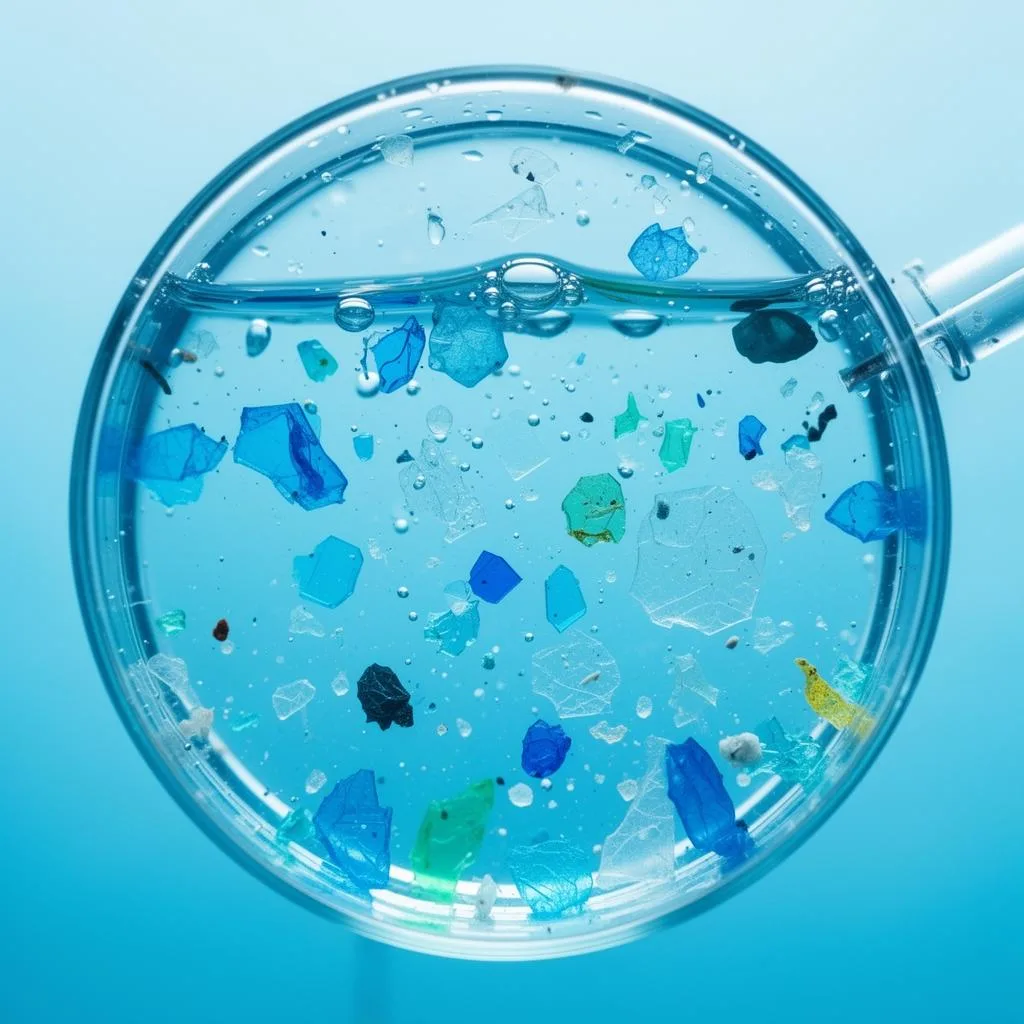
See how independent review turns your lab data into a defensible claim.
If a lab report cannot prove absence, the next question becomes who interprets what the data shows. A manufacturer’s own “BPA-free” or “plastic-free” label usually relies on supplier statements, isolated lab reports, and internal interpretation. The market often treats self-reported lab data as marketing, even when the testing was rigorous, because the company grading its own homework has a clear interest in the result.
The Wellness Quality Institute is an independent verification body. Its Plastic-Free Pathway Verification (PFPV) program, governed by the standard WQI-CS-01, reviews a company’s existing independent laboratory dataset, testing methodology, product scope, and supporting controls against defined criteria focused on particle size and polymer type. These criteria align with the California State Water Board’s drinking-water microplastics reference framework.

The Wellness Quality Institute does not run laboratory tests and does not certify that any product is free of plastic. It has no commercial interest in the verification outcome. California serves as a technical reference point rather than a geographic boundary. Verification is available to US companies nationally. California did not create, approve, authorize, or endorse The Wellness Quality Institute or its standard. The Wellness Quality Institute serves US companies only.
The Wellness Quality Institute Plastic-Free Pathway Verification does not certify that a product contains zero plastic, microplastics or nanoplastics. It shows that the company is on a verified pathway toward plastic-free standards. Verification applies only to the reviewed products, submitted datasets, tested ranges, polymer panels, production or sampling periods, and supporting controls. The Wellness Quality Institute verification is not a California approval, government certification, or health or safety certification.
Verification sits within a broader standards landscape that many brands confuse with proof of plastic content. Several published standards relate to beverage packaging and plastic content. Each answers a different question, and none of them establish absence of plastic.
FDA food-contact compliance, which governs whether a packaging component or substance is authorized for contact with food under Title 21 of the CFR. It uses a component-by-component analysis across the full contact chain, yet it does not verify plastic content or support a plastic-free marketing claim.
EN 1186 migration testing, a European standard series that measures the transfer of substances from food-contact materials into food simulants under defined conditions. It produces an aggregate migration figure and demonstrates material performance. It does not identify every constituent or certify that a material is free of plastic.
ISO/IEC 17025:2017, the international standard for laboratory competence. Accreditation under this standard strengthens confidence in the data a laboratory produces. Accreditation is granted method by method and site by site, so a laboratory can hold accreditation while performing a specific test outside its accredited scope. Accreditation speaks to the lab’s competence, not to the truth of a plastic-free claim.
California SWB-MP1-rev1 and SWB-MP2-rev1, the California State Water Board’s published analytical methods for infrared and Raman spectroscopy. They have validated ranges of greater than 50 µm and greater than 20 µm respectively, both through 5,000 µm, and they represent the most stringent public reference methods reasonably applicable to testing today.
Food-contact compliance and migration testing address safety and performance questions. They do not answer the plastic-content question. No US federal standard exists for plastic content in beverages, and the category has no single gold standard.
Plastic-free verification for beverages relies on an independent review of a brand’s existing laboratory dataset, testing methodology, product scope, and supporting controls against defined criteria. That review produces a scope-locked verification decision that spells out what was reviewed, what was found, and what claim language the data can support. The steps below reflect how that review works in practice.
Define the exact product, SKU, and contact-material scope, including every component in the chain that touches or can influence the beverage.
Assemble the bill of materials and material declarations across the full contact chain, including container, inner lining, cap, closure, seal or gasket, label, adhesive, coating, and barrier layer.
Confirm the laboratory’s accreditation and confirm that the analytical method and product matrix fall within its accredited scope.
Commission or locate testing with adequate reporting limits, field and procedural blanks, spike-recovery data, replicates, and contamination controls appropriate to the product matrix.
Submit the dataset, method documentation, product scope, and supporting controls for independent review.
Receive a verification decision recorded as Standard Met or Standard Not Met.
Where Standard Met, use only the approved claim language and registry ID within the registered scope. Keep every claim within the reviewed product, production period, and tested range.
A single assessment fee covers review, the verification decision, and registry listing, so there is no separate mark-license or registry fee. Testing itself is not included. You arrange and pay a qualified independent laboratory separately. Because the outcome depends on the data, paying the assessment fee does not guarantee a Standard Met decision.
Many brands discover during verification that their existing data cannot support the claim they hoped to make. Assembling the right documentation before submission avoids paying for testing that cannot support a review.
The documents a beverage brand typically needs include:
Bill of materials covering the full contact-material chain
Supplier material declarations for every component
Food-contact declarations for each material in contact with the beverage
The independent laboratory report with full method documentation
Chain of custody records
Field and procedural blank data
Spike-recovery data
Reporting limits by size fraction
The defined production or sampling period
A thorough review examines several elements:
Laboratory qualification and accreditation
Analytical method and suitability for the product matrix
Sampling approach and tested particle-size range
Target polymer panel and reporting limits
Blank results, spike recoveries, and replicates
Chain of custody and data recency
Product scope and production or sampling period
The polymer panel sits at the center of that review. At minimum it should include PE (polyethylene), PP (polypropylene), PET (polyethylene terephthalate), PS (polystyrene), PVC (polyvinyl chloride), PA (polyamide or nylon), PC (polycarbonate), and PMMA (polymethyl methacrylate), anchored by PE, PS, PVC, and PET. Particle count, color, and morphology are reviewed only as supporting context, because visual identification alone cannot chemically confirm a polymer.
See how independent review turns your documentation into a clear, scope-locked claim.
The most common greenwashing pattern in this category involves extension. A brand tests one SKU, receives a favorable result, and stretches that result into a product-line or company-wide claim. The data was real, yet the extended claim overreaches what that data can support.
Scope lock prevents this extension. A verification applies only to the reviewed product, model or SKU, matrix, production or sampling period, tested particle-size range, polymer panel, and analytical method. No company-wide or product-line claim can grow from a single dataset. Every Standard Met product receives a public registry entry with a registry ID that any buyer, retailer, or journalist can check. That entry records the verified party, product scope, matrix, production or sampling period, tested particle-size range, lower method limit, polymer panel, reporting limits, testing laboratory and its accreditation, verification date, expiration date, and current status.
The verification period lasts 24 months from the sampling date of the most recent accepted dataset. Expired entries remain publicly visible and are marked “Expired,” so the record stays honest over time. A claim that survives a retailer’s diligence check carries more value than a broader claim that collapses under scrutiny. The same logic applies to shoppers reading labels, which is why the next section translates these technical limits into plain language for consumers.
As explained above, “none detected” is bounded by the instrument’s detection floor and the polymers screened. On a beverage label, that same limitation applies, so the phrase describes a bounded statement rather than a guarantee. Anthropogenic particles have been found in 81% of 159 tap water samples sourced across five continents, and that same 2018 bottled-water study found roughly twice the particle concentration of tap water, reinforcing that the packaging itself acts as a contamination route.
Beverages most likely to show microplastics in testing tend to have the most polymer contact surfaces. That includes products in plastic containers, products with plastic-lined caps, and products stored in heat, which accelerates how plastics break down. The World Health Organization’s 2019 assessment of microplastics in drinking water found no indication of health risk at current levels on the limited evidence available, while stressing that the conclusion rests on incomplete information and that more research is urgently needed.
Brands frequently repeat the same errors when handling plastic-related claims for beverages.
Treating “none detected” as proof of absence. It means none found above the detection floor for the screened polymers in the tested lot. The method’s limits define the finding.
Assuming a glass bottle is plastic-free when the cap liner is plastic. Metal twist-off and lug caps almost always contain a polymeric liner to create the airtight seal. The container material alone never defines claim scope.
Conflating food-contact compliance with plastic-content verification. FDA food-contact compliance establishes that a material is authorized for contact with food. It does not verify plastic content or support a plastic-free marketing claim.
Extending one product’s result across a line. This pattern represents the most common form of the extension problem described above. A single dataset cannot support a brand-wide or product-line claim.
Using “certified” or “certification” for a verification. Certification language suggests a settled, guaranteed state that current science cannot provide. Verification accurately describes an independent review against a defined standard.
Assuming California endorses the program. The Wellness Quality Institute aligns its criteria with California’s drinking-water microplastics framework because it offers the most stringent credible public reference available. That alignment does not mean California authorized, approved, or endorsed the program.
Current laboratory technology cannot confirm the complete absence of plastic across every particle size and polymer type. A verification confirms only what the reviewed dataset supports within the tested particle-size range, using an independently reviewed method, for the specific product and production period reviewed. It is a statement about reviewed evidence. A company receiving a Standard Met outcome is on a verified pathway toward plastic-free standards, and the product is not described as plastic-free.
A qualified independent laboratory performs the testing, not The Wellness Quality Institute. The Wellness Quality Institute prefers a California ELAP-accredited laboratory for the applicable method, accepts ISO/IEC 17025-accredited laboratories with the method and matrix explicitly within their accredited scope, and may conditionally accept other qualified independent laboratories through a documented method-equivalence review. The Wellness Quality Institute then reviews the resulting data, method, and controls. That separation keeps the review independent.
This program functions as a verification of reviewed data and demonstrated progress. The Wellness Quality Institute deliberately avoids the terms “certified” and “certification” for this program. As noted earlier, a certification implies a settled, guaranteed state, and no such guarantee is scientifically available. Verification describes an independent review against a defined standard that produces a Standard Met or Standard Not Met outcome.
A lab report and a defensible market claim serve different purposes. A laboratory report tells you what the laboratory found. It does not, on its own, tell the market what that finding supports or reassure a skeptical buyer that the interpretation is independent. An independent review examines whether the method suited the matrix, whether the reporting limits were adequate, whether blanks and controls were run, and what claim the data can actually carry. Many brands discover that their existing data supports a narrower or stronger claim than they assumed.
A Standard Not Met outcome remains private. It carries no public claim, no logo rights, and no registry listing, and it is never described as a failed product. It often reflects insufficient data, an unsupported method, or incomplete scope rather than a problem with the product itself. A brand may submit corrected or additional information for future review. Participating in the review process creates no public downside risk.
Plastic free verification for beverages centers on scope. The beverage contact-material chain, including container, inner lining, cap, closure, seal or gasket, label, adhesive, coating, and barrier layer, makes that scope more complex than in most other categories. Plastic-free and microplastic-free are different claims that require different evidence, and neither can be stated as an absolute. “None detected” is bounded by the method’s detection floor and the polymers screened. No laboratory today can certify that any product is free of plastic.
The Wellness Quality Institute’s Plastic-Free Pathway Verification independently reviews existing lab data against published criteria, issues scope-locked approved claim language, and publishes a checkable registry entry. A company on a verified pathway toward plastic-free standards gains something a self-reported lab report cannot provide: an independent third party with no stake in the outcome, willing to stand behind the interpretation.
Turn real lab data into a claim you can support with Plastic-Free Pathway Verification.
Certification
The Wellness Quality Institute's document-by-document guide helps US brands verify supplier plastic content claims and stay compliant. Start here.
Read article
The Wellness Quality Institute's document-by-document guide helps US brands verify supplier plastic content claims and stay compliant. Start here.
Read articleThe Wellness Quality Institute's document-by-document guide helps US brands verify supplier plastic content claims and stay compliant. Start here.
Read article