
Microplastics Testing Standards: The Complete Guide
The Wellness Quality Institute explains which microplastics testing standards apply to your sample, method, and role — clearly and in plain language.
Read articleWhat does sustainability verification prove—and what can't it? The Wellness Quality Institute offers science-backed brand verification. Start today.

Written by: Scott Steveson, Specialist, Wellness Quality Institute
Talk With The Wellness Quality Institute About Plastic-Free Pathway Verification
Independent sustainability verification is a process where an outside expert reviews a company’s data, methods, and scope against a published standard, then issues a finding tied to that defined scope. Unlike certification, which guarantees a settled state, or self-reporting, where a company reviews its own results, verification gives a bounded, evidence-based conclusion about what the reviewed dataset actually supports.
The Wellness Quality Institute introduces clarity here because the difference between verification and certification affects legal risk and reputation. Many provider pages, and some AI summaries, blur the line and increase greenwashing exposure.
Verification is an independent review of data against a defined standard and scope. The finding connects directly to what was reviewed: a specific dataset, method, product, and time period. It stops at those boundaries.
Certification is a settled-state guarantee. It claims that a product or process meets a standard in an absolute or ongoing way. In plastics, current science cannot support that level of certainty. No laboratory today can confirm complete absence of plastic across every particle size, polymer type, and production lot.
Self-reporting is a company publishing its own laboratory results and asking the market to trust its interpretation. However strong the testing, self-reported data carries a built-in conflict of interest. Buyers and journalists treat it as marketing because the company grading its own homework benefits from a positive grade.
The plastics context makes this distinction especially important. A brand holding a laboratory report that reads “no microplastics detected” may believe it has a plastic-free product. In reality, it has a finding bounded by that instrument’s detection floor, the polymers screened, and the lot tested. Independent verification reviews whether that finding supports any claim at all and what claim language the evidence can defend. The comparison table below shows how verification, certification, and self-reporting differ in nature of finding, scope, and public checkability.
| Attribute | Verification | Certification | Self-Reporting |
|---|---|---|---|
| Nature of Finding | Bounded conclusion tied to reviewed scope, method, and dataset | Settled-state guarantee against a standard | Company’s own interpretation of its own data |
| Scope | Locked to reviewed product, dataset, tested range, polymer panel, and production period | Typically product- or process-wide, ongoing | Defined by the company, with no external constraint |
| Public Checkability | Registry entry with defined scope, registry ID, and current status | Varies by program; some registries exist | Not independently checkable; relies on trust |
A credible verification rests on a recognized public standard. Several frameworks work together here. Some define how to run an assurance engagement. Others define how to account for emissions or how to accredit verification bodies.
ISSA 5000 is the International Standard on Sustainability Assurance. It was issued by the International Auditing and Assurance Standards Board (IAASB) in 2024 and is the first comprehensive global standard purpose-built for sustainability assurance. It is framework-neutral, so it can apply to disclosures prepared under any recognized reporting standard. It supports both limited and reasonable assurance engagements and is designed to meet the assurance requirements of the EU’s Corporate Sustainability Reporting Directive (CSRD). ISSA 5000 takes effect for periods beginning on or after 15 December 2026.
ISO 14064-3 is the international standard for validating and verifying greenhouse gas (GHG) statements. It defines two assurance levels, limited and reasonable, and sets out how independent third parties conduct verification engagements on GHG inventories and projects. It is a methodology standard that does not accredit verification bodies.
ISO/IEC 17029 is the generic conformity-assessment standard for validation and verification bodies across any subject matter. It sets requirements for the competence, consistent operation, and impartiality of bodies performing verification. It governs the verifier itself rather than the criteria used to assess a claim.
ISO 14065 is a sector application of ISO/IEC 17029 for environmental information. It governs impartiality, competence, structure, process control, and records for bodies that validate and verify environmental data. A reporting company is never “accredited to ISO 14065.” Instead, it is verified by a body that holds that accreditation.
The GHG Protocol is the most widely used international accounting tool for governments and businesses to understand, quantify, and manage GHG emissions. It underpins most corporate carbon reporting and is referenced by ISSA 5000, ISO 14064-3, and major regulatory frameworks.
The CSRD is shifting sustainability assurance from voluntary to regulated in the EU, requiring limited assurance on sustainability statements from in-scope companies. California’s SB 253 follows a similar trajectory for GHG data, with limited assurance from 2027 and reasonable assurance by 2030. These moves raise the bar for evidence behind sustainability claims and shape expectations in the United States.
For plastics, the key public reference is the California State Water Board’s drinking-water microplastics framework. California defines microplastics in drinking water as solid polymeric material with particles that have at least three dimensions greater than 1 nanometer and less than 5,000 micrometers. Two analytical methods sit alongside this definition:

The Wellness Quality Institute’s review criteria align with this framework. California did not create, approve, authorize, or endorse the Wellness Quality Institute or its standard. These methods act as reference points that organizations may choose to adopt. They are not mandatory steps for consumer brands. Whatever standard a verifier uses, the strength of the finding also depends on the level of assurance the engagement provides.
The level of assurance changes how much work the verifier performs and how strong the conclusion is. Both limited and reasonable assurance are legitimate, defined levels. Neither is a rubber stamp.
Limited assurance produces a negative-form conclusion: the practitioner states that “nothing has come to our attention that causes us to believe the information is materially misstated.” Procedures focus on inquiry and analytical review. The verifier targets high-risk areas, compares against prior periods, and reviews key controls. The data is examined, but the work aims to spot red flags rather than build a full positive case.
Reasonable assurance produces a positive-form conclusion: “in our opinion, the information is fairly stated in all material respects.” It requires more extensive work, including substantive testing of individual data points against source documents, detailed control testing, larger samples, third-party confirmations, and recalculation of methods. It resembles a financial statement audit in rigor.
As the ESG Training Institute notes, ISSA 5000 gives companies a roadmap to move from limited to reasonable assurance as systems mature. Roughly 82% of sustainability assurance engagements globally still sit at the limited level.
Every verification statement should state its assurance level clearly. Without that detail, a buyer cannot judge how strong the evidence behind the finding really is.
A verification statement has power because it is specific. The Wellness Quality Institute focuses on making those boundaries clear.
Scope lock is the defining feature. Verification applies only to the reviewed product, dataset, tested particle-size range, polymer panel, production or sampling period, and supporting controls. A single dataset does not support a company-wide or product-line claim. A brand that verifies one SKU has not verified its entire line. A brand that verifies one production lot has not verified the next.
“None detected” is a bounded finding. It means none found above that instrument’s detection floor, for the polymers screened, in the lot tested. It does not guarantee absence. The California definition reaches down to 1 nanometer, while the best validated methods begin at 20 or 50 micrometers, which are thousands of times larger. The 1–20 µm fraction is not validated under either California method, and everything below that range sits beyond reliable commercial measurement today.
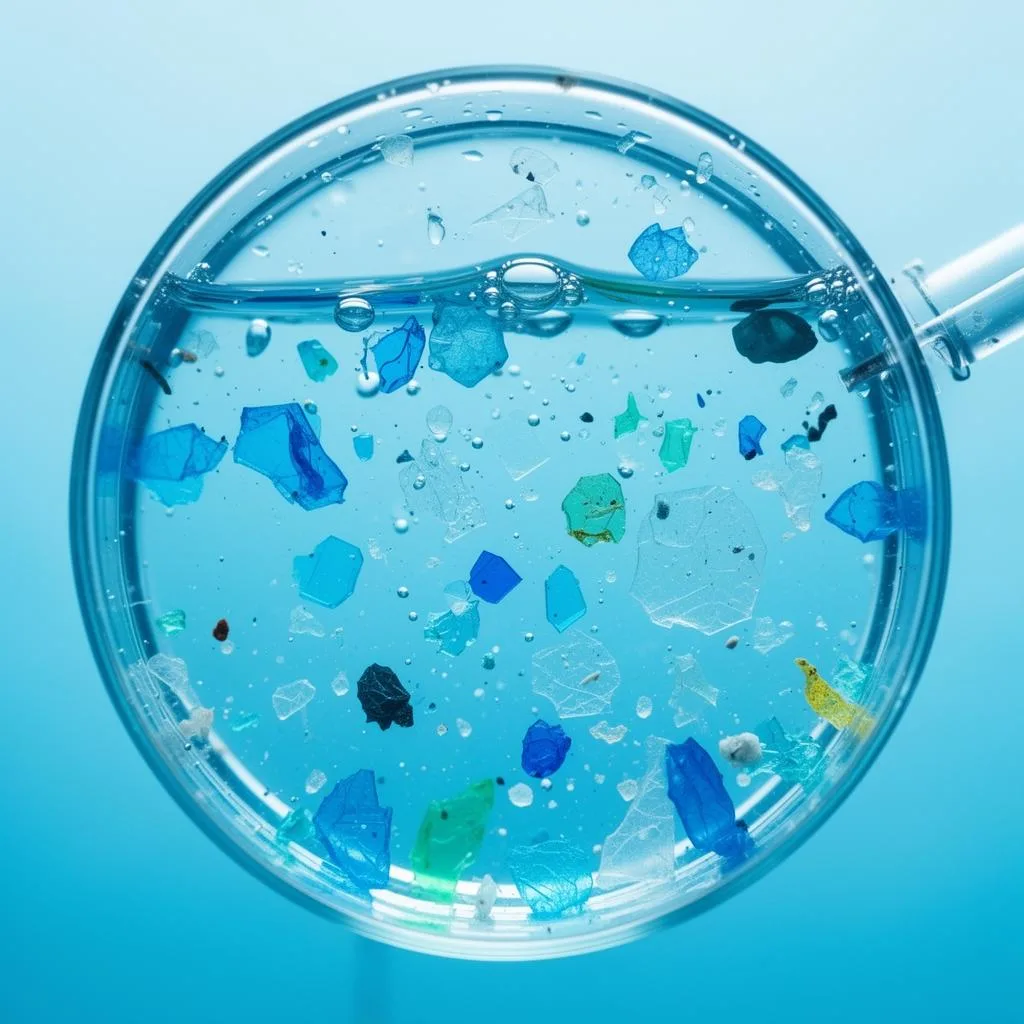
This measurement gap reflects current technical limits and has three main causes:
No laboratory can prove that a product is free of plastic. A verification statement describes reviewed evidence. It does not promise absence. That boundary keeps the statement defensible.
WQI Plastic-Free Pathway Verification does not certify that a product contains zero plastic, microplastics or nanoplastics. It shows that the company is on a verified pathway toward plastic-free standards. Verification applies only to the reviewed products, submitted datasets, tested ranges, polymer panels, production or sampling periods, and supporting controls. WQI verification is not a California approval, government certification, or health or safety certification.
See How WQI Verifies Your Lab Data Against WQI-CS-01
A well-structured verification program follows a clear, repeatable process. The Wellness Quality Institute’s Plastic-Free Pathway Verification, governed by its WQI-CS-01 standard, follows these steps:

A single assessment fee covers review, verification decision, and registry listing. There is no separate mark-license or registry fee. A qualified independent laboratory arranges and bills for testing. Paying the assessment fee does not guarantee a Standard Met decision.
Choosing the right verifier protects your brand and your customers. The questions below work together as a quick due-diligence checklist.
The Wellness Quality Institute is an independent verification body that reviews existing third-party laboratory data against WQI-CS-01, publishes its criteria, issues a public registry listing with a registry ID, and provides approved claim language. The Wellness Quality Institute also draws a firm line on what it will not claim. The word “pathway” in “WQI Plastic-Free Pathway Verified” always appears. It signals progress toward a plastic-free standard rather than arrival at a state that science cannot confirm today.
The answer depends on your goals and the data you already hold. For a brand with real laboratory data that wants to use it, the real choice is whether to turn that data into a defensible claim or leave it unused while competitors make claims the market cannot easily check.
The regulatory trajectory described earlier, including the CSRD’s limited-assurance mandate and SB 253’s 2027 and 2030 milestones, now shapes expectations for US buyers and retailers. They increasingly expect claims to rest on evidence that could withstand the same level of scrutiny.
A defensible claim survives retailer diligence and legal review. An unverifiable claim does not. Greenwashing litigation now targets companies whose plastic-free claims lack support. A claim that looks strong on packaging can collapse quickly when a litigator asks what the underlying data actually shows.
Under the Wellness Quality Institute’s program, a Standard Not Met outcome stays private. It carries no public claim, no logo rights, and no registry listing. It is never described as a failed product. It may simply reflect insufficient data, an unsupported method, or incomplete scope. Participation adds no new public downside. The real risk lies in making a claim that your current data cannot defend.
Verification is an independent review of data against a defined standard and scope. The finding connects to a specific dataset, method, product, and time period and stops there. Certification is a settled-state guarantee that a product or process meets a standard on an absolute or ongoing basis. The Wellness Quality Institute uses “verification” rather than “certification” because no laboratory today can confirm complete absence of plastic across every particle size, polymer type, and production lot. A certification claim in this context would not match the science. A properly scoped verification claim does.
“None detected” means none found above that instrument’s detection floor, for the polymers screened, in the lot tested. It is a bounded finding. It does not guarantee absence. The California State Water Board’s definition of microplastics reaches down to 1 nanometer, while the best validated analytical methods begin at 20 or 50 micrometers, which are thousands of times larger. The fraction between 1 and 20 micrometers is not validated under either California method. A result of “none detected” can coexist with particles present below the method’s size floor, outside the tested polymer panel, or in a different production lot.
Independent sustainability verification and ESG certification serve different purposes. ESG certification usually refers to a settled-state guarantee against a framework, claiming that a company or product meets a defined standard on an ongoing basis. Independent sustainability verification reviews specific data against a defined standard and ties findings to that scope. A strong verification statement discloses its assurance level, scope, and governing standard. An ESG certification label without those details gives buyers little to evaluate.
The Wellness Quality Institute’s verification period is 24 months from the sampling date of the most recent accepted dataset. After that, continued claim use requires re-verification with current data. Expired registry entries remain publicly visible and marked “Expired,” so the record stays honest over time. This approach reflects lot-to-lot variability. A verification result reflects the production it came from, not every future lot.
Companies remain responsible for ensuring that all product, packaging, and marketing claims are accurate and properly substantiated under applicable law. The Wellness Quality Institute verification is an independent review of a dataset against a defined standard. It is not legal, regulatory, or advertising-claims counsel. The Wellness Quality Institute provides approved claim language and clear lists of what may and may not be said, so the compliant version is easy to use. A brand’s legal team still owns final responsibility for published claims.
Independent sustainability verification creates value because it is bounded. A verification statement only matters when the scope, method, and detection limits are clear.
Before you engage any verifier, ask what its standard is anchored to, what the reviewed scope covers, and whether the result is publicly checkable. A verifier that cannot answer those questions clearly is selling a label, not a defensible finding.
For brands holding laboratory data on plastic or microplastic content, the Wellness Quality Institute’s Plastic-Free Pathway Verification provides an independent review against WQI-CS-01, a public registry entry, and approved claim language that stays inside what the evidence supports. That is the difference between a claim a company asserts and a claim a company can substantiate.
Explore WQI Plastic-Free Pathway Verification For Your Products
Reports

The Wellness Quality Institute explains which microplastics testing standards apply to your sample, method, and role — clearly and in plain language.
Read article
The Wellness Quality Institute helps brands turn plastic lab results into defensible claims. Get independent review you can trust. Learn more.
Read article
Can a product really be plastic-free? The Wellness Quality Institute turns lab data into honest, scope-locked microplastics claims. Learn how.
Read article