
Home Water Testing: City, Well Water & Microplastics
Learn how to test city or well water, read results, and spot microplastics. The Wellness Quality Institute helps brands verify plastic-related claims.
Read articleThe Wellness Quality Institute helps U.S. beverage brands verify microplastic claims & meet supplier standards. Get your practical guide today.
Written by: Scott Steveson, Specialist, Wellness Quality Institute
Approved water suppliers under Water Quality Month standards must have third-party laboratory datasets on microplastics independently reviewed against defined criteria, not just commissioned testing.
The U.S. federal regulatory landscape for microplastics in drinking water remains unsettled. EPA’s draft CCL 6 names microplastics a priority contaminant, while UCMR 6 excludes them because no validated analytical methods exist yet.
California’s State Water Resources Control Board microplastics framework is the strongest current technical benchmark and can guide any U.S. water or beverage brand, regardless of location.
Current laboratory methods cannot prove complete absence of plastic across all particle sizes, polymer types, and production lots. Detection confirms presence, not absence.
Plastics are polymer materials such as polyethylene (PE), polypropylene (PP), polyethylene terephthalate (PET), polystyrene (PS), PVC, and nylon. As plastic objects sit in sunlight, heat, and mechanical stress, they break into smaller pieces that still behave like plastic long after they stop looking like the original product.

The field groups these fragments by size:
Microplastics are particles smaller than 5 millimeters. At the larger end of this range, laboratories can count and chemically identify them with current methods.
Nanoplastics are particles smaller than 1 micrometer, or one-thousandth of a millimeter. These particles sit below the reliable reach of routine commercial testing.
Sources fall into two main categories. Primary microplastics are manufactured small, such as microbeads in personal-care products or industrial pellets. Secondary microplastics are far more common and come from the breakdown of everyday plastic items. Packaging, synthetic clothing fibers, tire wear, agricultural films, and even dust in the air can all shed particles into water and food.
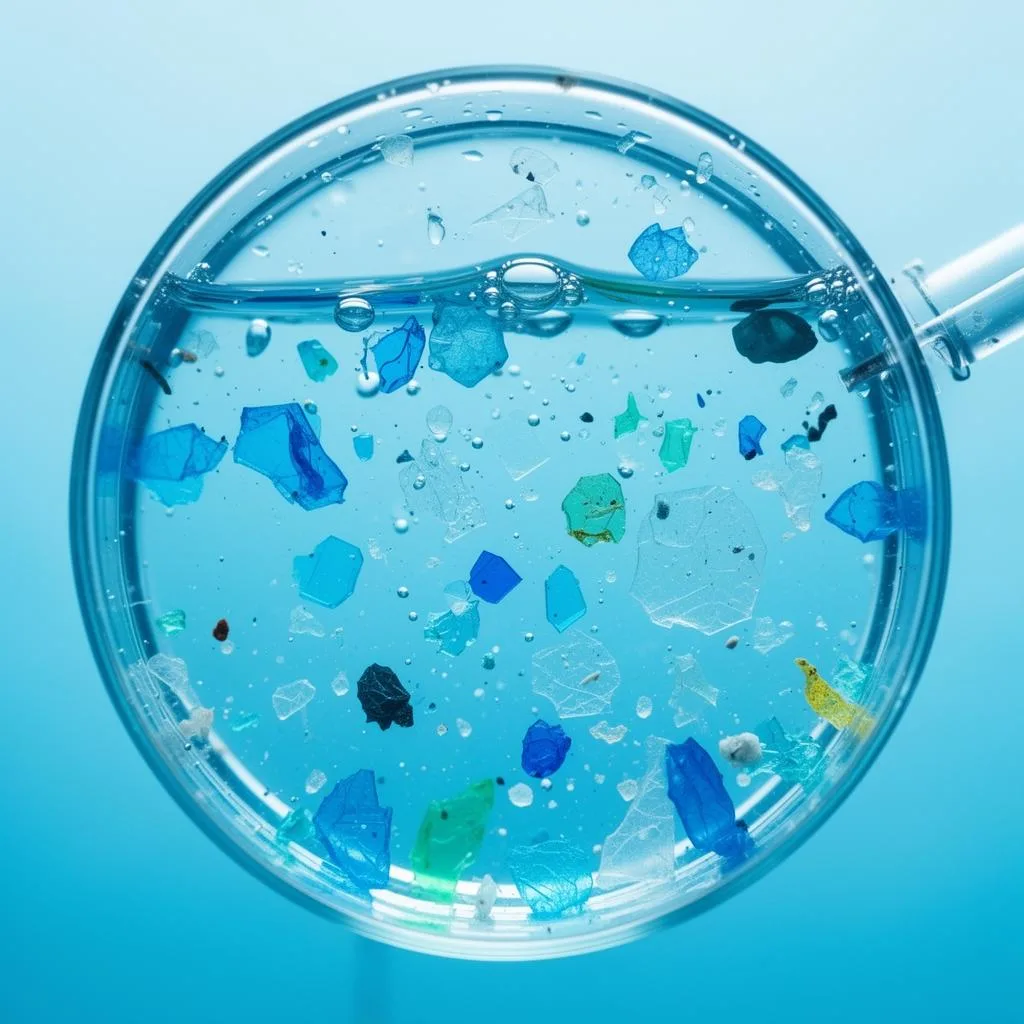
A critical measurement gap shapes every microplastics discussion. California’s regulatory definition covers particles from 1 nanometer to 5,000 micrometers. The two California State Water Board validated analytical methods, SWB-MP1-rev1 (infrared spectroscopy, validated above 50 µm) and SWB-MP2-rev1 (Raman spectroscopy, validated above 20 µm), start thousands of times above the lower end of that definition. The 1–20 µm fraction is not validated under either method, and everything smaller than that currently sits beyond reliable commercial measurement.
This gap creates the field’s core constraint: detection establishes presence, not absence. A 2018 peer-reviewed study by Kosuth, Mason, and Wattenberg in PLOS ONE found anthropogenic particles in 81% of 159 tap water samples across five continents. A separate 2018 study led by Sherri Mason at SUNY Fredonia, published in Frontiers in Chemistry, found microplastics in 93% of 259 bottled water samples across eleven brands, with polypropylene, the material used in many bottle caps, as the most common polymer identified.
More recently, a 2026 study in Science of the Total Environment reported nanoplastic concentrations three times higher in bottled water than in treated tap water, with nanoplastics making up more than half of all detected particles in both sample types. These studies confirm that plastic particles are present. No laboratory can prove absence across every particle size, polymer type, and production lot, and no responsible supplier claim should say otherwise.
Laboratory qualification is the first filter for any compliance or procurement team reviewing supplier data. Not every laboratory that offers microplastics testing produces results with the same level of defensibility. The Wellness Quality Institute uses a California-aligned framework with three accreditation tiers as its technical benchmark:

Preferred: California ELAP-accredited (Environmental Laboratory Accreditation Program) for the applicable State Water Board microplastics method.
Accepted: ISO/IEC 17025-accredited, which is the international standard for laboratory competence, with the specific microplastics method and the product matrix, meaning the type of liquid tested, clearly listed in the accredited scope.
Conditional: Other qualified independent laboratories, when they pass a documented method-equivalence review and receive technical approval.
Accreditation alone is not enough. The method must fit the specific product matrix. Reporting limits, which are the lowest concentrations a method can reliably measure, must meet defined thresholds. A “none detected” result with a weak reporting limit is not defensible. Laboratories must run and report blank controls, which are samples processed without product to catch contamination introduced during analysis. The polymer panel, or list of plastic types screened, must at minimum include PE, PP, PET, PS, PVC, PA, PC, and PMMA. Strong contamination-control practices during sampling and processing are essential because microplastics occur at very low levels, and secondary contamination during filtration or density separation can distort results.
The Wellness Quality Institute’s Plastic-Free Pathway Verification (PFPV), governed by its standard WQI-CS-01, adds an independent review layer that turns a qualified laboratory dataset into a scope-locked, defensible claim. The verification decision tree produces two outcomes:
Standard Met: The dataset meets all applicable technical and data-quality requirements, and no reportable target polymer particles are detected within the tested particle-size range and approved reporting limits. This outcome includes a public registry listing, a scope-locked license to use the WQI mark, and approved claim language.
Standard Not Met: One or more requirements are not satisfied. This outcome remains private, with no public claim, no registry listing, and no public downside risk. It may reflect limited data or an unsupported method rather than a product problem, and the company may resubmit with updated information.
The Wellness Quality Institute does not perform laboratory testing. It reviews the data, methods, and controls that a qualified independent laboratory has already produced.
Voluntary supplier documentation in the water and beverage category is converging on a few shared practices, even without federal microplastics standards. Risk-based requalification is the prevailing approach under ISO 9001:2015 and ISO/IEC 17025:2017, with critical suppliers often requalified annually and lower-risk suppliers on longer cycles. Off-cycle requalification usually follows process changes, site moves, certification lapses, or declining quality performance.
Traceability is becoming a baseline expectation for retailers and procurement teams. Traceability means you can connect each test result to a specific production lot, sampling date, and chain of custody. A test result without lot-specific scope cannot support a product-level claim and can only describe the sampled lot. Organizations may choose to adopt documentation practices such as chain-of-custody records tied to production periods, spike recovery data that confirm the method can detect what it claims, replicate measurements, and data-recency rules linked to a defined verification period.
All standards and processes referenced in this guide are optional examples that organizations may choose to use. No single framework is federally mandated for microplastics in the water and beverage category as of August 2026.
The numbered table below outlines supplier-requirements criteria that procurement and compliance teams can use as an optional evaluation framework. Each criterion draws from the California State Water Board’s drinking-water microplastics reference framework and WQI-CS-01 as a technical benchmark.
|
# |
Requirement Area |
Criterion |
Notes |
|---|---|---|---|
|
1 |
Laboratory Accreditation |
California ELAP preferred, ISO/IEC 17025 with method and matrix in accredited scope accepted, other labs conditional on method-equivalence review |
EPA excluded microplastics from UCMR 6 because no validated consensus method exists |
|
2 |
Analytical Method |
SWB-MP1-rev1 (infrared, ≥50 µm) or SWB-MP2-rev1 (Raman, ≥20 µm), with a method appropriate for the product matrix |
No single method covers the full range of micro- and nanoplastic particles |
|
3 |
Polymer Panel |
Minimum panel includes PE, PP, PET, PS, PVC, PA, PC, and PMMA, and laboratories must report unidentified particles with no spectral match |
Visual identification alone is never sufficient, and counted particles must be chemically confirmed |
|
4 |
Reporting Limits and Blank Controls |
Reporting limits must meet defined thresholds, blank data must be reported, and spike recoveries and replicates are required |
Contamination controls during processing are essential at low concentrations |
|
5 |
Traceability and Lot Scope |
Chain of custody must link samples to a specific production lot and sampling date, and results apply only to the reviewed lot |
A single lot result cannot be stretched into a product-line or company-wide claim |
|
6 |
Testing Frequency |
Lot-specific testing with risk-based requalification and off-cycle triggers for process or site changes |
No universal fixed frequency exists, and risk tier determines the interval |
|
7 |
Corrective Action Protocol |
Documented response procedure for detected particles above reporting limits, including supplier notification, lot quarantine, and retest steps |
|
|
8 |
Re-verification Cycle |
Twenty-four months from the sampling date of the most recent accepted dataset, with continued claim use after expiration requiring re-verification with current data |
Expired registry entries remain publicly visible and clearly marked “Expired” |
Approved claim language for verified products includes: “Reviewed and accepted under the Wellness Quality Institute (WQI)’s Plastic-Free Pathway Verification standard” and “Dataset reviewed against a standard aligned with the California State Water Board’s drinking-water microplastics reference framework.”
Prohibited claims, without exception:
“Plastic-free” or “microplastic-free” as a product claim
“Zero plastic” or “100% plastic-free”
“Certified” or “certification” in connection with the Wellness Quality Institute verification
Any claim of California approval or government endorsement
Any claim that extends a single product’s result to a product line or the company as a whole
Any claim suggesting the Wellness Quality Institute performed the laboratory testing
Three recurring errors appear in supplier documentation and marketing claims, and each one creates legal and reputational risk.
Over-extending single-lot results. A test result describes the production lot it came from. Extending one dataset to cover an entire product line, brand, or company breaks that scope. Lot-to-lot variability is a basic quality-management principle, and a clean result on one run does not guarantee the next.
Confusing “none detected” with “free of plastic.” “None detected” means the method did not find particles above its detection floor, for the polymers it screened, in the lot it tested. A 2026 PRISMA-guided review in Molecules concludes that conventional FTIR and routine Raman workflows are not adequate for true nanoscale analysis, and that the main uncertainty in drinking-water nanoplastic measurements reflects unresolved analytical chemistry constraints as much as environmental variability. A method that begins at 50 µm cannot see anything smaller, which echoes the measurement gap described earlier. “None detected” and “free of plastic” are not the same statement.
Using unaccredited laboratories without method-equivalence review. EPA researchers note that the wide range of particle sizes, densities, and compositions means no single method can characterize the full variety of micro- and nanoplastic particles, and that method standardization is still developing. A result from a laboratory whose method has not been reviewed for suitability to the specific product matrix cannot support a defensible claim, no matter what number appears on the report.
The Wellness Quality Institute verification is a structured review that helps companies understand what their laboratory data actually supports. The answers below explain how the program works in practice.
No. As explained in the measurement gap section, current laboratory technology cannot confirm complete absence across all particle sizes and polymer types. WQI’s Plastic-Free Pathway Verification confirms that a company’s existing laboratory dataset has been independently reviewed against defined criteria, within the tested particle-size range and polymer panel, for the specific product and production period reviewed. It is a statement about reviewed evidence, not a guarantee of a plastic-free product. The word “pathway” in the program name signals progress toward plastic-free standards, not arrival at them.
A qualified independent laboratory performs the testing, not the Wellness Quality Institute. WQI reviews the resulting data, method documentation, and contamination controls, and that separation keeps the review independent. For laboratory qualification, WQI uses a three-tier framework described earlier: California ELAP accreditation for the applicable State Water Board microplastics method is preferred, ISO/IEC 17025 with method and matrix in scope is accepted, and other qualified laboratories may be conditionally accepted through method-equivalence review. Companies can confirm in advance whether their chosen laboratory will produce a reviewable dataset and avoid paying for testing that cannot support a verification decision.
No. California has not created a consumer-product plastic standard and does not endorse, approve, or authorize the Wellness Quality Institute or its standard. WQI aligns its review criteria with the California State Water Board’s drinking-water microplastics framework because that framework is the most stringent credible public reference available nationally, not because California authorized the program. WQI verification is not a California approval, a government certification, or a health or safety certification. The California framework serves as a technical reference point, not a geographic boundary, and verification is available to U.S. water and beverage brands nationwide.
The verification period lasts 24 months from the sampling date of the most recent accepted dataset. Continued claim use after expiration requires re-verification using current data. This cycle reflects lot-to-lot variability, because a result describes the production it came from, not future production. Expired registry entries remain publicly visible and marked “Expired,” so the record stays accurate over time. Off-cycle re-verification may also make sense after major process changes, manufacturing site moves, or changes to product formulation or packaging that could affect microplastic content.
A Standard Not Met outcome remains private. It carries no public claim, no logo rights, and no registry listing, and it is never described as a failed product. The outcome often reflects limited data, an unsupported analytical method, weak contamination controls, or incomplete scope rather than a product defect. The company may submit corrected or additional information for future review. Participating in the review process creates no public downside risk by design, so brands can safely learn what their existing data actually supports before making a public claim.
Ready to understand what your lab data actually supports? Start your WQI verification review.
The regulatory landscape for microplastics in U.S. drinking water and beverages is shifting. EPA’s draft CCL 6 designation in April 2026 marks the first federal step toward potential future regulation, yet enforceable federal standards do not exist today. In this gap, the California State Water Board’s drinking-water microplastics framework remains the most defensible technical benchmark, and independent review of laboratory data against that benchmark is what turns a raw test result into a claim that compliance teams, retailers, and legal departments can evaluate.
The practical framework in this guide, including laboratory accreditation tiers, method suitability review, polymer panel requirements, blank controls, lot-specific scope, corrective-action protocols, and 24-month re-verification cycles, offers an optional set of criteria that organizations may choose to adopt. No element is federally mandated for microplastics as of August 2026. The distance between holding a laboratory report and holding a defensible market claim is not closed by the report alone. It closes when independent reviewers apply published criteria and tie approved claim language to the specific evidence reviewed.
The Wellness Quality Institute’s Plastic-Free Pathway Verification is designed to close that gap. A single assessment fee covers the review, verification decision, and public registry listing where the standard is met. WQI has no commercial interest in the outcome, and the independence is the product.
WQI Plastic-Free Pathway Verification does not certify that a product contains zero plastic, microplastics, or nanoplastics. It shows that the company is on a verified pathway toward plastic-free standards. Verification applies only to the reviewed products, submitted datasets, tested ranges, polymer panels, production or sampling periods, and supporting controls. WQI verification is not a California approval, government certification, or health or safety certification.
Close the gap between lab reports and defensible claims. Get started with WQI verification.
Water Quality

Learn how to test city or well water, read results, and spot microplastics. The Wellness Quality Institute helps brands verify plastic-related claims.
Read article
The Wellness Quality Institute explains California's microplastics rules—MCLs, notification levels & basin plans—to keep your claims defensible.
Read article
The Wellness Quality Institute helps brands verify water quality claims with independent testing. Build consumer trust with solid evidence. Start now.
Read article