
Home Water Testing: City, Well Water & Microplastics
Learn how to test city or well water, read results, and spot microplastics. The Wellness Quality Institute helps brands verify plastic-related claims.
Read articleTest bottled water for microplastics the right way. The Wellness Quality Institute helps you turn verified lab data into a claim you can stand behind.

Written by: Scott Steveson, Specialist
Only accredited laboratories using Raman or micro-FTIR spectroscopy can reliably detect microplastics in bottled water. At-home kits lack the sensitivity and contamination controls needed for defensible results.
Independent studies have found microplastics in 93% of bottled water samples, with polypropylene from bottle caps identified as a primary contamination source.
Reliable testing requires strict contamination controls, clear chain-of-custody documentation, and validated methods aligned with reference frameworks such as the California State Water Board standard operating procedures (SOPs).
A “none detected” result means no particles were found above the instrument’s detection floor for the tested polymers and lot. It does not prove the complete absence of plastic.
Independent review through The Wellness Quality Institute converts laboratory data into defensible claims that retailers and legal reviewers can trust. Learn more about Plastic-Free Pathway Verification.
A brand needs a clear testing question before commissioning any laboratory work. Microplastics are solid plastic particles smaller than 5 millimeters. Nanoplastics are particles smaller than 1 micrometer, which is one thousandth of a millimeter.

No current commercial method reliably detects nanoplastics in bottled water. That size range sits beyond the reach of validated laboratory techniques. A brand can test only the fraction that current methods can see.
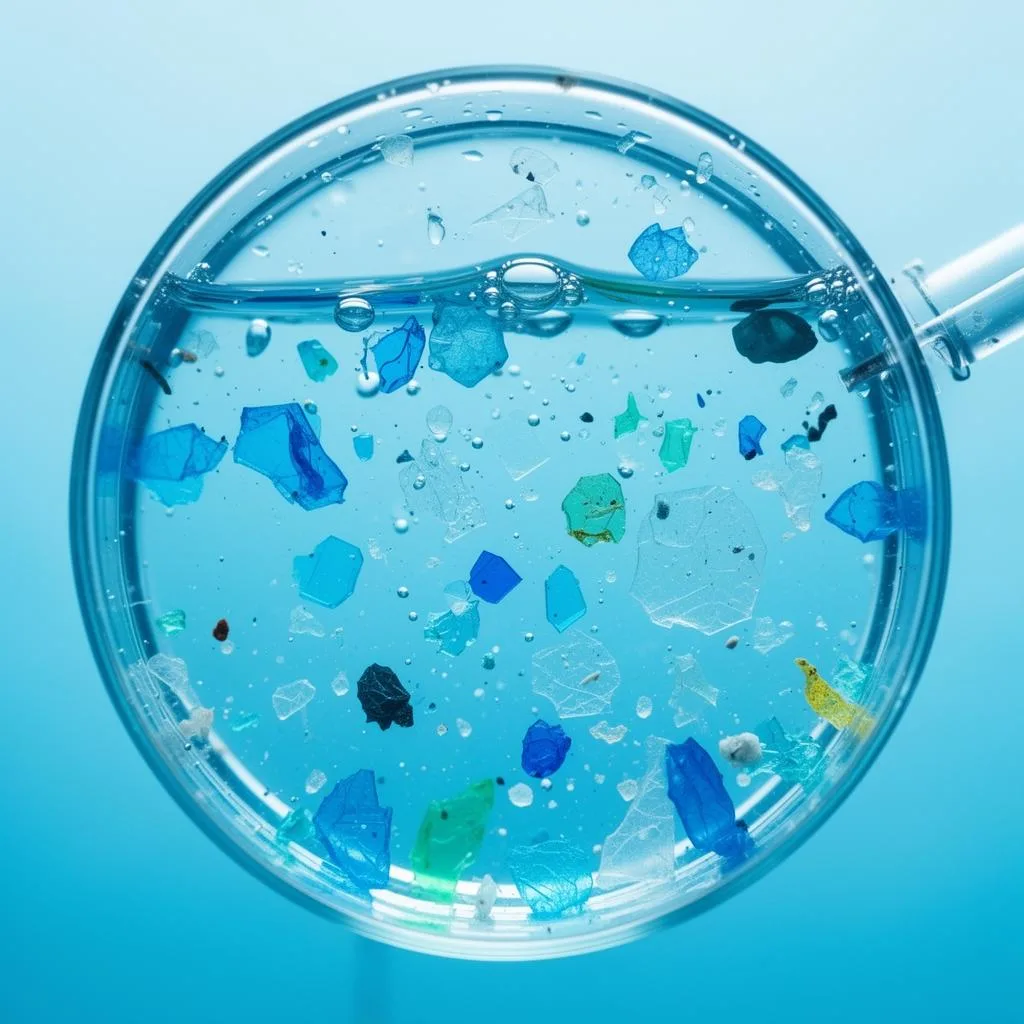
One example of a regulatory definition comes from the California State Water Board. Its drinking-water definition covers solid plastic material with particles that have at least three dimensions greater than 1 nanometer and less than 5,000 micrometers. The best validated laboratory methods start at 20 or 50 micrometers, which is thousands of times larger than the lower bound of that definition.
Knowing this gap at the outset helps a brand avoid paying for testing that cannot support any clear claim. The test result will always be limited by the particle sizes the method can actually measure.
Laboratory capability for microplastics testing varies widely. The instruments are expensive, and detection performance differs between laboratories and even between instruments in the same facility. Choosing a laboratory by name alone is not enough. Accreditation tier is the meaningful filter.

The Wellness Quality Institute, formally The Wellness Quality Institute, uses the following hierarchy under its review standard WQI-CS-01. This structure offers one practical way to think about accreditation tiers.
Preferred: State accreditation for the specific microplastics method and water type. An example is the California Environmental Laboratory Accreditation Program (ELAP). The state has independently verified the laboratory’s competence for this exact analysis.
Accepted: ISO/IEC 17025 accreditation with the microplastics method and the specific water matrix explicitly listed in the accredited scope. ISO/IEC 17025 is the international standard for laboratory competence.
Conditional: Other qualified independent laboratories that pass a documented method-equivalence review. The laboratory must show that its method produces results comparable to validated reference methods.
Confirming accreditation tier before commissioning testing ensures the resulting data will be eligible for independent review.
Microplastic concentrations in clean water can be extremely low. Even small amounts of contamination during sampling or shipping can overwhelm the true signal and invalidate results. Established quality-assurance frameworks for microplastic analysis require at least the following controls.
Use glass containers rather than plastic for sample collection and storage.
Handle samples in a biological safety cabinet or laminar-flow clean bench to reduce airborne fibers.
Avoid synthetic clothing and cosmetics during sampling because both shed particles.
Use only filtered, particle-free water for any rinsing steps.
Run field blanks, which are empty samples that travel through the entire collection process, to detect contamination introduced during sampling.
Run procedural blanks in the laboratory to identify contamination introduced during analysis.
These controls only work when they are documented. Blank results must be reported transparently, including the average and standard deviation of particles found in blanks, with both raw and blank-corrected data presented. Without blank data, a laboratory has not produced a result that can be independently evaluated.
Chain of custody, often shortened to COC, is the written record of who handled a sample, when they handled it, and under what conditions. The record starts at collection and continues through laboratory analysis. Without a complete COC, no one can rule out that a sample was compromised in transit. In that case, the data will not stand up in a retailer or legal context.
COC documentation should record the sample collection date and time, the collector’s identity, the container type and sealing method, shipping conditions, laboratory receipt confirmation, and any deviations from the sampling plan. The laboratory should acknowledge receipt and flag any anomalies before analysis begins.
Every analytical method has a detection floor, which is the smallest particle size it can reliably identify. Each method also has a polymer panel, which is the list of plastic types it can recognize. A result is only as meaningful as the method that produced it.
The California State Water Board provides one strong reference point. It has published two standard operating procedures that currently represent the most stringent public reference for microplastics in drinking water.
SWB-MP1-rev1 uses infrared spectroscopy and is validated for particles greater than 50 micrometers through 5,000 micrometers.
SWB-MP2-rev1 uses Raman spectroscopy and is validated for particles greater than 20 micrometers through 5,000 micrometers.
ISO 16094-2:2025 specifies procedures for measuring microplastic particle counts by polymer type and size range in clean water, including drinking water and bottled water, using micro-FTIR and micro-Raman spectroscopy. It can serve as an analytical reference when method, water type, laboratory validation, and equivalence are reviewed and accepted. It is not automatically interchangeable with the California methods.
A minimum polymer panel for bottled water should include polyethylene (PE), polypropylene (PP), polyethylene terephthalate (PET), polystyrene (PS), polyvinyl chloride (PVC), polyamide (PA), polycarbonate (PC), and polymethyl methacrylate (PMMA). Results should also report any other confirmed polymers and any unidentified particles with no spectral match.
A laboratory report that states “none detected” means no particles were found above that instrument’s detection floor for the polymers it screened in the lot it tested. The phrase does not mean the product contains no plastic. This distinction is the central interpretive boundary of all microplastics testing.
A method validated above 50 micrometers cannot see anything smaller. A polymer panel that screens eight types cannot detect a ninth. A result from one production lot does not guarantee the next lot will match it.
The World Health Organization’s 2019 assessment Microplastics in Drinking-Water notes that the evidence base remains limited and that more research is urgently needed. That caution applies directly to how individual laboratory results are interpreted.
A credible laboratory report will state its limit of detection (LOD) and limit of quantification (LOQ). These values mark the thresholds below which the method cannot reliably distinguish a signal from background noise. Without them, a non-detect result cannot be judged as robust or method-limited.
Results should be reported by size fraction rather than as a single combined figure. Recovery spike data, which are tests that confirm the method can actually find particles when they are present, should accompany the report.
A laboratory report and a defensible market claim are different things. Retailers, procurement teams, and legal reviewers often discount self-reported results because the brand has a direct interest in the outcome. Independent review converts a dataset into a finding that a third party is willing to stand behind.
These seven questions help a brand decide whether its data are ready for independent review.
Was the laboratory accredited for this method and water type?
Were blanks run and reported?
Were recovery spikes included?
Does the tested particle-size range align with a validated reference method?
Does the polymer panel cover the minimum required types?
Is chain-of-custody documentation complete?
Does the data reflect the specific product and production period being claimed?
These questions determine whether your dataset is ready for verification. If the answer to any question is no, the dataset may not support a verification decision. An independent review will state that clearly, which still provides useful guidance.
Before moving to independent review, a brand needs to understand what any laboratory can actually measure. The table below summarizes the validated particle-size ranges for the two spectroscopy methods referenced in the California State Water Board’s drinking-water microplastics framework. The 1–20 micrometer fraction is not validated under either method. Everything below 1 micrometer, which is the nanoplastic range, currently sits beyond reliable commercial measurement.
|
Method |
Validated Particle-Size Range |
Notes |
|---|---|---|
|
Raman spectroscopy (SWB-MP2-rev1) |
>20 µm through 5,000 µm |
Higher spatial resolution than infrared, greater susceptibility to fluorescence interference from pigments and organic matter |
|
Infrared spectroscopy / µFTIR (SWB-MP1-rev1) |
>50 µm through 5,000 µm |
Higher throughput, lower interference from inorganic compounds, preferred for turbid matrices |
|
1–20 µm fraction |
Not validated under either California method |
Advanced techniques exist but lack the standardization, throughput, and interlaboratory reproducibility required for defensible commercial claims |
These validated ranges define what laboratories can measure. Understanding what those measurements actually prove requires a different kind of analysis. The boundaries of a laboratory result form the most important interpretive skill a brand can develop in this space. Four specific limits apply to every microplastics report.
Detection floors. As discussed in Step 5, detection floors limit what any method can find. Micro-FTIR spectroscopy reaches a practical floor of approximately 10–50 micrometers depending on the instrument and substrate. Micro-Raman reaches approximately 1–20 micrometers under standard conditions. The key interpretive point is that a non-detect result can coexist with the possibility that smaller particles are present.
A 2026 PRISMA-guided review in Molecules by Vega-Baudrit, Lopretti, and Orozco concludes that nanoplastic detection in drinking water remains analytically immature. No single method can simultaneously resolve particle size, shape, polymer identity, and mass concentration.
Polymer-panel gaps. A method can detect only the polymers it is configured to identify. A result of “none detected” applies only to the polymers in the tested panel. Any polymer outside that panel is not reported and is not confirmed absent.
Lot-to-lot variability. A clean result on one production lot does not guarantee the next lot will match it. Packaging degradation, filling conditions, and mechanical stress during opening and closing all vary between production runs. Verification tied to a specific production period is the only honest scope for a non-detect result.
Scope-limited “none detected” results. The phrase “none detected” in a laboratory report is a bounded statement. It means none found above this instrument’s floor, for these polymers, in this lot, under these conditions. It is not a guarantee of absence.
A 2026 critical review by Mallek and Barceló in the Journal of Xenobiotics notes that even detected microplastics data have limited direct health-risk interpretability. A non-detect result cannot be converted into a health-safety claim.
The absence of harmonized methods means one laboratory could report “none detected” under its protocol while another reports detectable levels on the same water sample. The US regulatory picture reinforces these limits.
The EPA’s proposed UCMR-6 rule, published in the Federal Register on July 1, 2026, excludes microplastics from mandatory monitoring because the agency lacks a validated or standardized method to test for them in drinking water. The FDA does not have a microplastics standard for bottled water. No country has established an enforceable microplastics limit for drinking water.
A brand therefore cannot point to federal compliance monitoring as the basis for a microplastics claim. Independent review against a defined standard becomes the practical route to a defensible statement.
“None detected” means no particles were found above the instrument’s detection floor for the specific polymers the method screened in the production lot that was tested. It is a statement about the method’s reach, not a guarantee that the product contains no plastic.
A method validated above 50 micrometers cannot see anything smaller. A polymer panel covering eight plastic types cannot detect a ninth. Without a stated detection limit and blank data accompanying the result, “none detected” cannot be evaluated as a robust finding. It may simply reflect the limits of the instrument rather than the absence of particles.
No. At-home kits lack the spectroscopic instruments, contamination controls, and accreditation required to produce data that can support any defensible claim. Identifying a microplastic particle requires reading its chemical composition, typically by Raman or infrared spectroscopy, not its appearance under a basic microscope.
A particle that looks like a fiber could be polyester, cotton, polyethylene, or silica. Without chemical confirmation, a count is not a microplastics result. No accredited clinical or commercial assay exists for consumer-grade microplastics testing of water. Published research relies on research-grade methods with rigorous contamination controls that cannot be replicated in a postal consumer workflow.
Retailers, procurement teams, and legal reviewers often discount self-reported laboratory results because the brand commissioning and publishing its own data has an obvious interest in the outcome. A raw lab report carries a number but not the independent review needed to explain what that number means. It also lacks a third party willing to stand behind the interpretation.
Independent review by a body with no commercial interest in the result, working against published criteria, converts a laboratory dataset into a finding the market can evaluate. The Wellness Quality Institute’s Plastic-Free Pathway Verification program exists to bridge that gap. WQI reviews a brand’s existing third-party laboratory data against defined criteria and issues scope-locked claim language tied to what the evidence actually supports.
A minimum polymer panel for bottled water testing should include polyethylene (PE), polypropylene (PP), polyethylene terephthalate (PET), polystyrene (PS), polyvinyl chloride (PVC), polyamide (PA), polycarbonate (PC), and polymethyl methacrylate (PMMA). The report should also include a category for other confirmed polymers and a category for unidentified particles with no spectral match.
Particle counts must be chemically confirmed by spectroscopy. Visual identification alone is never sufficient because particle shape and color cannot identify polymer type. Results should be reported by size fraction rather than as a single aggregate figure.
These are fundamentally different claims. No laboratory today can confirm the complete absence of plastic across every particle size, polymer type, and production lot. No honest organization can certify a product as plastic-free.
The Wellness Quality Institute’s Plastic-Free Pathway Verification is an independent review of a brand’s existing laboratory dataset against defined criteria aligned with the California State Water Board’s drinking-water microplastics reference framework. A Standard Met outcome confirms that the reviewed data meet WQI’s requirements within the tested particle-size range, polymer panel, and production period. It does not state that the product is free of plastic.
The word “pathway” in the program name signals progress toward plastic-free standards, not arrival at a destination that current science cannot reach or measure. The California State Water Board has not created, approved, authorized, or endorsed WQI or its standard.
Many brands already hold valuable laboratory data. They have commissioned independent testing, paid for it, and acted on the results. What they often lack is a trusted way to use those results in the market.
A laboratory report stating “none detected” is bounded entirely by that instrument’s detection floor. It means none found above a certain size using a specific method on a specific lot, not none present. Without independent review, even rigorous data can read as marketing.
The Wellness Quality Institute reviews a brand’s existing third-party laboratory dataset, testing methodology, product scope, and supporting controls against WQI-CS-01. This standard aligns with the California State Water Board’s drinking-water microplastics reference framework.
A single assessment fee covers the review, verification decision, and public registry listing. There is no separate mark-license or registry fee. Independent laboratory testing is arranged and billed separately by a qualified independent laboratory.
A Standard Not Met outcome is private, carries no public claim, and can be resubmitted with updated information. Participation carries no public downside risk.
WQI does not certify that any product is free of plastic. It verifies that a company’s reviewed dataset meets defined criteria and supports genuine progress toward plastic-free standards. That is the strongest claim current science can support and the one that holds up when a retailer, journalist, or litigator examines it.
WQI Plastic-Free Pathway Verification does not certify that a product contains zero plastic, microplastics or nanoplastics. It shows that the company is on a verified pathway toward plastic-free standards. Verification applies only to the reviewed products, submitted datasets, tested ranges, polymer panels, production or sampling periods, and supporting controls. WQI verification is not a California approval, government certification, or health or safety certification.
Water Quality

Learn how to test city or well water, read results, and spot microplastics. The Wellness Quality Institute helps brands verify plastic-related claims.
Read article
The Wellness Quality Institute explains California's microplastics rules—MCLs, notification levels & basin plans—to keep your claims defensible.
Read article
The Wellness Quality Institute helps brands verify water quality claims with independent testing. Build consumer trust with solid evidence. Start now.
Read article