
How to Avoid Greenwashing Lawsuits on Plastic Claims
Avoid greenwashing lawsuits over plastic claims. The Wellness Quality Institute turns real data into defensible, FTC-compliant environmental claims.
Read articleTurn lab reports into defensible claims. The Wellness Quality Institute verifies your sustainability data with independent, registry-backed results.

Written by: Scott Steveson, Specialist
Companies routinely commission independent laboratory testing on plastic content, pay for rigorous analysis, and receive detailed reports. When those results are published by the brand itself, the market still reads them as marketing. Self-reported data, however carefully gathered, carries the same credibility problem as grading your own homework. Retailers, procurement teams, and legal reviewers discount it, not because the underlying science is wrong, but because no independent party has reviewed whether the interpretation holds up.

A second problem is technical and harder to resolve. No laboratory today can confirm the complete absence of plastic in any product. Microplastics are defined as solid plastic particles with at least three dimensions greater than 1 nanometer and less than 5,000 micrometers, which is an intentionally broad range. The best validated analytical methods, however, start at 20 or 50 micrometers, thousands of times larger than the lower bound of that definition. A laboratory result of “none detected” means no particles were found above the method’s limit of detection, not that the product is free of plastic. The 1–20 micrometer fraction is not validated under published methods, and nanoplastics, which are particles below 1 micrometer, fall entirely outside the reliable reach of commercially available methods.
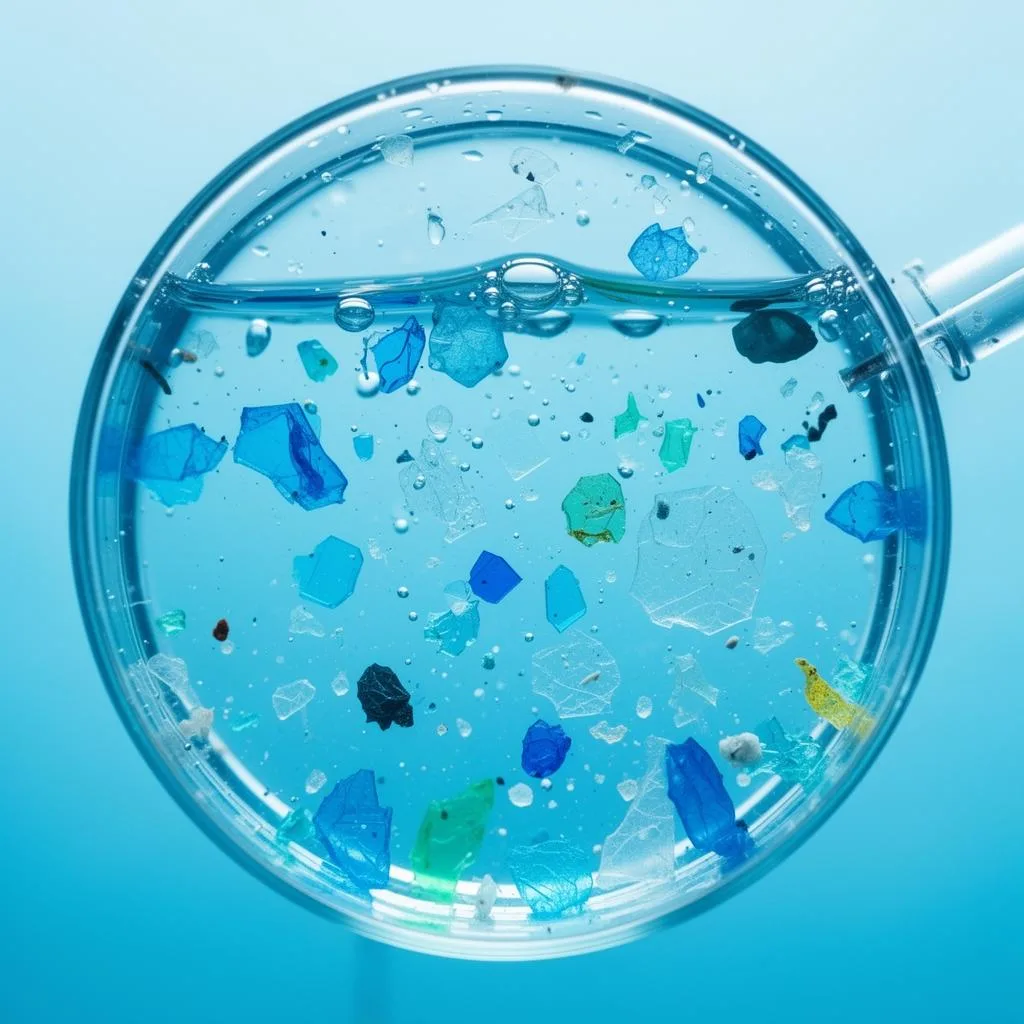
Because no test can prove complete absence of plastic, sustainability data verification takes a different approach. It does not test products. It reviews existing laboratory datasets, analytical methods, contamination controls, and product scope against published criteria. It then produces a clear conclusion about what that data can and cannot support.
The six steps below show how an independent review of plastic content laboratory data is structured. Organizations can adopt the full framework or start with the pieces that match their current data and claim goals.
Sustainability assurance standards distinguish between two levels of confidence, limited assurance and reasonable assurance. The table below maps those levels to plastic-data realities and shows where the Wellness Quality Institute outcome fits. The Wellness Quality Institute’s Plastic-Free Pathway Verification produces a binary Standard Met or Standard Not Met outcome rather than a traditional assurance conclusion, so the table serves as context.
| Assurance Level | Procedures | Conclusion Form | Plastic-Data Example |
|---|---|---|---|
| Limited assurance | Inquiry, analytical procedures, and targeted testing of significant risk areas, with fewer procedures and less evidence than reasonable assurance | Negative conclusion: “nothing came to our attention indicating material misstatement” | Reviewer confirms that particle counts and polymer identifications appear consistent with the submitted method documentation, without exhaustive re-testing of controls. |
| Reasonable assurance | Comprehensive substantive testing, larger samples, site visits, and scrutiny of systems and controls, with coverage typically reaching 80–90% of relevant information | Positive conclusion: the information is materially correct and a fair representation | Reviewer independently evaluates the design and effectiveness of contamination controls, blank protocols, and chain-of-custody systems across the production period. |
| Wellness Quality Institute Standard Met outcome | Independent review of laboratory qualification, method, particle-size range, polymer panel, blanks, spike recoveries, replicates, chain of custody, reporting limits, and scope, against WQI-CS-01 criteria aligned with published drinking-water microplastics reference frameworks. | Binary outcome: Standard Met, which receives a public registry listing and approved claim language, or Standard Not Met, which remains private with no public listing. | Dataset reviewed for a bottled-water product using Raman spectroscopy with a validated range above 20 micrometers through 5,000 micrometers. Scope is locked to the reviewed SKU and production period, and the registry entry records the tested polymer panel and lower method limit. |
ISSA 5000, the first comprehensive global sustainability assurance standard issued by the IAASB, takes effect for assurance engagements on sustainability information for periods beginning on or after 15 December 2026. Current leading resources for sustainability assurance focus on general ESG frameworks under ISSA 5000 or ISAE 3000. None address the specific requirements of plastic and microplastic laboratory datasets, such as particle-size limits, polymer panels, blank controls, or scope lock for consumer-product claims.
A single laboratory result, however rigorous, describes one product, one production lot, and one set of tested parameters. Scope lock is the mechanism that keeps a verified claim inside those boundaries. It prevents a result from being stretched into a statement about an entire product line, a brand, or a production period that was never tested.
Consider a hypothetical premium bottled-water brand that submits Raman spectroscopy data generated under SWB-MP2-rev1, with a validated range above 20 micrometers through 5,000 micrometers, for a single SKU and a defined three-month production period. The dataset includes blank results, spike recoveries, and chain-of-custody documentation. The polymer panel covers all eight required types. Reporting limits meet Wellness Quality Institute requirements. No reportable target polymer particles are detected within the tested range.

The resulting registry record lists the verified party, the specific product and SKU, the matrix, which in this case is still water, the production period, the tested particle-size range, the lower method limit above 20 micrometers, the polymer panel, the testing laboratory and its accreditation reference, the verification and expiration dates, and the registry ID. The brand may use approved claim language tied to that scope. It may not extend the result to other SKUs, other production periods, or the company as a whole. Making an environmental claim about an entire product or business activity when the claim actually relates only to a specific aspect is a recognized form of greenwashing under emerging regulatory frameworks.
Three alternatives to independent verification are common in the market, and each carries a structural limitation that leaves a credibility gap.
A raw laboratory report carries a number but not the review needed to say what that number means. Effective verification requires both process evidence, such as documented procedures, defined responsibilities, and system controls, and source evidence, not merely the final reported numbers. A report alone provides the numbers without the process evidence.
Even when companies attempt to interpret that data internally, the result faces a different problem. An internal review, which is a company’s own interpretation of its own data, reads as marketing regardless of its rigor. Internal validation of sustainability data risks questions of bias or greenwashing and may fail to meet independent third-party verification requirements.
Shifting the burden to suppliers does not solve this credibility gap either. A supplier statement transfers the credibility problem rather than resolving it, because the supplier has the same interest in a favorable result as the brand itself.
Independent verification addresses all three limitations through a single mechanism. A third party with no commercial interest in the outcome, no role in the testing, and published criteria reviews the data and issues a conclusion that anyone can check. Courts have scrutinized consumer-product claims involving trace contaminants such as microplastics, and practitioners recommend formal claims substantiation protocols backed by supply-chain data, third-party test results, or production specifications. A registry-backed verification outcome with a public registry ID is a direct way to meet that standard.
The regulatory environment reinforces this need for independent support. The FTC’s Green Guides caution against broad, unqualified environmental benefit claims and require clear, specific, and prominent qualifications to avoid implying more than the product delivers. The EPA’s April 2026 draft Sixth Contaminant Candidate List places microplastics on the federal regulatory radar for the first time, which increases the risk of more extensive compliance costs and potential litigation for consumer product companies. Recent consumer class actions have targeted “plastic free” and similar claims, with some theories surviving early dismissal motions.
Verification confirms that a company’s existing laboratory dataset, covering a specific product, production period, particle-size range, and polymer panel, was reviewed against the Wellness Quality Institute’s defined criteria and met all applicable technical and data-quality requirements. It also confirms that no reportable target polymer particles were detected within the tested range and approved reporting limits. Verification does not confirm that the product contains zero plastic, zero microplastics, or zero nanoplastics. Because of the measurement limitations described earlier, verification cannot confirm zero plastic across every particle size, polymer type, and production lot. As explained earlier, the microplastics definition spans from 1 nanometer to 5,000 micrometers, but validated methods only reach the 20–50 micrometer floor, which leaves the smaller fractions unmeasurable. Verification is a statement about reviewed evidence within a defined scope, not a guarantee about what was not and could not be measured.
Testing is what a laboratory does. The lab analyzes a physical sample using instruments such as Raman or infrared spectroscopy and reports what it finds within the method’s detection range. Review is what the Wellness Quality Institute does. The Institute examines the laboratory’s dataset, method documentation, contamination controls, chain of custody, and product scope against published criteria to determine whether the data supports a defined conclusion. The Wellness Quality Institute does not run laboratory tests and does not handle physical samples. That separation is the source of its independence, because it has no commercial interest in the testing outcome and no role in producing the data it reviews. Companies arrange independent laboratory testing separately, and the Wellness Quality Institute then reviews the resulting dataset.
A Standard Not Met outcome means that one or more requirements of the Wellness Quality Institute’s review criteria were not satisfied by the submitted dataset. This result frequently reflects the testing rather than the product itself. Examples include reporting limits that do not meet Wellness Quality Institute requirements, incomplete blank data, an analytical method not suited to the product matrix, missing chain-of-custody documentation, or a polymer panel that does not cover the required types. The outcome is never described as a failed product. The outcome is private and carries no public claim, no logo rights, and no registry listing. The company may address the identified gaps by supplementing the dataset, commissioning additional testing, or correcting documentation, and then resubmit. Participating in the review process creates no public downside risk by design.
Every Standard Met product receives a public registry entry that records the verified party, product scope, matrix, production or sampling period, tested particle-size range, lower method limit, polymer panel, reporting limits, testing laboratory and its accreditation reference, verification date, expiration date, registry ID, approved result statement, and current status. Permitted statuses are Active, Suspended, Expired, and Withdrawn. Expired entries remain publicly visible and marked “Expired”, so the record stays honest over time rather than quietly disappearing. Standard Not Met outcomes are never listed. Every public verification claim must include or link to the registry ID, which makes the claim checkable by any retailer, journalist, or consumer who wants to verify it independently.
The verification period is 24 months from the sampling date of the most recent accepted dataset. Continued use of approved claim language and the Wellness Quality Institute mark after expiration requires re-verification using current data. This cadence reflects the reality of lot-to-lot variability in production. A result reflects the specific production period from which the sample was drawn, not an indefinite state of the product. Re-verification against current production allows the mark to mean something at the moment a customer, retailer, or procurement team actually checks it. A permanent, never-revisited mark cannot offer that level of current relevance.
The gap between a laboratory report and a defensible market claim is not a gap in the science. It is a gap in independent review. Brands that have already commissioned rigorous testing hold real data. What they lack is a trusted, independent process for determining what that data supports and a registry-backed outcome that lets buyers verify the conclusion without taking the brand’s word for it.
Sustainability data verification supplies that process. It reviews laboratory qualification, analytical method, particle-size range, polymer panel, contamination controls, reporting limits, and product scope against published criteria. It produces a binary outcome. For products that meet the standard, it issues a scope-locked, registry-backed verification with approved claim language that stays inside what the evidence actually supports.
The Wellness Quality Institute’s Plastic-Free Pathway Verification aligns with published drinking-water microplastics reference frameworks, which are among the most stringent credible public references available, and is available to US companies nationally. A single assessment fee covers the review, verification decision, and registry listing, with no separate mark-license or registry fee. Independent laboratory testing is arranged and billed separately.
Wellness Quality Institute Plastic-Free Pathway Verification does not certify that a product contains zero plastic, microplastics, or nanoplastics. It shows that the company is on a verified pathway toward plastic-free standards. Verification applies only to the reviewed products, submitted datasets, tested ranges, polymer panels, production or sampling periods, and supporting controls. Wellness Quality Institute verification is not a government approval, government certification, or health or safety certification.
Certification

Avoid greenwashing lawsuits over plastic claims. The Wellness Quality Institute turns real data into defensible, FTC-compliant environmental claims.
Read article
Avoid greenwashing risks. The Wellness Quality Institute helps you substantiate recyclable, compostable & plastic-free claims. Get verified today.
Read article
The Wellness Quality Institute helps retailers choose labs, interpret results, and make honest microplastics claims. Start testing with confidence.
Read article