
How to Avoid Greenwashing Lawsuits on Plastic Claims
Avoid greenwashing lawsuits over plastic claims. The Wellness Quality Institute turns real data into defensible, FTC-compliant environmental claims.
Read articleMeet FTC plastic claim substantiation rules with confidence. The Wellness Quality Institute turns your lab data into verified, registry-linked proof.

Written by: Scott Steveson, Specialist
A recyclable claim tells consumers they can divert the product from landfill through a recycling program. The FTC sets a specific, documented threshold for an unqualified claim.
Active litigation reinforces this checklist. Two putative class actions were filed in 2026 challenging K-Cup recyclability claims.
Recycled-content claims state that a product or package includes material recovered from the waste stream. The FTC separates two categories: post-consumer recycled content (PCR), which is material recovered after a consumer has used and discarded it, and pre-consumer or post-industrial recycled content (PIR), which is manufacturing waste diverted before it ever reached a consumer.
Compostable claims state that a product will break down into usable compost under defined conditions. The FTC requires that the claim spell out those conditions when they are not widely available.
Biodegradable claims face frequent challenges because the FTC standard is strict and most plastic packaging cannot meet it under real-world disposal conditions.
The enforcement landscape for plastic-related environmental claims has expanded significantly. Three risk channels now operate at the same time.
FTC enforcement. The FTC pursues unsubstantiated environmental claims as unfair or deceptive acts or practices under Section 5 of the FTC Act. The 2014 action against N.E.W. Plastics Corp. required removal of unsubstantiated recycled-content and recyclability claims. This federal enforcement channel operates alongside two additional risk vectors.
NAD review. The National Advertising Division reviews environmental claims against the same competent-and-reliable-evidence standard the FTC applies, which creates a second enforcement pathway that operates independently of federal action. NAD’s approach, illustrated across recent cases, focuses on whether the evidence supports the exact message a reasonable consumer would take from the claim, not just the literal words used.
Class-action litigation. The K-Cup cases mentioned earlier illustrate a broader pattern. Plaintiff attorneys are actively pursuing plastic-related claims that cannot be substantiated. Retailer scrutiny follows the same logic. A claim that cannot survive a buyer’s diligence request creates supply-chain exposure before any litigation begins.
Given the enforcement risks above, including FTC action, NAD review, and class-action litigation, the practical defense is a complete substantiation dossier assembled before any claim goes public. The following checklist covers the elements that survive scrutiny across all three channels.
A substantiation dossier is the organized file of evidence that supports a specific claim. The following 10-item checklist covers the elements that withstand NAD, class-action, or retailer scrutiny for plastic-related claims.
The following table consolidates the primary standards, test conditions, and material scope requirements across all five claim categories covered in this article. Use it as a quick reference to identify which framework applies to your specific claim type.
| Claim Category | Primary ASTM/ISO Standard | Particle-Size Range or Test Condition | Polymer Panel or Material Scope |
|---|---|---|---|
| Recyclable | No single ASTM standard, FTC 16 CFR 260.12, APR Design Guide | 60% consumer access threshold, material accepted by programs serving that population | All components of the package, each resin type documented separately |
| Recycled Content | ISO 14021, 16 CFR 260.13, chain-of-custody per ISO/IEC 17025 or APR | Percentage by weight, pre-consumer vs. post-consumer distinguished | Specific resin type, such as rPET, rHDPE, rPP, with food-contact FDA clearance where applicable |
| Compostable (Industrial) | ASTM D6400 for plastics, ASTM D6868 for coated paper or fiber | At least 90% CO₂ conversion within 180 days, at least 90% disintegration through 2 mm sieve at 84 days, industrial composting conditions of roughly 60–71°C | Full product or component tested, heavy metals below defined limits, no adverse ecotoxicity |
| Compostable (Home) | TÜV Austria OK Compost HOME, AS 5810 | Lower-temperature backyard composting conditions, longer timeframe than industrial | Full product or component tested, separate certification from industrial compostable |
| Biodegradable | No single ASTM standard accepted by FTC for landfill conditions, 16 CFR 260.8 | Complete breakdown within one year under customary disposal conditions, typically landfill | Entire product or package, condition-specific evidence required |
| Microplastic-Content / Plastic-Reduction (Pathway) | State Water Board methods using infrared above 50 µm and Raman above 20 µm, ISO 16094-2:2025, ISO 24187:2023 | Tested range stated explicitly, 1–20 µm fraction not validated under either state method, nanoplastic range below 1 µm beyond current reliable commercial measurement | Minimum panel of PE, PP, PET, PS, PVC, PA, PC, PMMA, unidentified particles reported separately, visual identification alone insufficient, chemical confirmation required |
Microplastics are plastic particles smaller than 5 millimeters. Nanoplastics are particles smaller than 1 micrometer, roughly a thousandth of a millimeter. This distinction matters for claim substantiation because the two size categories sit in very different places relative to what laboratory methods can currently measure.
State water boards define microplastics in drinking water as solid polymeric material with particles having at least three dimensions greater than 1 nanometer and less than 5,000 micrometers. The best validated analytical methods, infrared spectroscopy and Raman spectroscopy, begin at 50 µm and 20 µm respectively. The fraction between 1 and 20 µm is not validated under either method. Everything below 1 µm, the entire nanoplastic range, is currently beyond reliable commercial measurement.
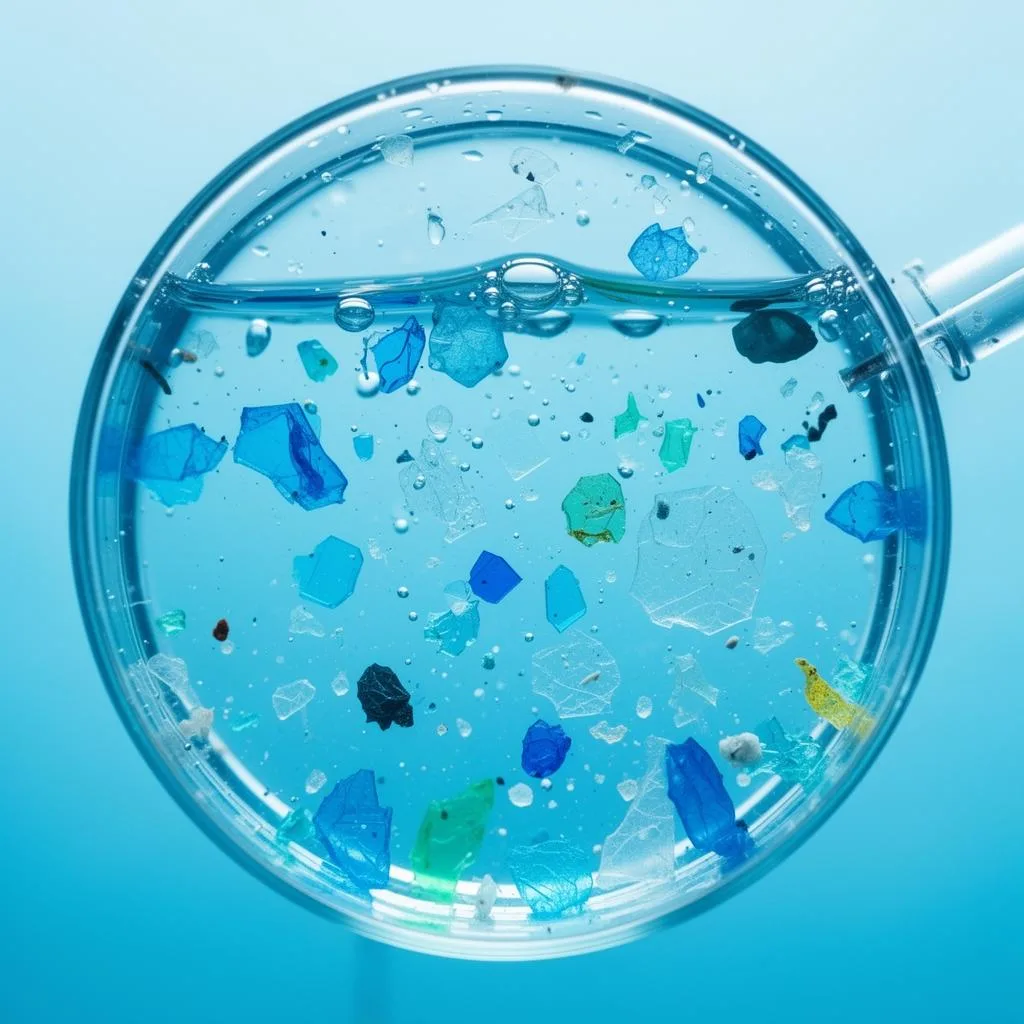
This gap has a direct consequence for claim language. A result reported as “no microplastics detected” means no particles were found above the method’s detection floor, for the polymers screened, in the lot tested. It does not mean no particles are present. A 2018 study led by Sherri Mason at the State University of New York at Fredonia, published in Frontiers in Chemistry, found microplastics in 93% of 259 bottled water samples across eleven brands, with polypropylene, the material used in bottle caps, as the most commonly identified polymer. A peer-reviewed 2018 study by Kosuth, Mason, and Wattenberg in PLOS ONE found anthropogenic particles in 81% of 159 tap water samples sourced across five continents. Detection can establish presence. It cannot establish absence.

The World Health Organization’s 2019 assessment, Microplastics in Drinking-Water, found low concern for health risk at current levels on the limited evidence available, while stressing that the conclusion rests on incomplete information and that more research is urgently needed. Detection of a particle is not the same as proof of harm, and content should not conflate the two.
For brands making any claim that touches microplastic content, the practical requirement is scope-locked language. That means a statement that identifies the tested particle-size range, the polymer panel screened, the analytical method, and the production period covered. A claim that implies the product contains no plastic in any form, at any size, is a claim the science cannot currently carry and one that carries significant legal exposure.
The Wellness Quality Institute (WQI) is an independent verification body that reviews companies’ existing third-party laboratory data on plastic and microplastic content against a defined standard. This review helps brands substantiate real progress toward plastic-free standards instead of making impossible zero-plastic claims.
WQI’s core program, Plastic-Free Pathway Verification (PFPV), is governed by the standard WQI-CS-01. The review examines laboratory qualification, analytical method, product matrix, sampling, tested particle-size range, target polymer panel, reporting limits, blank results, spike recoveries, replicates, chain of custody, data recency, and product scope. These are the same elements covered in the substantiation dossier checklist above. WQI does not perform laboratory testing. It reviews the dataset a company’s qualified independent laboratory has already produced.

Two outcomes are possible. Standard Met requires that the dataset satisfies all applicable technical and data-quality requirements and that no reportable target polymer particles are detected within the tested particle-size range and approved reporting limits. A non-detect result alone is not enough. The reporting limits themselves must meet WQI requirements. Standard Met unlocks a scope-locked license to use the approved mark “WQI Plastic-Free Pathway Verified,” a public registry listing, and approved claim language tied to the specific reviewed evidence. Standard Not Met is a private outcome. It carries no public claim, no logo rights, and no registry listing, and it is never described as a failed product. It may reflect insufficient data, an unsupported method, or incomplete scope rather than anything about the product itself, and the company may resubmit.
Every public verification claim must include or link to a registry ID. The registry entry records the verified party, product scope, matrix, production or sampling period, tested particle-size range, lower method limit, polymer panel, reporting limits, testing laboratory and its accreditation, verification and expiration dates, and current status. The claim becomes checkable rather than simply assertable.
Approved claim language is specific. The mark “WQI Plastic-Free Pathway Verified” may be used only for Standard Met products, within the registered scope, accompanied by access to the Verification Scope record. It may not imply plastic-free, microplastic-free, nanoplastic-free, zero plastic, state approval, government certification, or health or safety certification. The word “pathway” is never optional because it carries the meaning that separates a defensible claim from a prohibited one.
WQI’s review criteria align with state water board drinking-water microplastics reference frameworks, which are the most stringent public reference reasonably applicable to testing today. States did not create, approve, authorize, or endorse WQI or its standard. Alignment with state frameworks serves as a technical reference point, not a geographic boundary or a government endorsement. Verification is available to US companies nationally.
A single assessment fee covers review, verification decision, and registry listing, with no separate mark-license or registry fee. Independent laboratory testing is arranged and billed separately by a qualified independent laboratory. Payment of the assessment fee does not guarantee a verification decision.
WQI Plastic-Free Pathway Verification does not certify that a product contains zero plastic, microplastics or nanoplastics. It shows that the company is on a verified pathway toward plastic-free standards. Verification applies only to the reviewed products, submitted datasets, tested ranges, polymer panels, production or sampling periods, and supporting controls. WQI verification is not a state approval, government certification, or health or safety certification.
The reasonable basis standard, as applied by the FTC under the Green Guides, requires that a marketer hold competent and reliable scientific evidence before making any environmental claim, including any claim that touches recyclability, recycled content, compostability, biodegradability, or plastic content. Competent and reliable scientific evidence means tests, studies, or other objective data conducted and evaluated by qualified people using methods that experts in the relevant field would accept as accurate and reliable. The standard applies to both express claims, such as a stated percentage of recycled content, and implied claims, such as a recycling symbol used without qualification. A company cannot make the claim first and gather evidence later. The evidence must exist before the claim is published.
Recyclable and recycled-content claims are supported by established infrastructure, including defined ASTM standards, third-party certification programs, and documented chain-of-custody frameworks. Microplastic and plastic-reduction claims operate in a category where no equivalent gold standard exists. The analytical methods available today cannot detect every particle size or polymer type, and no laboratory can confirm the complete absence of plastic in a product. This reality means any claim that touches microplastic content must be scope-locked, explicitly bounded by the tested particle-size range, the polymer panel screened, the analytical method used, and the production period covered. An unqualified “microplastic-free” or “plastic-free” claim is not supportable under current science and carries significant legal exposure.
Three enforcement channels operate at the same time. The FTC can pursue unsubstantiated environmental claims as unfair or deceptive acts under Section 5 of the FTC Act, with civil penalties per violation. The National Advertising Division reviews claims against the same competent-and-reliable-evidence standard and can recommend discontinuation or modification. Class-action plaintiff attorneys are actively filing suits against brands whose plastic-related claims cannot be substantiated, with multiple putative class actions challenging single-product recyclability claims in 2026 alone. Retailer and procurement scrutiny adds a fourth channel. A claim that cannot survive a buyer’s diligence request creates supply-chain exposure before any litigation begins.
A laboratory report tells a company what a laboratory found. It does not, on its own, tell the market what that finding supports, whether the method was appropriate for the product matrix, whether reporting limits are adequate, whether contamination controls were run, or what claim the data can actually carry. Self-reported results are structurally discounted by buyers, retailers, and regulators because the company interpreting its own data has an obvious interest in the interpretation. Independent verification, meaning review by a third party with no commercial interest in the outcome and no role in the testing, converts a laboratory dataset into a reviewed finding with approved claim language attached. The independence is the product because it allows a claim to carry weight that self-reporting cannot achieve.
Every plastic-related environmental claim, including recyclable, recycled-content, compostable, biodegradable, or any claim that touches microplastic content, requires a reasonable basis of competent and reliable scientific evidence before it is made. The evidence thresholds are specific. Recyclable claims rely on a 60% consumer access threshold. Recycled-content claims rely on weight-based percentage calculations with chain-of-custody documentation. Compostable claims rely on ASTM D6400 or D6868 test results with facility qualification. Biodegradable claims rely on complete one-year breakdown evidence under customary disposal conditions. For microplastic and plastic-reduction claims, the requirement is scope-locked language that accurately reflects what the method can and cannot detect because no laboratory today can confirm the complete absence of plastic across every particle size and polymer type.
The Wellness Quality Institute exists to close the gap between real laboratory data and a claim a company can confidently stand behind. WQI’s Plastic-Free Pathway Verification independently reviews a company’s existing dataset against defined criteria aligned with state water board drinking-water microplastics reference frameworks and issues scope-locked, registry-linked claim language that reflects what the evidence supports and nothing more.
Get started with WQI Plastic-Free Pathway Verification today.
Certification

Avoid greenwashing lawsuits over plastic claims. The Wellness Quality Institute turns real data into defensible, FTC-compliant environmental claims.
Read article
Avoid greenwashing risks. The Wellness Quality Institute helps you substantiate recyclable, compostable & plastic-free claims. Get verified today.
Read article
The Wellness Quality Institute helps retailers choose labs, interpret results, and make honest microplastics claims. Start testing with confidence.
Read article