
How to Avoid Greenwashing Lawsuits on Plastic Claims
Avoid greenwashing lawsuits over plastic claims. The Wellness Quality Institute turns real data into defensible, FTC-compliant environmental claims.
Read articleThe Wellness Quality Institute turns microplastics lab data into credible, scrutiny-ready claims using ISO, ASTM & CA standards. Learn how.

Written by: Scott Steveson, Specialist
ISO 24187:2023 is a broad principles standard for microplastics analysis across water, sediment, and living organisms. It does not set one required test method or a regulatory limit. Instead, it lays out baseline expectations for sampling, contamination control, sample preparation, identification, quantification, quality assurance, and reporting that any credible workflow should cover.
The standard also defines a specific way to classify plastic particle sizes, recognizes vibrational micro-spectroscopy (infrared and Raman microscopy) as suitable tools for chemical identification, and calls for results to be reported mainly as particle counts and size classes, not just total plastic mass. Each product type still needs its own method validation. ISO 24187:2023 on its own does not make a dataset ready for verification.
The core measurement gap behind every microplastics claim is simple. Some regulatory definitions reach down to 1 nanometer, while the best validated commercial methods usually start at 20 or 50 micrometers, which are thousands of times larger. That gap reflects current technical limits, not a failure by individual laboratories.

Practical detection floors by method in water-based samples include:
The 1–20 µm size range is not validated under some methods, and anything below 1 µm, the nanoplastic range, still sits outside reliable commercial testing. A result that reads “none detected” means no particles were found above the method’s detection limit. It does not prove that the product contains no plastic at all. Any result that omits the detection limit or size cutoff cannot support a claim of absence or “low microplastic” content.
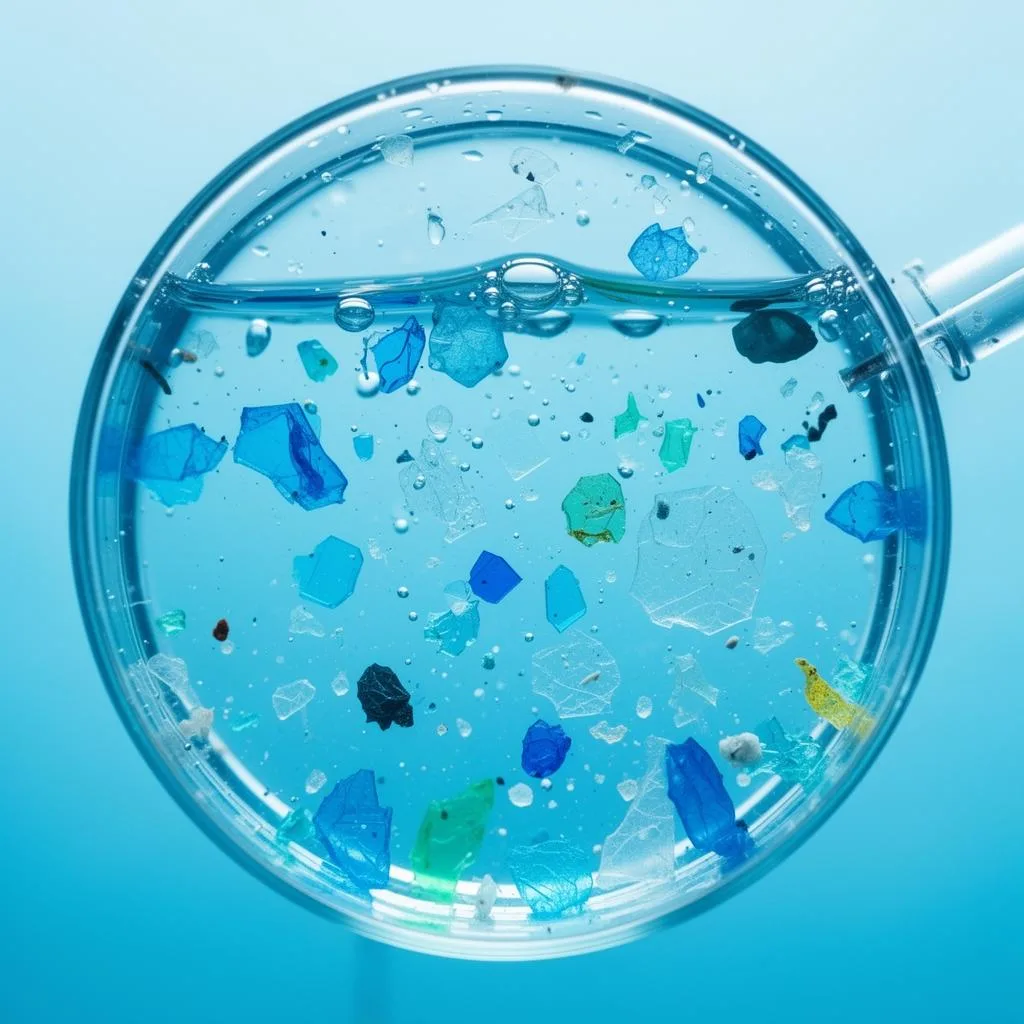
A laboratory report only becomes verification-ready when it includes enough detail to show what the result actually covers. Raw particle counts without context do not tell you what you can safely claim. A reported zero microplastics concentration is meaningless without the method’s limit of detection or quantification and the size cutoff clearly stated.

Every dataset submitted for independent review needs to report:
Blank correction, which means subtracting background contamination picked up during sampling and lab processing from the reported result, is mandatory for credible microplastics work. Result reporting must include both raw and blank-corrected data, the average and standard deviation of particles counted in blanks, and a clear statement on whether blank correction was applied.
Three blank types are needed to track contamination at each stage:
Publishing particle counts without blanks destroys measurement credibility. A 2024 PNAS study reported about 240,000 plastic particles per liter of bottled water. A later PNAS commentary argued that contaminated procedural blanks and weak quality control undermined that number. The critique focuses on the same blank-control rules that any verification-ready dataset must meet.
A non-detect result only has value when you know which plastic types the method actually checked. A dataset that tests for two polymers and finds none cannot support a claim about the eight most common plastics in consumer products.
The Wellness Quality Institute’s standard WQI-CS-01 sets a minimum target polymer panel of PE (polyethylene), PP (polypropylene), PET (polyethylene terephthalate), PS (polystyrene), PVC (polyvinyl chloride), PA (polyamide/nylon), PC (polycarbonate), and PMMA (acrylic), with PE, PS, PVC, and PET as anchor polymers. The dataset must also include reporting categories for other confirmed polymers and for particles that show no spectral match. Visual checks alone, such as counting particles by color or shape under a microscope, never suffice. Counted particles, or a statistically valid subsample, must be chemically confirmed by spectroscopy.
Once your polymer panel meets the Wellness Quality Institute’s minimum requirements, the next step is choosing a method that has been validated for your specific product type. The table below shows how common methods perform for drinking water compared with other simple liquids.
| Method | Validated Size Range | Drinking Water Suitability | Other Simple Liquids |
|---|---|---|---|
| SWB-MP1-rev1 (µFTIR) | >50 µm – 5,000 µm | Accepted, with accreditation preferred. Less affected by fluorescence in cloudy samples. | Method and matrix suitability must be reviewed. Equivalence is not automatic for non-water liquids. |
| SWB-MP2-rev1 (µRaman) | >20 µm – 5,000 µm | Accepted, with accreditation preferred. Offers better resolution for smaller particles. | Fluorescence can limit performance in colored or complex liquid products. |
| Pyrolysis-GC/MS (ASTM D8401) | Sub-micron mass quantification; no particle size data | Applies to drinking water and wastewater but does not provide particle counts or shapes. | Applies across many matrices. Mass-only output still needs a separate particle-count method for full reporting. |
| ISO 16094-2:2025 (vibrational spectroscopy) | Designed for clean water; size cutoff depends on the specific method | May serve as an analytical reference when method, matrix, and equivalence are reviewed and accepted. It is not automatically interchangeable with other procedures. | Not designed for samples with heavy solids. Any new matrix requires an equivalence review. |
| Standard | Type | Validated Range | WQI Status |
|---|---|---|---|
| SWB-MP1-rev1 | California standard operating procedure using infrared spectroscopy | >50 µm – 5,000 µm | Accepted method, with accreditation preferred |
| SWB-MP2-rev1 | California standard operating procedure using Raman spectroscopy | >20 µm – 5,000 µm | Accepted method, with accreditation preferred |
| ISO 24187:2023 | International principles standard | 1 µm – 5 mm as a principles range; actual range depends on the method | Used as a baseline. Method suitability and equivalence must still be shown. |
| ASTM D8401 | Pyrolysis-GC/MS test method | Sub-micron mass; no particle size output | Conditionally accepted after documented method-equivalence review. Mass-only output must be paired with particle data. |
The Wellness Quality Institute aligns its criteria with California’s drinking-water microplastics framework because it is the most stringent credible public reference available today. California did not create, approve, authorize, or endorse the Wellness Quality Institute or its standard. Verification is available to companies across the United States, not just those selling in California.
Every dataset the Wellness Quality Institute reviews under WQI-CS-01 is checked against the same core elements. If any of these pieces are missing, the dataset cannot support a verification decision, regardless of the particle counts.
No laboratory can prove that a product is completely free of plastic. The gap between what regulations define and what any validated method can measure is real, documented, and unlikely to close soon. The World Health Organization’s 2019 review of microplastics in drinking water found low concern based on limited evidence and called for more research, a position that still largely holds.
The legal and commercial context has shifted. Retailers now demand proof. Class-action lawsuits target plastic-related claims that lack support. A raw lab report sitting in a folder is not a defensible market claim. It is a number limited by a detection floor, a polymer panel, and a production window that many brands have never had independently reviewed.
The Wellness Quality Institute reviews that dataset against WQI-CS-01, a defined standard aligned with the California State Water Board’s drinking-water microplastics framework. The review produces one of two outcomes. A Standard Met result includes a verification decision, a scope-locked license to use the WQI mark, a public registry listing, and approved claim language. A Standard Not Met result remains private and can be resubmitted with updated information. One assessment fee covers review, verification, and registry listing. Independent lab testing is arranged and billed separately.
The claims that survive scrutiny rest on reviewed evidence, stay within their true scope, and are checked against a published standard by an independent party with no stake in the outcome.
ISO 24187:2023 is a principles standard. It explains what a credible microplastics analysis should cover, including contamination control, chemical identification, blank correction, and size-fraction reporting, but it does not lock in one method or regulatory limit. The California State Water Board’s SWB-MP1-rev1 and SWB-MP2-rev1 are detailed procedures with validated size ranges: infrared spectroscopy above 50 µm and Raman spectroscopy above 20 µm, both up to 5,000 µm. A dataset produced under the California procedures by an accredited lab meets the Wellness Quality Institute’s preferred laboratory criteria. A dataset produced under ISO 24187:2023 principles using a different method may still qualify, but the method must be shown to fit the specific product matrix and to be equivalent to the California framework. Following one standard does not automatically mean the other is satisfied.
“None detected” is a bounded statement, not a promise that no plastic is present. As explained earlier, the result is limited by the method’s detection floor, the tested size range, the plastic types on the panel, and the production lot sampled. A method that only measures particles above 50 µm cannot see anything smaller, while some definitions of microplastics reach down to the nanometer scale. Without independent review of the method, the polymer panel, and the blank controls, the result cannot safely support a market claim, because neither a retailer nor a court can see what the number truly covers. The Wellness Quality Institute’s review turns that bounded dataset into scope-locked claim language that spells out what was tested, at what size range, for which polymers, and over which production period, so the claim remains accurate within its stated limits.
ASTM D8401, published in 2024 by ASTM International, is a test method for identifying and measuring microplastics in water using pyrolysis-gas chromatography/mass spectrometry, often shortened to pyrolysis-GC/MS. It applies to treated drinking water, surface water, marine water, and wastewater, and can measure polymer mass from very small particles, including some in the nanoplastic range. The tradeoff is that pyrolysis-GC/MS burns the particles during analysis, so the output is polymer mass by type, not particle count, size, or shape. A dataset that relies only on ASTM D8401 cannot meet the Wellness Quality Institute’s requirement for particle counts by size fraction or for chemical confirmation of individual particles. It can still contribute to a verification dataset after documented method-equivalence review, especially when polymer mass is a key question, but it does not replace spectroscopic particle-count methods.
The Blank-Correction Requirements section earlier explains what blank correction is and describes field, procedural, and air blanks. For review by the Wellness Quality Institute, your dataset must include all three blank types, with both raw and blank-corrected particle counts reported. You must also provide the average and standard deviation of particles counted in blanks, a clear statement confirming that blank correction was applied, and spike recovery data. Without these elements, the Wellness Quality Institute cannot determine what the reported counts actually mean, and the outcome will be Standard Not Met.
Verification under WQI-CS-01 applies only to the specific product, model or SKU, product matrix, production or sampling period, tested particle-size range, polymer panel, analytical method, and supporting controls that were reviewed. A Standard Met outcome for one bottled-water SKU does not extend to other SKUs, formats, production periods, or the brand as a whole. This reflects real variation between production lots, where a clean result on one run does not guarantee the next. Every public claim must link to the registry ID for the specific verified product, and claim language that reaches beyond that registered scope is not allowed under WQI-CS-01. Companies that want to verify additional products or time periods submit each one for separate review.
Certification

Avoid greenwashing lawsuits over plastic claims. The Wellness Quality Institute turns real data into defensible, FTC-compliant environmental claims.
Read article
Avoid greenwashing risks. The Wellness Quality Institute helps you substantiate recyclable, compostable & plastic-free claims. Get verified today.
Read article
The Wellness Quality Institute helps retailers choose labs, interpret results, and make honest microplastics claims. Start testing with confidence.
Read article