
How to Avoid Greenwashing Lawsuits on Plastic Claims
Avoid greenwashing lawsuits over plastic claims. The Wellness Quality Institute turns real data into defensible, FTC-compliant environmental claims.
Read articleAvoid greenwashing penalties in 2026. The Wellness Quality Institute turns FTC Green Guides rules into defensible plastic and green claims. Start now.

Written by: Scott Steveson, Specialist
Plastic breaks into smaller pieces instead of disappearing. Global plastics production roughly doubled from 234 million tonnes in 2000 to about 460 million tonnes in 2019, according to the Global Plastics Outlook from the OECD, and is projected to rise another 70% by 2040 on current paths. Those particles enter drinking water. A peer-reviewed 2018 study by Kosuth, Mason, and Wattenberg in PLOS ONE found human-made particles in 81% of 159 tap water samples across five continents. A separate 2018 study led by Sherri Mason at the State University of New York at Fredonia, published in Frontiers in Chemistry, found microplastic contamination in 93% of 259 bottled water samples across eleven brands, roughly twice the particle concentration of tap water, with polypropylene from bottle caps as the most common plastic.

Growing awareness of these findings has increased retailer and regulatory pressure on brands that make plastic-reduction claims. TINA.org has tracked more than 150 greenwashing class-action lawsuits as of March 2025. Private lawsuits under state consumer-protection laws in all 50 states are often the main way greenwashing claims reach court, even when the FTC does not act directly. Plastic-specific phrases such as “plastic-free,” “microplastic-free,” and “no detectable microplastics” carry particular risk. The science of detection is still developing, and a claim that sounds precise may rely on a method that cannot see particles below a certain size.
The FTC looks at environmental claims through four practical lenses: evidence quality, claim scope, testing method, and real-world relevance. Weakness in any one area can turn an honest claim into a deceptive one under Section 5.
Evidence quality asks whether qualified people produced the data using methods that scientists in that field generally accept. Under FTC Green Guides § 260.2, a reasonable basis for an environmental claim often requires “competent and reliable scientific evidence.” That means tests, analyses, research, or studies conducted and evaluated objectively, with sufficiency judged by quality, quantity, and the full body of relevant evidence.
Claim scope asks whether the statement matches what was actually measured. A claim about one production lot cannot cover an entire product line. A claim about particles above 50 micrometers (µm), a unit equal to one millionth of a meter, cannot say anything about smaller particles. The FTC expects claims to specify whether they refer to the product, its packaging, a service, or only part of any of these, unless the context makes that unmistakably clear.
Testing method asks whether the lab technique fits the product “matrix,” meaning the type of material tested, such as bottled water versus a solid food. A method validated for one matrix may give unreliable results in another. Practical relevance asks whether the claim reflects real-world conditions instead of only theoretical possibilities. This standard has driven recyclability enforcement when products were technically recyclable but not accepted by facilities that actually serve the brand’s customers.
Several plastic-related terms appear often in marketing and have specific technical meanings that differ from everyday speech.
Microplastics are solid plastic particles smaller than 5 millimeters, including fragments, fibers, films, and beads. Nanoplastics are particles smaller than 1 micrometer, roughly one-thousandth of a millimeter, and current commercial lab methods cannot reliably measure them. Primary microplastics are manufactured small, such as microbeads in personal-care products. Secondary microplastics are pieces created when larger plastic items break down over time.
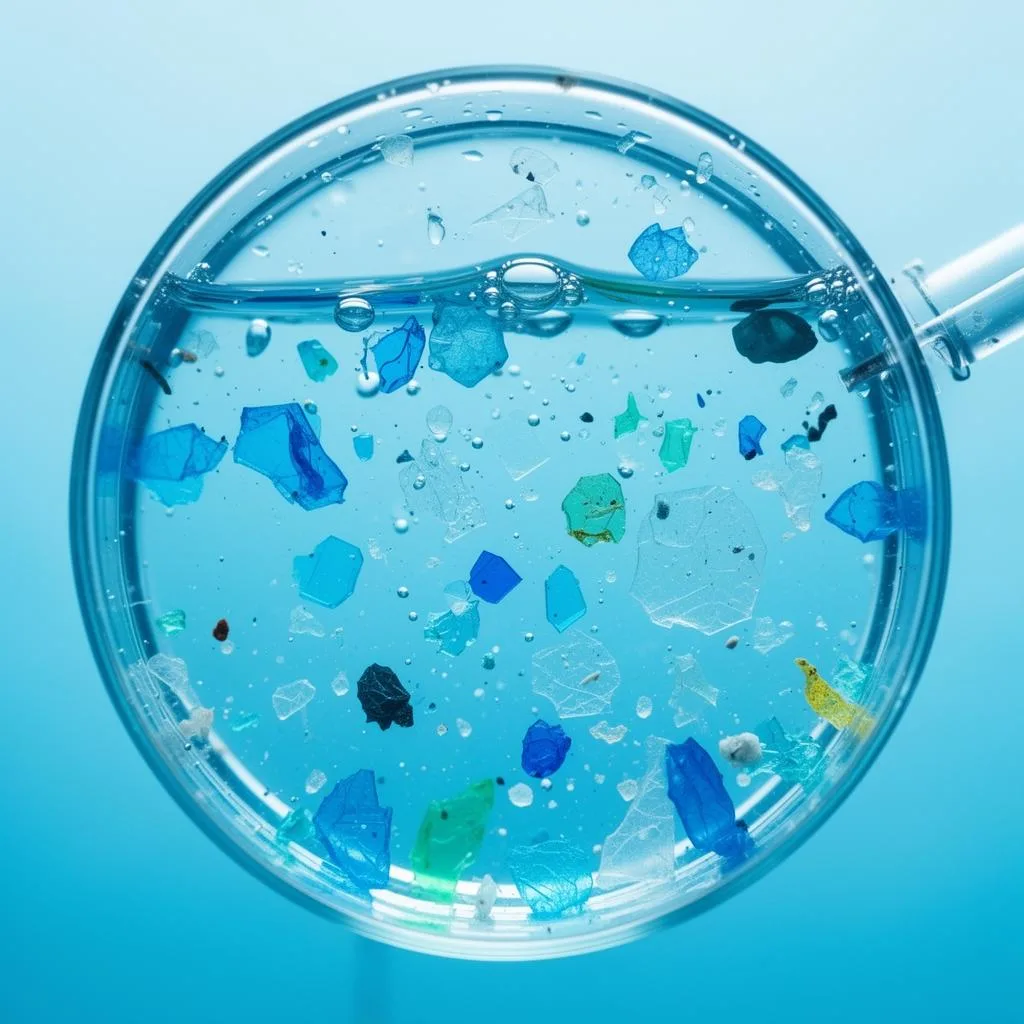
A detection floor, also called a reporting limit, is the smallest particle size a given instrument can reliably identify. A result of “none detected” means none were found above that floor, not that none exist. A polymer panel is the list of plastic types a test checks for. No single test covers every plastic type across every product format.
No U.S. federal gold standard exists for microplastics testing in consumer products. The most credible public reference is the California State Water Board’s drinking-water microplastics framework. It defines microplastics as solid plastic material with particles that have at least three dimensions greater than 1 nanometer and less than 5,000 micrometers. California has published two validated methods: SWB-MP1-rev1, which uses infrared spectroscopy for particles larger than 50 µm, and SWB-MP2-rev1, which uses Raman spectroscopy for particles larger than 20 µm. This framework serves as a technical benchmark that organizations may choose to follow. It is not a federal requirement, and California has not created a consumer-product plastic standard that applies nationwide.
Detection can prove presence. It cannot prove absence. Finding a particle takes one confirmed result. Proving that no plastic is present would require ruling out everything a method cannot see, including particles below the detection floor, plastics outside the tested panel, and production lots that were never sampled. These are fundamentally different types of claims, and the FTC’s substantiation standard treats them differently.
The gap between what regulations define and what any method can detect is large. California’s definition reaches down to 1 nanometer. The best validated methods start at 20 or 50 micrometers, which are thousands of times larger. The 1–20 µm range is not validated under either California method, and everything below 1 µm is beyond reliable commercial measurement today. A lab report that says “no microplastics detected” using an infrared method has a floor of 50 µm. That result says nothing about smaller particles.
Lot-to-lot variability adds another limit. A clean result on one production lot does not guarantee the next lot will match. Scope-locked claims that tie statements to the specific product, dataset, particle-size range, polymer panel, and production period are more defensible than broad claims about a product line or brand.
Assessing whether lab data can support a claim requires looking at several parts of the dataset, not just the headline “none detected” or particle count.
Laboratory qualification is the starting point. A lab’s accreditation should cover the specific method and the specific product matrix. California ELAP accreditation for the relevant SWB microplastics method is one strong benchmark. ISO/IEC 17025 accreditation that explicitly lists the method and matrix is another. Results from a lab whose accreditation does not cover the method or matrix carry less weight.
Blank controls and contamination controls are often missing from microplastics datasets. A blank is a sample that goes through the full procedure without the test material, used to spot contamination from the lab environment or equipment. A 2024 PNAS study that reported about 240,000 plastic particles per liter of bottled water was later critiqued in a PNAS commentary for contaminated blanks and weak quality control. That example shows why blank data must be reported and reviewed alongside any result.
Reporting limits must match the claim. A non-detect result matters only if the reporting limit is low enough to be meaningful. A “none detected” result at a 500 µm floor supports a much narrower claim than a “none detected” result at 20 µm.
Polymer panel completeness asks whether the test covered the plastics most likely to appear, based on packaging, processing, and supply chain. A panel that omits polypropylene, the most common polymer in the Mason bottled water study mentioned earlier and the material used in many bottle caps, leaves a real gap in any claim about plastic content.
Data recency and production period matter because manufacturing changes over time. A dataset from three years ago may not match current production. A claim based on outdated data is easier to challenge.
The FTC expects you to hold substantiation before you publish a claim, not after someone challenges it. Marketers should keep a claim file for each environmental statement. That file should include the exact wording, where it appears, supporting evidence, assumptions, geographic limits, product-versus-package distinctions, testing data, and any third-party reviews or audits.
Disclosures that qualify environmental claims must be clear, prominent, and written in plain language. They should sit close to the claim they qualify. A disclosure buried in fine print or separated from the main claim by unrelated content does not meet FTC expectations. Qualifying disclosures for environmental claims must remain clear, prominent, and aligned with FTC guidance to reduce class-action risk.
Scope specificity is mandatory. A claim must state whether it applies to the product, the packaging, a service, or part of any of these. A bottle claim that says “made with recycled content” without stating the percentage and whether that content is pre-consumer or post-consumer does not meet the specificity standard in 16 CFR § 260.13.
Independent review of existing lab data against defined criteria gives organizations a way to turn raw results into defensible, regulator-ready language. Self-reported results carry less weight because everyone understands that a company grading its own homework has a stake in the outcome.
The categories below group the key questions a brand should answer before publishing any plastic-related environmental claim.
Technical:
Operational:
Regulatory:
Reputational:
Treating “none detected” as “none present.” A non-detect result is limited by the method’s detection floor. A statement such as “no microplastics detected” using an infrared method that starts at 50 µm says nothing about smaller particles. Claim language must state that boundary clearly.
Extending one product’s result to a product line or brand. One dataset covers one product, one production period, and one tested scope. Extending that result to other SKUs, other production runs, or the company as a whole turns credible data into a greenwashing claim. This pattern is the most common way rigorous testing becomes a legal problem.
Using broad, unqualified language. Terms such as “eco-friendly,” “clean,” “natural,” and “sustainable” are viewed skeptically by the FTC because they can suggest that a product has no negative environmental impact, which is rarely supportable. The same logic applies to plastic-specific language. “Plastic-free” suggests an absolute state that current science cannot confirm.
Misunderstanding what a “free-of” claim requires. Under FTC Green Guides § 260.9, a technically truthful “free-of” claim can still be deceptive if the product contains substances with the same or similar environmental risks as the absent substance, or if the substance has not been associated with that product category. A “free-of” claim for a trace contaminant is allowed only if the level is no more than an acknowledged background level, the presence does not cause material harm, and the substance was not intentionally added.
Relying on technical recyclability instead of real-world recyclability. The Keurig Dr Pepper K-Cup cases filed in 2026 show this clearly. Plaintiffs allege that pods labeled “recyclable” do not meet consumer expectations because most municipal systems do not accept them due to size, materials, and contamination. Technical recyclability and real-world recyclability are different claims, and the FTC focuses on real-world conditions.
The FTC organizes its review of environmental claims along a spectrum that runs from vague general benefit statements to specific, qualified attribute claims. The table below maps this spectrum to real-world plastic claims. It shows how each type of statement fares under FTC scrutiny and what concrete changes can turn weak or non-compliant language into something defensible. Notice the pattern of progressive narrowing: the more specific and method-bound the claim, the more likely it is to withstand review.
| Claim Type | Example Language | FTC Compliance Status | What Would Make It Defensible |
|---|---|---|---|
| Vague general benefit | “Eco-friendly packaging” | Likely non-compliant, broad unqualified claims are difficult to substantiate | Specify the attribute: which environmental benefit, for which component, measured how |
| Absolute plastic absence | “Plastic-free” / “Microplastic-free” / “Zero plastic” | Non-compliant, no current method can confirm complete absence across all particle sizes, plastic types, and production lots | Not currently achievable, replace with scope-locked, method-bounded language |
| Unqualified recyclable | “Recyclable” with no qualification | Under 16 CFR § 260.12(b)(1), a product may be labeled “recyclable” only if recycling facilities are available to a substantial majority of consumers where the product is sold, interpreted by the FTC as at least 60% | Verify facility access data, add a qualification if access is below 60% |
| Qualified recyclable | “Recyclable in communities with appropriate facilities” | Compliant when access is limited, 16 CFR § 260.12(b)(2) | Keep the qualification prominent and close to the claim |
| Recycled content, unqualified | “Made from recycled materials” | Compliant only if the product is made from recycled material, 16 CFR § 260.13 | State the percentage and whether content is pre-consumer or post-consumer |
| Recycled content, qualified | “Made with 30% post-consumer recycled content” | Compliant when supported by evidence, 16 CFR § 260.13(b),(c) | Maintain documentation that separates pre-consumer and post-consumer sources |
| Scope-locked plastic reduction | “No reportable target polymers detected within the tested particle-size range [20–5,000 µm] using Raman spectroscopy, for [Product X], [production period]” | Compliant when backed by a reviewed dataset that meets applicable evidence standards | Obtain independent review of the dataset, method, blanks, and controls against defined criteria |
| Verified progress claim | “Dataset reviewed and accepted under WQI’s Plastic-Free Pathway Verification standard” (Standard Met products only) | Compliant, scope-locked, method-bounded, independently reviewed, and linked to a public registry | Pair with access to the Verification Scope record and the required qualifying statement |
The evaluation framework in this guide rests on four distinctions that brands should internalize before publishing any plastic-related claim. Detection is not absence. Scope-locked findings are not brand-wide claims. Technical recyclability is not real-world recyclability. A lab report is not a defensible market claim without independent review of the method, controls, and scope behind it.
For deeper reading on the regulatory framework, the FTC’s guidance at 16 CFR Part 260 remains the primary reference. The WHO’s 2019 report, Microplastics in Drinking-Water, offers a clear summary of current health evidence. The California State Water Board’s SWB-MP1-rev1 and SWB-MP2-rev1 procedures represent the most stringent validated analytical methods that are publicly available and provide one example of a technical benchmark organizations may choose to adopt.
Many brands already hold lab data that could support a defensible claim once that data is reviewed against defined criteria by an independent party with no stake in the outcome. The Wellness Quality Institute (WQI), formally introduced here, is an independent verification body that reviews companies’ existing third-party lab data on plastic and microplastic content against a defined standard, WQI-CS-01. That standard aligns with the California State Water Board’s drinking-water microplastics framework. WQI does not run lab tests. It reviews the data, method, product scope, and controls that a company already has and issues either a Standard Met or Standard Not Met outcome. A Standard Met outcome includes a scope-locked license to use the WQI mark, a public registry listing, and approved claim language. A Standard Not Met outcome remains private and can be resubmitted with updated information.
Certification

Avoid greenwashing lawsuits over plastic claims. The Wellness Quality Institute turns real data into defensible, FTC-compliant environmental claims.
Read article
Avoid greenwashing risks. The Wellness Quality Institute helps you substantiate recyclable, compostable & plastic-free claims. Get verified today.
Read article
The Wellness Quality Institute helps retailers choose labs, interpret results, and make honest microplastics claims. Start testing with confidence.
Read article