
Home Water Testing: City, Well Water & Microplastics
Learn how to test city or well water, read results, and spot microplastics. The Wellness Quality Institute helps brands verify plastic-related claims.
Read articleLearn how California's microplastics drinking water rules work. The Wellness Quality Institute turns lab data into defensible claims for your brand.

Written by: Scott Steveson, Specialist, Wellness Quality Institute | Last updated: August 27, 2026
No federal maximum contaminant level for microplastics in drinking water exists today. The EPA’s proposed Unregulated Contaminant Monitoring Rule 6 (UCMR 6), released in July 2026, omits microplastics entirely because there are no validated federal testing methods. That gap leaves California’s framework as the primary public reference model for microplastics analysis in U.S. drinking water.
California’s obligation comes from Senate Bill 1422, enacted in 2018. The law directed the State Water Resources Control Board to create a statewide microplastics monitoring program. The approved program runs as a two-phase, four-year plan that requires certain large wholesale public water systems to monitor microplastics in drinking water.
California defines microplastics in drinking water as solid polymeric material, meaning plastic particles, with at least three dimensions greater than 1 nanometer and less than 5,000 micrometers, or about 5 millimeters. That definition covers a wider size range than current analytical methods can reliably measure. The laboratory section below explains how current methods handle this gap.

For organizations outside California’s regulated scope, including national beverage brands, bottled water companies, and other private-sector businesses, this framework acts as a voluntary technical reference rather than a legal requirement. The later section on private-sector verification explains how companies can use that reference in practice.
The five-step sequence below mirrors California’s monitoring program and gives regulated wholesale systems a practical roadmap. Private-sector organizations can also use this sequence as a model when they choose to follow the same technical structure voluntarily.
For regulated California systems, laboratory qualification depends on specific method and matrix approvals, not on general reputation or broad accreditation. The State Water Board lists SWB-MP1-rev1 and SWB-MP2-rev1 as the approved methods. Laboratories must hold ELAP accreditation for the exact method and matrix to generate results that count for regulatory reporting.
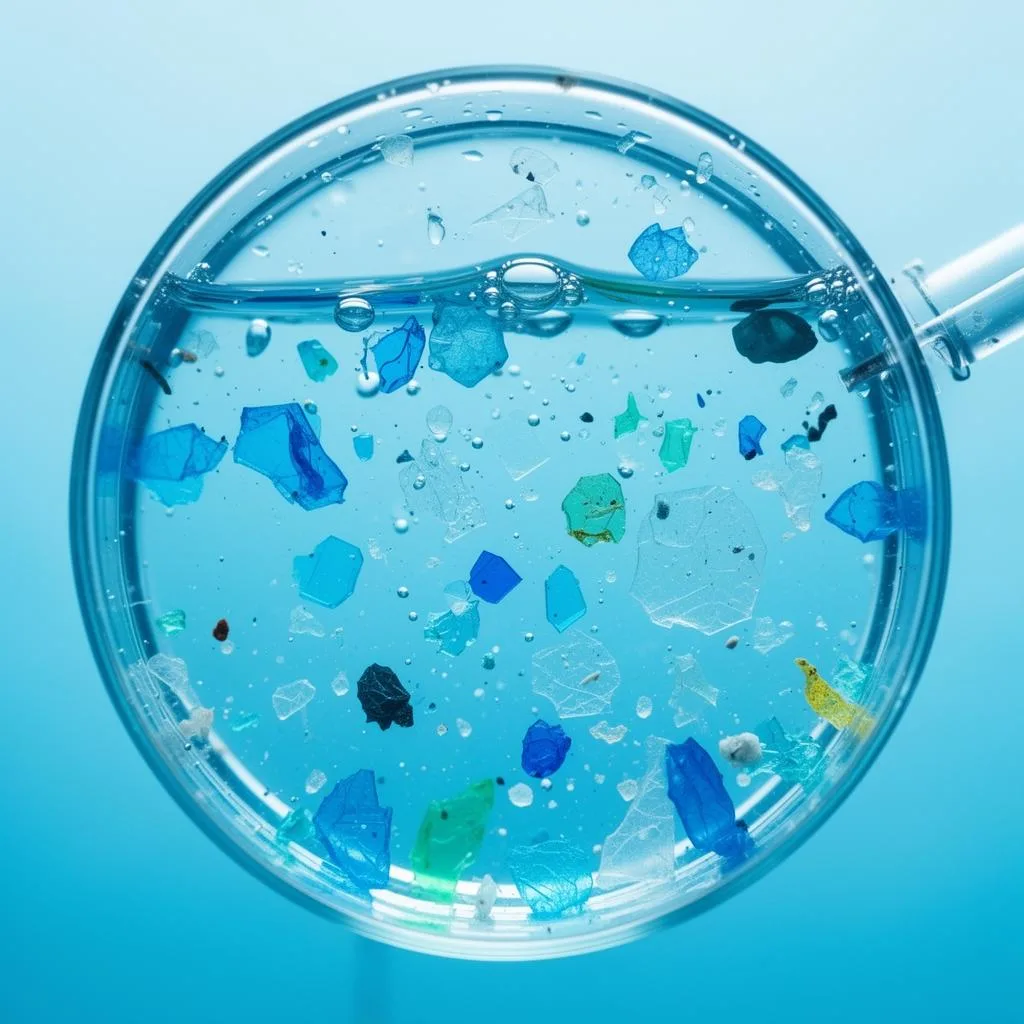
ELAP, the California Environmental Laboratory Accreditation Program run by the State Water Board’s Division of Drinking Water, accredits labs for specific combinations of matrix, analyte, and method. The matrix is what you test, such as treated drinking water. The analyte is what you measure, such as microplastic particles. The method is how you measure it. General ISO/IEC 17025 accreditation or accreditation from another state does not automatically qualify a lab for California regulatory work because reciprocity is limited.

The Wellness Quality Institute uses a three-tier lab qualification model that aligns with this structure:
Compliance officers should always check a lab’s current ELAP certificate against the State Water Board’s public registry. Certificates expire and depend on periodic on-site assessments, so a vendor-supplied PDF is not enough. The Moore Institute for Plastic Pollution Research is one example of a lab with ELAP accreditation for microplastics analysis in drinking water using FTIR, or Fourier-transform infrared spectroscopy, from 50 µm to 5 mm.
A Sampling and Analysis Plan, often called an SAP, is the written playbook for how you collect, handle, test, and report samples. For Phase Two monitoring, the SAP should cover at least the elements below.
California’s monitoring program requires regulated systems to submit results through the State Water Board’s reporting portal and to share results with the public. Disclosure language should match what the data actually shows. That means naming the method used, the detection range, and the polymer types analyzed, without stretching the findings.
A result that states “no particles detected” always sits within the method’s detection floor and the specific polymer panel tested. It does not claim that no plastic exists in the water. The State Water Resources Control Board has acknowledged that the full regulatory method is still evolving. Compliance officers should watch for updates to submission formats and disclosure templates as Phase Two continues.
The compliance rules above apply only to regulated California wholesale water systems that meet the program thresholds. Private-sector companies, including bottled water brands, functional beverage makers, supplement companies, and other consumer product brands, do not fall under California’s monitoring mandate, no matter where they operate in the United States.
This boundary is critical and needs to stay clear. A private company can follow California’s technical framework, but it cannot present that choice as regulatory compliance, California approval, or government certification. California did not create, approve, authorize, or endorse the Wellness Quality Institute or its standard.
For private organizations, California’s framework offers a credible public technical reference. It defines particle-size ranges, validated methods, a documented polymer panel, and lab qualification criteria. A company can compare its existing third-party lab data against these elements through an independent review.
Plastic-Free Pathway Verification from the Wellness Quality Institute, which follows the WQI-CS-01 standard, exists for this exact use case. The Wellness Quality Institute acts as an independent verification body. It does not run laboratory tests and does not benefit from any particular outcome. A company submits its independent lab dataset, method documentation, product scope, and supporting controls. WQI then reviews that material against criteria aligned with the California framework, including lab tier, method suitability for the product, tested particle-size range, polymer coverage, reporting limits, blank and contamination controls, chain of custody, data age, and product scope.
The review leads to one of two results. A Standard Met outcome includes a verification decision, a tightly defined license to use the WQI mark, a public registry listing, and approved claim language. A Standard Not Met outcome remains private and can be revisited with updated information. Verification applies only to the reviewed product, dataset, tested size range, polymer panel, and production period. A company cannot stretch one dataset into a company-wide or product-line claim.
The OECD’s Global Plastics Outlook projects a further 70% rise in global plastics production by 2040 if current trends continue. At the same time, the World Health Organization’s 2019 review of microplastics in drinking water found no clear health risk at current levels, while stressing that evidence remains limited and more research is urgent. Consumer and retailer scrutiny of plastic-related claims is growing faster than formal standards. Independent review of lab data against a published, California-aligned standard turns a technical lab report into a market claim that can stand up to questions.
California’s microplastics monitoring program uses a two-phase, four-year plan approved in 2022 for certain large wholesale public water systems. The State Water Resources Control Board’s guidance explains the specific timing, scope, and requirements for each phase.
California’s regulatory definition of microplastics, which covers solid polymeric material from 1 nanometer to 5,000 micrometers, aims to be scientifically complete. It covers the full range of particles that might exist in water. Validated analytical methods, however, are limited by what instruments can reliably detect and confirm today.
SWB-MP2-rev1, which uses Raman spectroscopy, starts at 20 micrometers. SWB-MP1-rev1, which uses infrared spectroscopy, starts at 50 micrometers. The range from 1 nanometer to 20 micrometers, including all nanoplastics, is not yet within reliable commercial measurement. This gap reflects the current state of analytical science rather than a regulatory mistake. No lab can confirm the complete absence of plastic across every particle size, so the Wellness Quality Institute verifies a defined scope instead of an absolute “plastic-free” state.
A private brand can choose to follow California’s technical framework, including particle-size ranges, validated methods, polymer panel, and lab criteria, when it commissions and evaluates lab testing. The brand cannot describe that choice as regulatory compliance, California approval, or government certification, because California’s monitoring rules apply only to regulated wholesale water systems.
For private companies, Plastic-Free Pathway Verification from the Wellness Quality Institute offers a structured, independent review of third-party lab data against California-aligned criteria. The process includes approved claim language that stays within what the evidence supports. Verification is available to U.S. companies nationwide, not just those based in California.
Scope lock means a verification decision covers only the specific product, model or SKU, product matrix, production or sampling period, tested size range, polymer panel, analytical method, and supporting controls that WQI reviewed. A Standard Met result for one product does not extend to an entire product line, the full company, or a different production period.
This limit exists because results can vary from lot to lot, and a clean result from one run does not guarantee the next. Stretching a single dataset into a broad claim is how credible data can turn into greenwashing. Every public verification claim must include or link to the registry ID so any buyer, retailer, or journalist can check the exact scope.
The verification period lasts 24 months from the sampling date of the most recent accepted dataset. Continued use of the WQI mark and approved claim language after that date requires a new review using current data.
Expired registry entries remain visible and carry an “Expired” label rather than disappearing. This approach reflects the fact that verification describes a specific dataset from a specific production period, not a permanent product trait. Re-verification against current production keeps the claim accurate when a customer or procurement team checks it.
California’s microplastics monitoring framework, built on two validated methods, a defined polymer panel, tiered lab qualification, and a structured sampling and disclosure process, now anchors drinking water plastic analysis in the United States. Regulated wholesale systems can use the five-step sequence above as a practical guide for compliance. Private-sector brands can treat the same technical foundation as a voluntary reference, while Plastic-Free Pathway Verification from the Wellness Quality Institute provides the independent, tightly scoped review that turns lab data into a claim that can withstand scrutiny.
One Wellness Quality Institute assessment fee covers the review, verification decision, and public registry listing. There is no separate fee for mark licensing or registry access. Independent lab testing is arranged and billed directly by a qualified lab, and paying the assessment fee does not guarantee a positive verification decision.
WQI Plastic-Free Pathway Verification does not certify that a product contains zero plastic, microplastics, or nanoplastics. It shows that the company is on a verified pathway toward plastic-free standards. Verification applies only to the reviewed products, submitted datasets, tested ranges, polymer panels, production or sampling periods, and supporting controls. WQI verification is not a California approval, government certification, or health or safety certification.
Water Quality

Learn how to test city or well water, read results, and spot microplastics. The Wellness Quality Institute helps brands verify plastic-related claims.
Read article
The Wellness Quality Institute explains California's microplastics rules—MCLs, notification levels & basin plans—to keep your claims defensible.
Read article
The Wellness Quality Institute helps brands verify water quality claims with independent testing. Build consumer trust with solid evidence. Start now.
Read article