
How to Avoid Greenwashing Lawsuits on Plastic Claims
Avoid greenwashing lawsuits over plastic claims. The Wellness Quality Institute turns real data into defensible, FTC-compliant environmental claims.
Read articleTurn microplastics lab data into defensible claims. The Wellness Quality Institute reviews reports so your brand stays credible and compliant.
Written by: Scott Steveson, Specialist
No federal microplastic standard for consumer products exists in the United States. The U.S. Environmental Protection Agency’s April 2026 draft Sixth Contaminant Candidate List (CCL 6) places microplastics on the federal regulatory radar for the first time, but that designation is a research and evaluation step, not a current compliance obligation for products or water systems. Separately, EPA excluded microplastics from its proposed Sixth Unregulated Contaminant Monitoring Rule (UCMR 6) because there is still no consensus drinking-water analytical method with adequate quality control.
Into that gap, California has built the most stringent credible public technical reference available. Under California Senate Bill 1422, the State Water Resources Control Board (SWB) adopted a formal definition of microplastics in June 2020 and released standardized measurement methods in December 2021. California’s framework is not a consumer-product prohibition and does not establish numeric limits. It is a monitoring and reporting structure for large public water systems. Its value for brands lies in the fact that it represents the most rigorous public technical reference point available anywhere in the U.S., which is why The Wellness Quality Institute aligns its review criteria to it. California did not create, approve, authorize, or endorse The Wellness Quality Institute or its standard.

To apply that framework, brands need to understand what California actually defines as a microplastic. The SWB defines microplastics in drinking water as solid polymeric material with particles having at least three dimensions greater than 1 nanometer and less than 5,000 micrometers. This definition covers a very wide range of particle sizes and types, and it is broader than any current analytical method can reliably measure. That measurement gap is not a side detail. It is the central fact every brand making a plastic-related claim needs to understand.
California’s regulatory activity expanded further in 2026. The state’s Department of Toxic Substances Control (DTSC) finalized a rulemaking adding microplastics to its Safer Consumer Products Candidate Chemicals List on June 18, 2026, effective October 1, 2026. That listing alone imposes no immediate product restrictions or reporting obligations. Regulatory requirements can only arise if DTSC later identifies and lists a specific Priority Product through a separate rulemaking process. However, the listing increases the compliance significance of product-level microplastics data and, as legal analysts have noted, may trigger disclosure obligations for cookware manufacturers under AB 1200 as early as October 2026.
The SWB has published two standard operating procedures (SOPs) for measuring microplastics in drinking water. Each uses a different analytical technique, which is a specific way of identifying chemicals, and each covers a different validated size range. Understanding both methods helps brands judge whether any laboratory dataset can support a market claim. The table below compares the validated particle-size ranges and practical detection limits of both methods. The key takeaway is that neither method reliably measures particles below 20 micrometers, which leaves a critical detection gap.
| Method | Validated Particle-Size Range | Notes |
|---|---|---|
| SWB-MP1-rev1, infrared spectroscopy (µFTIR) | >50 µm through 5,000 µm | Accepted under WQI-CS-01, less susceptible to fluorescence interference in cloudy or colored samples, practical lower detection limit about 10–50 µm depending on instrument configuration |
| SWB-MP2-rev1, Raman spectroscopy (µRaman) | >20 µm through 5,000 µm | Accepted under WQI-CS-01, better spatial resolution for smaller particles in clean water, can extend detection to about 1 µm in research settings, but the validated range under the SWB SOP begins at 20 µm |
The California definition reaches down to 1 nanometer. The best validated methods begin at 20 or 50 micrometers, which are thousands of times larger. The 1–20 µm fraction is not validated under either method, and everything below that range is currently beyond reliable commercial measurement. A spokesman for the State Water Resources Control Board acknowledged in 2026 that the state’s protocol is not yet “a fully validated, end-to-end regulatory method.” That candor matters because it shows that even the reference framework’s own authors recognize the measurement gap.
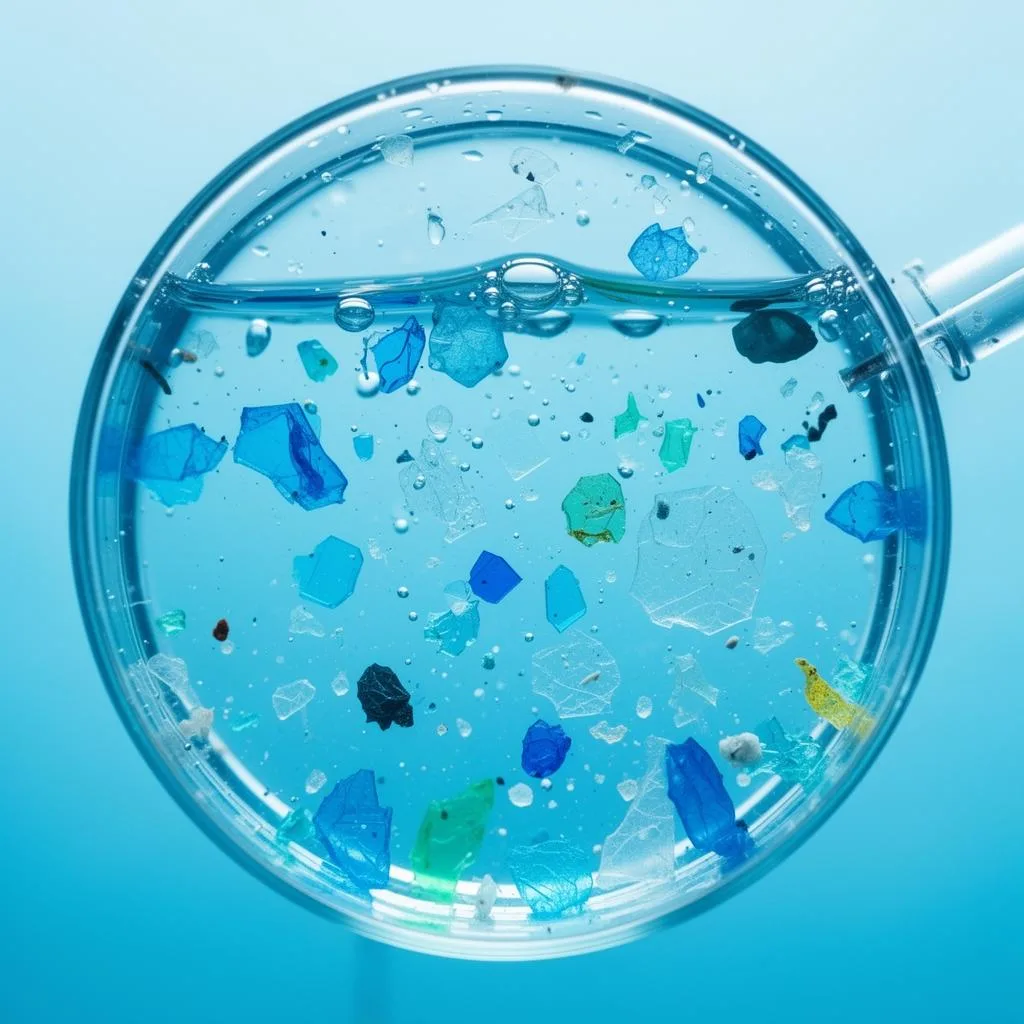
The EPA notes that the wide range of microplastic particle sizes, densities, and compositions means no single method can characterize all micro- and nanoplastic particles. That reality reinforces the point that a dataset’s value is always limited by the method that produced it.
No laboratory can prove a product is free of plastic. That statement reflects three hard technical limits that apply regardless of how rigorous the testing is.
Many studies did not consistently implement blank controls and spike-recovery experiments. These quality-assurance steps show whether a “none detected” result reflects the product or the method’s limitations. The same logic applies to commercial laboratory reports. The result is only as meaningful as the controls behind it.
This is the environment in which The Wellness Quality Institute’s Plastic-Free Pathway Verification, governed by the standard WQI-CS-01, operates. WQI Plastic-Free Pathway Verification is a verification pathway that reviews a company’s existing third-party laboratory dataset against criteria aligned with the California State Water Board’s drinking-water microplastics reference framework. It issues a binary Standard Met or Standard Not Met decision and, when the standard is met, provides scope-locked approved claim language and a public registry entry. The Wellness Quality Institute does not perform laboratory testing and does not certify products as plastic-free. Verification applies only to the reviewed product, dataset, tested particle-size range, polymer panel, and production period. A company may not extend a single dataset to a company-wide or product-line claim.

The minimum polymer panel reviewed under WQI-CS-01 covers PE, PP, PET, polystyrene (PS), polyvinyl chloride (PVC), polyamide (PA), polycarbonate (PC), and polymethyl methacrylate (PMMA). The panel also includes required reporting categories for other confirmed polymers and for unidentified particles with no spectral match. A single assessment fee covers review, verification decision, and registry listing, with no separate mark-license or registry fee. Independent laboratory testing is arranged and billed separately by a qualified independent laboratory.
The legal and reputational stakes for brands making plastic-related claims continue to rise. FTC Green Guides § 260.9 require that free-of claims be clearly and prominently qualified to avoid deception, and that they rest on competent and reliable scientific evidence evaluated by qualified persons using methods generally accepted in the relevant scientific fields. State attorneys general and regulators have applied consumer-protection theories to plastics-related claims, including sending Civil Investigation Demands and pursuing litigation. A raw laboratory report, published without independent review, does not meet that standard on its own.
“No microplastics detected” means no particles were found above that instrument’s detection floor, for the polymer types it screened, in the sample lot it tested. It does not mean no microplastics are present.
Every laboratory result is bounded by four technical realities that most brand teams and many legal reviewers do not fully account for.
Gregory S. Berlin, Partner at Alston & Bird, summarized the practical implication. Companies should be able to explain what their methods can and cannot detect and should avoid overstating conclusions from tests that do not capture the full range of potentially relevant particles. Independent review of the method behind a result matters as much as the result itself.
Before treating a laboratory report as the basis for a market claim, brand teams and compliance officers can evaluate the dataset against four categories of criteria.
Technical
Operational
Regulatory alignment
Reputational and claim defensibility
Common mistakes that convert genuine data into greenwashing exposure include extending a single-product result to an entire product line, treating “none detected” as equivalent to absence, and implying that a laboratory result constitutes California approval or a government-backed finding.
No. Current laboratory technology cannot confirm the complete absence of plastic across every particle size, polymer type, and production lot. WQI Plastic-Free Pathway Verification confirms that a company’s existing third-party laboratory dataset was independently reviewed against defined criteria aligned with the California State Water Board’s drinking-water microplastics reference framework, and that the dataset met those criteria within the tested particle-size range, polymer panel, and production period. It is a statement about reviewed evidence, not a guarantee of a plastic-free product. The program name includes the word “Pathway” deliberately because it describes progress toward plastic-free standards, not arrival at a state that no laboratory can currently confirm.
A laboratory report and a defensible market claim are not the same thing. A report tells you what a laboratory found. It does not, on its own, tell the market what that finding supports or reassure a skeptical retailer, legal team, or regulator that the interpretation is independent. Self-reported results are often discounted as marketing, regardless of how rigorous the underlying testing was. The Wellness Quality Institute’s review assesses whether the method suited the product matrix, whether reporting limits are adequate, whether blanks and contamination controls were run, and what claim the data can actually carry. Many companies discover their existing data supports a narrower or a stronger claim than they assumed.
A Standard Not Met outcome is private. It carries no public claim, no logo rights, and no registry listing, and it is never described as a failed product. A Standard Not Met result often reflects insufficient data, an unsupported method, or incomplete scope rather than anything about the product itself. The company may submit corrected or additional information for future review. Participating in WQI Plastic-Free Pathway Verification creates no public downside risk, which is by design.
No. As noted earlier, California has not created a consumer-product plastic standard and does not endorse The Wellness Quality Institute. WQI aligns its review criteria with California’s drinking-water microplastics reference framework because it represents the most stringent credible public reference available. A verification is not a California approval, a government certification, or a health or safety certification. WQI verification is available to qualifying U.S. companies nationally, not only those operating in California.
A company whose dataset receives a Standard Met outcome may state that its dataset was reviewed and accepted under WQI’s Plastic-Free Pathway Verification standard. It may use the approved mark “WQI Plastic-Free Pathway Verified” for the specific products that met the standard and may use approved result language tied to its Verification Scope record. Every public claim links to a public registry ID that any buyer, retailer, or journalist can check. The company may not say “plastic-free,” “microplastic-free,” “zero plastic,” or “certified,” and may not extend a single product’s result to a product line or the company as a whole. WQI provides a press kit with approved headlines, quote templates, and badge language so the compliant version is the straightforward version.
The measurement gap described earlier, between California’s broad definition and what validated methods can actually detect, is not a temporary inconvenience. It is a hard technical limit that defines what any laboratory result can honestly claim. The World Health Organization’s 2019 assessment of microplastics in drinking water remains a clear statement of where the evidence stands. It finds low concern on limited evidence and calls for more research. The OECD’s Global Plastics Outlook projects global plastics production to rise a further 70% by 2040 on current trajectories, which means the measurement problem will only grow more commercially significant.
For U.S. brands holding laboratory data they cannot yet convert into defensible claims, independent third-party review against published criteria provides a practical bridge. WQI Plastic-Free Pathway Verification reviews existing datasets against criteria aligned with the California State Water Board’s drinking-water microplastics reference framework, issues a binary Standard Met or Standard Not Met decision, and, where the standard is met, provides scope-locked approved claim language and a public registry entry that any stakeholder can verify. The claim becomes checkable rather than merely assertable.
WQI Plastic-Free Pathway Verification does not certify that a product contains zero plastic, microplastics, or nanoplastics. It shows that the company is on a verified pathway toward plastic-free standards. Verification applies only to the reviewed products, submitted datasets, tested ranges, polymer panels, production or sampling periods, and supporting controls. WQI verification is not a California approval, government certification, or health or safety certification.
Certification

Avoid greenwashing lawsuits over plastic claims. The Wellness Quality Institute turns real data into defensible, FTC-compliant environmental claims.
Read article
Avoid greenwashing risks. The Wellness Quality Institute helps you substantiate recyclable, compostable & plastic-free claims. Get verified today.
Read article
The Wellness Quality Institute helps retailers choose labs, interpret results, and make honest microplastics claims. Start testing with confidence.
Read article