
How to Avoid Greenwashing Lawsuits on Plastic Claims
Avoid greenwashing lawsuits over plastic claims. The Wellness Quality Institute turns real data into defensible, FTC-compliant environmental claims.
Read articleMicroplastics are accumulating in human brain tissue. The Wellness Quality Institute breaks down what science confirms—and where the gaps remain.

Written by: Scott Steveson, Specialist
Peer-reviewed studies confirm microplastics are present in human brain tissue, but no study has shown that these particles cause disease or functional harm.
Current analytical methods have strict detection floors (20–50 micrometers) and limited polymer panels, so “none detected” never proves total absence of plastic.
Evidence for hormone-disrupting plastic additives is far more developed than evidence for the physical microplastic particles themselves, and claims should not mix the two.
Defensible market claims use scope-limited language tied to a specific particle-size range, polymer panel, production period, and independent review of the data.
The Wellness Quality Institute offers Plastic-Free Pathway Verification that independently reviews laboratory datasets and produces scope-locked, defensible claims learn more.
This article walks through four topics in sequence. It first explains what recent studies on microplastics in human brain tissue actually report. It then outlines the testing limits that restrict what those studies can prove. Next, it offers a simple way for consumers and brands to evaluate any claim built on this evidence. Finally, it describes the infrastructure that converts real laboratory data into a defensible, scope-limited market claim.
The evaluation lens throughout is four-part. It looks at evidence quality, including peer review, sample size, and controls. It clarifies claim scope, meaning what a finding covers and what it leaves out. It reviews testing methodology, including detection floor, polymer panel, and blank controls. It also considers practical relevance, asking whether findings at experimental doses match everyday exposure.
Two distinctions guide the entire discussion. Detection is not causation, so finding a particle in tissue does not prove that it causes harm. The evidence base for plastic chemical additives such as phthalates and bisphenols, which are well-established endocrine-disrupting compounds, is far more mature than the evidence base for microplastic particles themselves. These are related but separate questions, and borrowing confidence from the first to support claims about the second is the most common overreach in this field.
The balanced position is that microplastics are present, effectively unavoidable, and worth understanding. The measurement tools and claim standards needed for a serious public conversation are still under construction, and that reality should shape how brands speak and how consumers interpret claims.
Plastic is a family of polymer materials such as polyethylene (PE), polypropylene (PP), polyethylene terephthalate (PET), polystyrene (PS), PVC, and nylon. Plastic does not disappear; it breaks into smaller pieces. Sunlight, heat, and mechanical stress fragment plastic objects into particles that keep their chemical identity long after the original item stops being recognizable.
Researchers sort these fragments by size. Microplastics are particles smaller than 5 millimeters, large enough at the upper end to be counted and chemically identified with current laboratory methods. Nanoplastics are particles smaller than 1 micrometer, which is one-thousandth of a millimeter, and they sit below the reliable reach of most commercial analytical methods. Primary microplastics are manufactured small, such as microbeads in personal-care products or industrial pellets. Secondary microplastics are the much larger category and come from the breakdown of everyday plastic items.
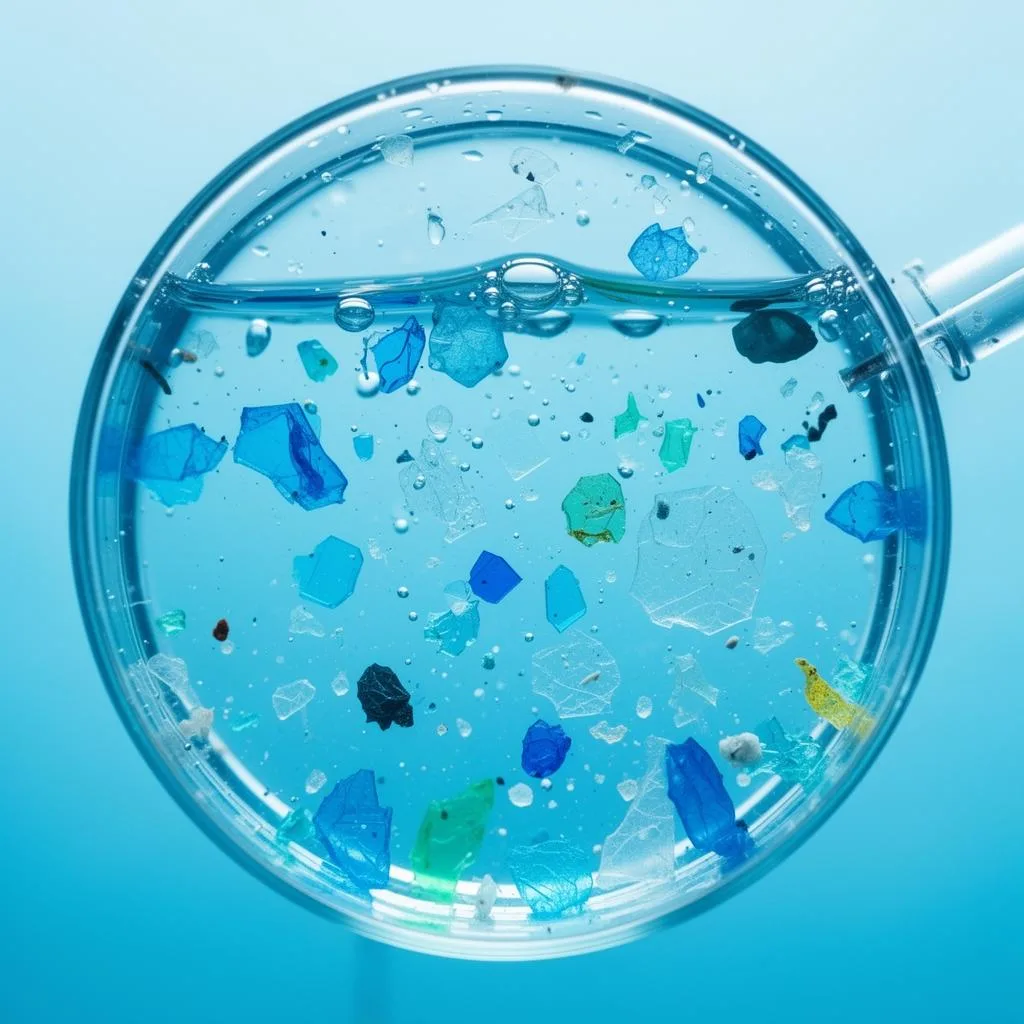
Particles enter the human food and water supply through packaging breakdown, synthetic textile shedding, tire wear, agricultural plastic films, personal-care products, and dust in the air. Global plastics production roughly doubled from 234 million tonnes in 2000 to about 460 million tonnes in 2019, according to the OECD’s Global Plastics Outlook, with production, use, and waste projected to rise a further 70% by 2040 on current trajectories. Every plastic item produced eventually degrades somewhere.

Detection has followed this growth. A 2018 study by Kosuth, Mason, and Wattenberg in PLOS ONE found anthropogenic particles in 81% of 159 tap water samples from five continents. A separate 2018 study led by Sherri Mason at the State University of New York at Fredonia, published in Frontiers in Chemistry, found microplastic contamination in 93% of 259 bottled water samples across eleven brands, at roughly twice the particle concentration of tap water, with polypropylene from bottle caps as the most common polymer.
There is currently no U.S. federal standard for microplastics in consumer products. One public reference point is the California State Water Board’s drinking-water microplastics framework, which defines microplastics as solid polymeric material with particles having at least three dimensions greater than 1 nanometer and less than 5,000 micrometers. This definition is a technical reference, not a geographic boundary, and it is broader than any current analytical method can reliably measure. Understanding how wide that gap is, and what it means for any claim built on current testing, requires comparing the regulatory definition with what validated methods can actually detect.
Validated analytical methods for detecting microplastics in drinking water from the California State Water Board show this measurement gap clearly. The table below compares the regulatory definition range with the validated detection floors of each approved method.
|
Reference |
Lower size boundary |
Upper size boundary |
Notes |
|---|---|---|---|
|
>1 nanometer |
<5,000 micrometers |
Regulatory definition, broader than any validated method can reach |
|
|
SWB-MP2-rev1 (Raman spectroscopy) |
>20 micrometers |
5,000 micrometers |
Validated range, better spatial resolution than infrared, higher susceptibility to interference |
|
SWB-MP1-rev1 (infrared spectroscopy) |
>50 micrometers |
5,000 micrometers |
Validated range, higher throughput, lower spatial resolution than Raman |
|
Unvalidated fraction (both methods) |
1 micrometer |
20 micrometers |
Not validated under either California SOP, so particles in this range cannot be reliably reported under these methods |
The California definition reaches down to 1 nanometer, while the best validated methods begin at 20 or 50 micrometers, which are thousands of times larger. That gap reflects a hard technical limit rather than a lack of effort. The EPA notes that no single analytical method can characterize the full range of microplastic and nanoplastic particle sizes, densities, and polymer compositions, and highlights the need to develop and standardize collection, extraction, quantification, and identification methods.
Three further constraints define what any result can honestly claim. Particle-size limits mean a method that starts at 50 micrometers cannot see anything smaller, so a “none detected” result can coexist with particles below that floor. Polymer diversity means no single test screens every polymer type across every product format. Lot-to-lot variability means a clean result on one production lot does not guarantee the next.
These three constraints apply to microplastic particle testing specifically, yet claims in this space often blur particle evidence with a separate, more mature body of research on plastic chemical additives. Phthalates and bisphenols carried by plastics are well-established endocrine-disrupting compounds, with evidence spanning animal models, human clinical observation, and epidemiology. The physical microplastic particles themselves remain a newer and far less settled question. One question concerns what plastics are made with, and the other concerns the particles they break into, and the evidence base for each cannot be swapped.
The 2025 Nature Medicine study led by Alexander Nihart at the University of New Mexico, Bioaccumulation of microplastics in decedent human brains, reported microplastic and nanoplastic accumulation in human brain, liver, and kidney tissue from postmortem samples. It found the highest concentrations in brain tissue, predominantly polyethylene, present largely as nanoscale shard-like fragments. Brains from individuals with a dementia diagnosis contained higher microplastic concentrations than brains from those without dementia. The study’s lead author, Matthew Campen, PhD, MSPH, stated explicitly: “We don’t think there is a causal relationship at this time between microplastics and dementia.”
Challenges in studying microplastics in human brain, a methodological critique published in the same journal, raised concerns about contamination controls and validation in the Nihart study. This critique reflects the scientific process at work rather than a dismissal of the findings. Anyone evaluating a claim built on this study should hold both the reported findings and the published critique together.
A 2026 study in Nature Health analyzed 156 diseased brain samples from 113 patients with brain tumors and 35 healthy brain samples from five post-mortem donors. It detected micro- and nanoplastics in 99.4% of diseased samples and 100% of healthy samples, with higher concentrations in peritumoural brain tissues than in healthy brain tissues. The authors suggested that a compromised blood-brain barrier in cancer patients may ease particle entry. The study observed this concentration difference but did not report any correlation between microplastic surface area and tumor growth.
Fazel Monikh, PhD, professor of analytical chemistry at the University of Padua, summarizes the state of the field: “The evidence does not yet justify definitive claims about microplastics in the human brain or their health effect. The science is still at a very early stage.”
Five questions help you evaluate any study or claim in this space.
Source credibility: Is the finding peer-reviewed, with named authors, a stated sample size, and disclosed methods?
Testing boundaries: What was the detection floor, which polymers were screened, and were blank controls reported?
Scope of findings: Does the study report detection, association, or causation, since each claim type requires different evidence?
Comparability: Were experimental doses and particle types similar to everyday human exposure, or were they far higher laboratory concentrations?
Limitations: Does the study, or any claim built on it, acknowledge what the method cannot see?
Organizations that receive third-party microplastics data face a consistent challenge. A laboratory report describes what a laboratory found, yet it does not by itself define what the market can reasonably claim or reassure a skeptical buyer that the interpretation is independent.
Quality controls matter as much as results. In microplastic research, field blanks detect contamination during sampling, procedural blanks identify contamination introduced in the laboratory, and air blanks monitor airborne fibers, with results expected to report both raw and blank-corrected data plus the average and standard deviation of particles found in blanks. A result without documented blank controls has limited meaning.

Laboratory accreditation provides one layer of assurance. ISO/IEC 17025, the general requirements standard for the competence of testing and calibration laboratories, gives independent reviewers a basis to assess whether a laboratory’s methods and sample types fall within its qualified scope. California’s Environmental Laboratory Accreditation Program (ELAP) offers one example of state-level accreditation for applicable microplastics methods and represents a stringent public reference for drinking-water microplastics testing.
Public-facing language in this category now receives close scrutiny. Absolute claims such as “microplastic-free,” “zero plastic,” or “none detected” stated without method context create legal and reputational risk as class-action litigation over unsubstantiated plastic claims grows. The emerging norm among careful brands is scope-limited language. These claims tie statements to a specific tested particle-size range, polymer panel, production period, and analytical method, with independent review of the underlying data.
The following categories apply when a consumer evaluates a brand’s claim and when a brand evaluates its own data.
Technical:
What analytical method was used, and what is its validated detection floor?
Which polymer types were screened, and does the panel include PE, PP, PET, PS, PVC, and other common polymers?
Were blank controls run and reported?
Are results reported by size fraction or as a single aggregate figure?
Is the laboratory ISO/IEC 17025-accredited, with the method and matrix clearly inside its accredited scope?
Operational:
Does the tested product and production lot match the claim being made?
How recent is the data, given that lot-to-lot variability means older results may not reflect current production?
Was chain of custody documented from sample collection through analysis?
Regulatory and claim scope:
Does the claim extend beyond what the tested particle-size range and polymer panel can support?
Is the claim applied to a single product or extended across a product line or company?
Has the claim language been reviewed against applicable advertising standards?
Reputational:
Is the data independently reviewed or self-reported?
Can a retailer, journalist, or buyer check the underlying scope of the claim?
Does the claim acknowledge what the method cannot see?
The following overextensions appear frequently in coverage of microplastics research and in consumer-facing brand claims.
Equating detection with harm. Finding a particle in brain tissue establishes presence but not damage at detected concentrations. Although 2025 measurements of nanoplastics in decedent human brain tissue found higher concentrations in cases of Alzheimer’s disease and vascular dementia than in neurologically normal controls, correlation is not causation, and experimental models are needed to determine whether nanoplastics play a causative, modifying, or bystander role.
Treating “none detected” as proof of absence. “None detected” means none were found above the instrument’s detection floor, for the polymers it screened, in the lot it tested. It is a bounded statement, not a guarantee.
Borrowing chemical-additive evidence to support particle claims. The strong evidence base for phthalates and bisphenols as endocrine disruptors does not transfer automatically to claims about microplastic particles themselves, which remain a separate question.
Extrapolating experimental doses to everyday exposure. A 2026 Frontiers in Immunology review notes that animal-model conclusions on micro- and nanoplastic effects cannot be directly equated with human health risks because experimental doses, durations, and particle characteristics often differ substantially from complex human environmental exposures.
Extending a single product’s result across a line or company. A clean result on one SKU, from one production lot, tested by one method, covers exactly that scope and nothing more.
Citing contested figures without their critique. Pyrolysis mass spectrometry methods used to quantify nanoplastics in human tissues have been criticized for possible overestimations of certain polymer types, while alkaline digestion processes may generate agglomerated fragments or destroy fragile polymers, leading to underestimations. Every number in this field carries its methodological context.
Assuming all cross-sectional findings establish causation. A 2026 systematic review by Alkhamees et al. in PeerJ found that all human investigations were cross-sectional and therefore could not establish causality between microplastics or plastic-associated compounds and altered cognitive function or neurodegenerative biomarkers.
The study, led by Alexander Nihart at the University of New Mexico, analyzed postmortem brain, liver, and kidney tissue and reported microplastic and nanoplastic accumulation in all three organ types, with the highest concentrations in brain tissue. The predominant polymer identified was polyethylene, present largely as nanoscale shard-like fragments. Brains from individuals with a dementia diagnosis contained higher concentrations than those without. As noted earlier, the study’s lead author stated that the team does not consider a causal relationship between microplastics and dementia to be established. A methodological critique published in the same journal raised concerns about contamination controls and validation. The study establishes presence and warrants serious attention but does not establish causation or a concentration threshold at which functional harm occurs.
The evidence is suggestive but not conclusive for humans under everyday exposure conditions. A mouse study showed that orally administered polystyrene nanoparticles crossed the blood-brain barrier within two hours, while larger particles did not, which supports a size-dependent pattern in experimental animals. A 2026 structured review notes that micro- and nanoplastics may cross brain barriers through multiple routes, particularly when the barrier is weakened by disease. A 2025 systematic review of cerebrovascular disease found that animal models show micro- and nanoplastic exposure can disrupt the blood-brain barrier, yet the limited number of human studies requires further standardized research before a causal relationship can be established. Animal mechanistic data alone does not prove equivalent crossing under typical human exposure conditions.
It means no particles were found above that instrument’s detection floor, for the polymer types it screened, in the specific lot it tested. A method validated above 50 micrometers cannot see anything smaller, so “none detected” can coexist with particles below that size. The statement is bounded entirely by the method’s detection floor, the polymer panel used, and the production lot sampled. It is not a guarantee that the product contains no plastic. This distinction explains why independent review of the method behind a result matters as much as the result itself.
Several factors contribute to this gap. No prospective longitudinal studies have tracked microplastic brain levels over time to see whether higher concentrations come before neurological decline. All existing human studies are cross-sectional, so they capture a moment rather than a trajectory. No single analytical technique can report nanoplastic concentration, size, shape, polymer type, and chemical additive composition in biological tissues at the same time, which makes results across studies hard to compare. Experimental animal studies often use doses and particle types that differ substantially from real-world human exposure. Wide differences between individuals in measured tissue concentrations also remain unexplained. The World Health Organization’s 2019 assessment found no indication of health risk at current levels in drinking water on the limited evidence available, while stressing that this conclusion rests on incomplete information and that more research is urgently needed.
The Wellness Quality Institute (WQI) is an independent verification body that reviews a company’s existing third-party laboratory data on plastic and microplastic content against defined criteria. It does not run laboratory tests itself. The Wellness Quality Institute’s core program, Plastic-Free Pathway Verification, governed by the standard WQI-CS-01, assesses the dataset, analytical method, product scope, and supporting controls against criteria aligned with the California State Water Board’s drinking-water microplastics reference framework. A Standard Met outcome produces a scope-locked verification that applies only to the reviewed product, tested particle-size range, polymer panel, and production period.
This verification does not certify that a product contains zero plastic, because no laboratory today can confirm the complete absence of plastic across every particle size, polymer type, and production lot. The verification shows that a company’s laboratory data has been independently reviewed against a defined standard and supports genuine progress toward plastic-free production. California has not created, approved, authorized, or endorsed the Wellness Quality Institute or its standard.
WQI Plastic-Free Pathway Verification does not certify that a product contains zero plastic, microplastics or nanoplastics. It shows that the company is on a verified pathway toward plastic-free standards. Verification applies only to the reviewed products, submitted datasets, tested ranges, polymer panels, production or sampling periods, and supporting controls. WQI verification is not a California approval, government certification, or health or safety certification.
The detection of microplastics in human brain tissue is real. The 2025 Nature Medicine study and the 2026 Nature Health study of brain tumor and healthy donor tissue both confirm presence. No current study, however, establishes a causal relationship between detected concentrations and functional brain impairment or a threshold at which harm occurs. A 2026 review in Trends in Neurosciences concludes that current evidence on microplastics and neurological dysfunction remains dominated by experimental models, with persistent knowledge gaps regarding long-term impacts on the nervous system.
The evaluation framework used here, covering evidence quality, claim scope, testing methodology, and practical relevance, is the same framework that separates a defensible market claim from an overreach. Detection does not equal causation. “None detected” does not equal absence. A single product’s result does not equal a company-wide claim. A laboratory report, however rigorous, does not equal an independently reviewed, scope-limited verification.
For consumers, the practical takeaway is proportion over panic. Microplastics are present and worth understanding, the science on harm remains unsettled, and informed reduction is a more realistic goal than absolute purity. For brands, the practical takeaway is that the gap between real data and a defensible claim is where legal and reputational exposure lives, and where independent review provides footing that self-reported results cannot match.
The Wellness Quality Institute exists to bridge that gap. The Wellness Quality Institute’s Plastic-Free Pathway Verification program independently reviews a company’s existing laboratory dataset against defined criteria, produces scope-locked approved claim language, and lists Standard Met products in a public registry that any buyer, retailer, or journalist can check. A single assessment fee covers review, verification decision, and registry listing, with no separate mark-license or registry fee, while independent laboratory testing is arranged and billed separately. Payment of the assessment fee does not guarantee a verification decision.
Research

Avoid greenwashing lawsuits over plastic claims. The Wellness Quality Institute turns real data into defensible, FTC-compliant environmental claims.
Read article
Avoid greenwashing risks. The Wellness Quality Institute helps you substantiate recyclable, compostable & plastic-free claims. Get verified today.
Read articleThe Wellness Quality Institute helps brands turn plastic lab results into defensible claims. Get independent review you can trust. Learn more.
Read article