
How to Avoid Greenwashing Lawsuits on Plastic Claims
Avoid greenwashing lawsuits over plastic claims. The Wellness Quality Institute turns real data into defensible, FTC-compliant environmental claims.
Read articleAvoid greenwashing risks. The Wellness Quality Institute helps you substantiate recyclable, compostable & plastic-free claims. Get verified today.

Written by: Scott Steveson, Specialist, Wellness Quality Institute
The Federal Trade Commission (FTC) Green Guides interpret Section 5 of the FTC Act. Courts treat these interpretations as a reliable guide even though they are not formal regulations. The Guides cover every kind of environmental marketing, from packaging copy to social media posts. Violations can trigger civil penalties of up to $50,120 per violation per day, corrective advertising, and repayment of profits.
Several specific thresholds in the Green Guides matter for plastic packaging.
Some states go further. Certain jurisdictions use a “60/60” threshold, which means recycling programs that serve at least 60% of the population must collect the item, and at least 60% of processing facilities must sort it. These rules often sit alongside design and composition requirements. Treat these state approaches as a preview of where national rules are heading, not as narrow regional concerns.
Enforcement activity is steady and visible. A March 2026 settlement between the Arizona Attorney General and Reynolds Consumer Products forced a redesign of Hefty bag packaging, required a front-of-box statement reading “These Bags Are Not Recyclable,” and imposed a $212,000 payment. Multiple putative class actions filed in 2026 challenge Keurig Dr Pepper’s K-Cup recyclability claims, arguing that most municipal systems do not accept the pods. These actions show that claims based on narrow or theoretical recycling routes, rather than broad real-world access, create serious legal risk.
Three pillars decide whether a sustainability claim can withstand legal and consumer scrutiny.
One claim type sits outside this framework entirely: “plastic-free.” No laboratory can prove complete absence of plastic, because every testing method has a detection floor, which is the smallest particle size it can see. A result that reads “no microplastics detected” means only that none were found above the instrument’s detection limit, for the polymers it checked, in the specific lot tested. That result does not show that the product contains no plastic. Current analytical science simply cannot deliver that level of certainty.

Defensible “recyclable” claims rest on recycling access data that show facilities available to at least 60% of consumers where the product is sold. They also need documentation that the package is actually collected, sorted, and processed, not just technically capable of being recycled. How2Recycle offers a practical guide to US recycling infrastructure and standardized labels. Common mistakes include relying on technical recyclability alone and overlooking how labels, inks, or adhesives can disqualify a package under standards such as the APR Design Guide.
Defensible “recycled content” claims rely on chain-of-custody documentation that tracks recycled material from source to finished product, along with percentage calculations by weight. Claims should distinguish clearly between pre-consumer and post-consumer content. A frequent error involves counting in-house manufacturing scrap as recycled content. FTC Green Guides § 260.13, Example 1 explains that material normally reused within the original manufacturing process does not qualify. Another error appears when brands claim “recycled packaging” even though only one part of a multi-piece package uses recycled material. ISO 22095:2020 offers an international chain-of-custody framework. The standard itself notes that chain of custody documents movement of material but does not, by itself, prove product characteristics.
Defensible “compostable” claims usually rely on certification to recognized standards such as ASTM D6400 for plastics and ASTM D6868 for coated paper and fiber. Claims must state clearly when an item needs industrial composting instead of a home compost bin. Many brands stumble when they imply home compostability for items that only break down in industrial facilities. PFAS contamination in fiber foodware can also undermine a compostability claim, and some certification programs now screen for PFAS as part of their review.
“Plastic-free” is not a defensible claim. No laboratory can prove absence of plastic across every particle size, polymer type, and production lot. The best validated analytical methods start at particle sizes far larger than the smallest particles covered by regulatory definitions. That gap spans several orders of magnitude. “Plastic-free” claims also appear more often in class action complaints. Safer language focuses on measured progress toward plastic-free standards instead of claiming that a product has already reached them.
The table below summarizes the risk levels and evidence needs for common claim phrases so you can see at a glance which claims are more defensible and what each one requires.
| Claim Phrase | Risk Level | Why | Substantiation Required |
|---|---|---|---|
| “Plastic-free” | High | Laboratory methods cannot prove total absence; heavily scrutinized in litigation | Not supportable with current science |
| “Recyclable” (unqualified) | Medium-High | Needs 60%+ consumer recycling access under FTC rules; some states apply stricter tests | Recycling access data and documentation of collection, sorting, and processing |
| “30% PCR HDPE” | Lower (if substantiated) | Specific attribute that can be verified | Chain-of-custody records and percentage calculation by weight |
| “Compostable” (unqualified) | Medium | Signals home compostability under FTC Green Guides | ASTM D6400/D6868 certification and clear note if industrial-only |
Third-party laboratory testing forms a foundation for defensible claims, yet testing alone does not complete the job. Several technical limits shape what any test result can truly support.
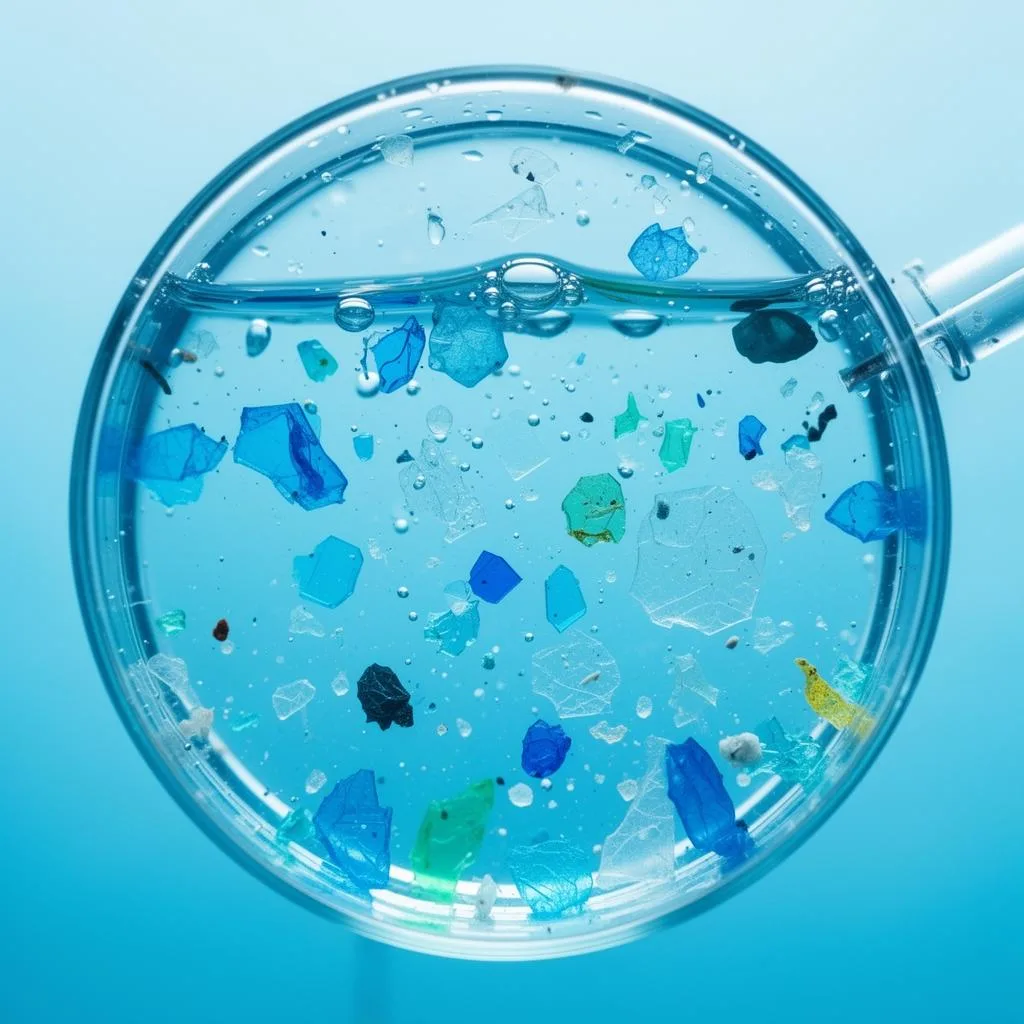
Every method has a detection floor, which means a “no microplastics detected” result only confirms that none appeared above that floor. As explained earlier, this result never proves total absence. When you read a report, focus on what the method can see and treat the result as bounded by that range.
No single test covers every plastic type. A practical minimum polymer panel for a defensible review should include polyethylene (PE), polypropylene (PP), polyethylene terephthalate (PET), polystyrene (PS), polyvinyl chloride (PVC), polyamide (PA), polycarbonate (PC), and polymethyl methacrylate (PMMA). Claims must stay within the set of polymers the lab actually screened.
Because a clean result on one production lot does not guarantee the next, claims need to stay locked to the tested product and production period. Even a well-scoped lab report does not become a defensible market claim on its own. Self-reported results carry less weight than independently reviewed data, so without independent review, even rigorous data often looks like marketing rather than evidence.
Independent verification of laboratory data adds credibility that self-reported results cannot match. The Wellness Quality Institute (WQI) offers Plastic-Free Pathway Verification (PFPV) to help US brands support plastic-related claims with clear evidence.

The Wellness Quality Institute reviews a company’s existing third-party laboratory data against a published standard, WQI-CS-01, which aligns with the California State Water Board’s drinking-water microplastics reference framework. The Wellness Quality Institute does not run laboratory tests and does not certify that any product is plastic-free. The review covers laboratory qualifications, analytical methods, product type, tested particle-size range, polymer panel, reporting limits, blank results, contamination controls, chain of custody, data recency, and product scope.
The “pathway” concept carries most of the weight in this program. “WQI Plastic-Free Pathway Verified” shows that a company is on a verified pathway toward plastic-free standards. It does not state that the product is plastic-free. Every review produces one of two outcomes. Standard Met carries a public verification decision, a scope-locked license to use the WQI mark, and a public registry listing. Standard Not Met remains private, never labels a product as a failure, and can be resubmitted with updated information. A single assessment fee covers review, verification decision, and registry listing. Independent laboratory testing is arranged and billed separately.
Turn real lab data into a claim you can stand behind. Talk to the Wellness Quality Institute about Plastic-Free Pathway Verification.
Run each claim through this checklist before it reaches packaging, websites, or ads.
As outlined in the key takeaways, a defensible claim stays specific, rests on solid evidence, and explains its limits. In practice, this means avoiding broad terms like “eco-friendly,” which are virtually impossible to substantiate. A focused claim such as “30% post-consumer recycled HDPE” can hold up when chain-of-custody records and accurate weight-based calculations support it. The claim also needs to reflect real-world conditions, not just technical possibilities, so infrastructure access becomes part of the proof.
Use clear, specific language that ties directly to documented performance and real infrastructure. Keep a substantiation file ready before any claim appears on packaging or in marketing. Independent verification adds weight that self-published data cannot match. Avoid “plastic-free” claims altogether, because no lab can prove absence and plaintiffs increasingly target this language. Apply the same caution to “microplastic-free,” “zero plastic,” and other absolute phrases.
Certification suggests a settled, guaranteed state in which a product meets a fixed standard on an ongoing basis. Verification describes an independent review of specific evidence against defined criteria, at a particular time, for a defined scope. The Wellness Quality Institute’s Plastic-Free Pathway Verification reviews laboratory data against the published criteria in WQI-CS-01. This process evaluates what the data show for the tested products and ranges rather than declaring that a product is free of plastic forever, which current science cannot support.
Under the FTC Green Guides, an unqualified “recyclable” claim requires recycling facilities to be available to at least 60% of consumers where the product is sold. The package must also be collected, sorted, and processed in practice, not just capable of being recycled in theory. Some states apply even stricter rules. Technical recyclability forms a starting point. Components such as inks, adhesives, and labels can still block a recyclability claim even when the base material is recyclable.
“None detected” means the lab did not find microplastics above the method’s detection floor for the polymers it screened in that specific lot. As noted earlier, every method has limits, so a non-detect result always sits inside those boundaries. The result becomes meaningful when the report discloses the method, polymer panel, and detection floor and when an independent reviewer confirms that the method fits the claim. On its own, a non-detect result does not justify a claim that a product is free of plastic.
Regulators, state lawmakers, and plaintiffs’ attorneys now expect more from sustainability claims on plastic packaging. The FTC Green Guides set a federal baseline, some states raise that bar, and private lawsuits target claims that lack support. Many brands do not yet have the verification systems to meet this standard, and a lab report by itself rarely creates a defensible claim.
Brands that focus on specificity, substantiation, and clear qualification, supported by independent review, can turn real laboratory data into claims they can stand behind. The Wellness Quality Institute’s Plastic-Free Pathway Verification offers that independent review, anchored to a published standard that aligns with the most stringent public reference available. The program delivers scope-locked outcomes and approved claim language that stays within what the evidence can carry.
Ready to turn your lab data into a defensible claim? Ask the Wellness Quality Institute how Plastic-Free Pathway Verification can apply to your product.
Certification

Avoid greenwashing lawsuits over plastic claims. The Wellness Quality Institute turns real data into defensible, FTC-compliant environmental claims.
Read article
The Wellness Quality Institute helps retailers choose labs, interpret results, and make honest microplastics claims. Start testing with confidence.
Read article
Don't publish plastic content claims on shaky data. The Wellness Quality Institute helps verify lab reports so every claim is defensible. Start today.
Read article