
Home Water Testing: City, Well Water & Microplastics
Learn how to test city or well water, read results, and spot microplastics. The Wellness Quality Institute helps brands verify plastic-related claims.
Read articleProtect your health this National Water Quality Month. The Wellness Quality Institute offers trusted third-party water & plastic claims verification.

Written by: Scott Steveson, Specialist, Wellness Quality Institute
Drinking water in the United States can carry contaminants from several distinct sources. The table below summarizes the five categories most relevant to consumer awareness, with typical detection contexts and health notes drawn from primary regulatory and scientific sources. A detection does not automatically mean water is unsafe. The concentration, duration of exposure, and individual susceptibility all matter.
| Contaminant Category | Common Sources | Regulatory Reference / Typical Detection Context | Health Context |
|---|---|---|---|
| Agricultural runoff (e.g., nitrates) | Fertilizer and manure from farms and feedlots carried by rainfall or snowmelt into surface water and groundwater | A 2026 Environmental Working Group analysis found roughly 62.1 million people served by systems with nitrate at or above 3 mg/L in at least one test (2021–2023); EPA MCL is 10 mg/L | EPA identifies pesticides and fertilizers as capable of percolating into aquifers; nitrate above 10 mg/L is associated with health risks, particularly for infants |
| Industrial effluents (e.g., solvents, heavy metals) | Industrial disposal sites, storage facilities, manufacturing discharge; organic solvents, petroleum products, heavy metals | EPA notes these can migrate into aquifers from industrial sites; PFAS from chemical manufacturers are a current regulatory focus | EPA states chemical exposure can cause nervous system or organ damage at high doses and chronic conditions including cancer at lower doses over long periods |
| Urban storm-drain pollution | Tire wear particles, road runoff, combined sewer overflows, urban surface contaminants carried into waterways | Recognized by EPA as a pathway for multiple contaminant types; contributes to surface water contamination that feeds treatment systems | Contaminant mix varies by location; contributes to the broader load that treatment plants must address before water reaches consumers |
| PFAS (per- and polyfluoroalkyl substances, synthetic “forever chemicals” that do not break down in the environment) | Industrial discharge, biosolids used as agricultural fertilizer, consumer products, firefighting foam | CDC surveys show most US residents have been exposed to some PFAS; EPA finalized MCLs of 4.0 ppt for PFOA and PFOS in April 2024; IARC classified PFOA as carcinogenic to humans (Group 1) in 2023 | EPA identifies drinking water as one exposure pathway; health advisory levels (0.004 ppt for PFOA) remain far below the enforceable MCL of 4 ppt, reflecting ongoing scientific uncertainty |
| Disinfection by-products (DBPs, chemicals formed when disinfectants react with naturally occurring organic matter in water) | Chlorine or chloramine treatment reacting with organic matter in source water | Federal MCL: 80 ppb for total trihalomethanes (TTHMs), 60 ppb for haloacetic acids (HAA5); reported in Consumer Confidence Reports as running annual averages | EPA notes long-term exposure to DBPs at elevated levels is associated with increased cancer risk; seasonal spikes in surface-water systems are worth monitoring |
Every US community water system serving 25 or more people year-round must publish an annual Consumer Confidence Report (CCR). This report is a plain-language summary of what was detected in your water supply during the prior calendar year. You can find your report using the EPA’s CCR locator or by searching your utility’s name online. Reading one effectively requires knowing what it can and cannot tell you.
Use this practical checklist when you read your CCR:
Starting in 2027, revised EPA rules require community water systems serving 10,000 or more people to distribute CCRs twice each year and aim to make them easier to read. Once you have reviewed your CCR and understand which contaminants may be present, you can decide what personal protection steps make sense for your home.
Public health authorities consistently recommend a set of proportionate, evidence-based actions for reducing contaminant exposure at home. These steps do not guarantee zero exposure, because plastics and many contaminants are present in the broader environment. They do provide a practical way to reduce risk where you can.
Many water and beverage brands have already commissioned independent laboratory testing on plastic and microplastic content. They have spent real money on this work, acted on the results, and in some cases made genuine progress toward reducing plastic in their products or packaging. The problem is not the data. The problem is that a laboratory report sitting in a folder is not a defensible market claim.
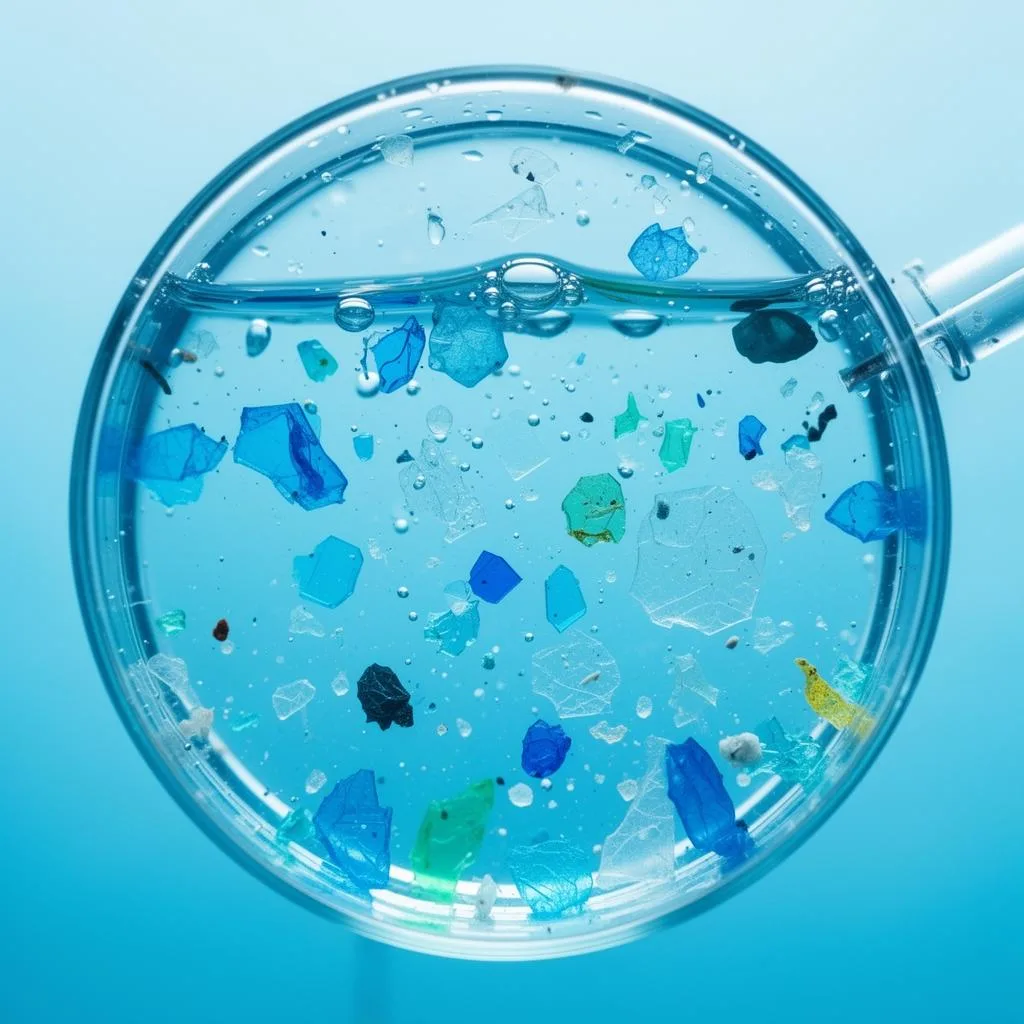
Three pressures are converging on brands simultaneously. Regulatory scrutiny is intensifying: the EPA’s draft Sixth Contaminant Candidate List (CCL 6), published April 2026, includes microplastics as a priority contaminant group for the first time, which signals growing federal attention to plastic in drinking water even before enforceable standards exist. That regulatory attention amplifies consumer concern, which in turn feeds litigation risk. The legal ecosystem pursuing companies whose environmental claims cannot be substantiated is active and expanding, and rising awareness gives plaintiffs more leverage.
Self-reported laboratory results carry less weight than independently reviewed data. When a brand publishes its own test results, the market tends to read that information as marketing, regardless of how rigorous the underlying testing was. Without a shared standard to measure against, even a brand doing everything right has nothing external to point to.
The Wellness Quality Institute (WQI) is an independent verification body that reviews companies’ existing third-party laboratory data on plastic and microplastic content against a defined standard. This process helps brands substantiate real progress toward plastic-related standards instead of making absolute zero-plastic claims that current science cannot support.

WQI’s core program, Plastic-Free Pathway Verification (PFPV), governed by the standard WQI-CS-01, independently reviews a company’s existing laboratory dataset, testing methodology, product scope, and supporting controls against defined criteria focused on particle size and polymer type. The review criteria are aligned with a state water board’s drinking-water microplastics reference framework as a technical reference point, not as a geographic boundary. Verification is available to US water and beverage brands nationally, and no state has created, approved, authorized, or endorsed WQI or its standard.
WQI does not run laboratory tests. It reviews the data that qualified independent laboratories produce. Every review produces one of two outcomes. A Standard Met outcome carries a verification decision, a scope-locked license to use the WQI mark, a public registry listing, and approved claim language. A Standard Not Met outcome remains private, is never described as a failed product, and can be resubmitted with updated information.
Each verification decision applies only to the specific product, the reviewed dataset, the tested particle-size range, the polymer panel, and the defined production period. No company-wide or product-line claim may be extended from a single dataset. A single assessment fee covers review, verification decision, and registry listing, with no separate mark-license or registry fee. Independent laboratory testing is arranged and billed separately.
The regulatory and scientific landscape around water contaminants has shifted materially in the past two years, and scrutiny is increasing rather than easing.
On PFAS: the EPA’s 2024 standards mentioned earlier were explicitly set at the lowest level reliably measurable by existing analytical methods, tying enforceable limits directly to current detection capability. In May 2026, the EPA proposed rescinding limits for four of the six compounds on procedural grounds while retaining PFOA and PFOS standards and extending the compliance deadline from 2029 to 2031. The FDA separately plans to establish allowable PFAS levels for bottled water, which directly affects beverage brands.
On nitrates from agricultural runoff: the EWG analysis cited earlier also found that more than 3 million of those 62.1 million people received water that exceeded the EPA’s 10 mg/L threshold, the enforceable limit, at least once during the same period. Agricultural manure and fertilizer runoff were identified as the most likely source at levels above 3 mg/L.
On microplastics: the CCL 6 inclusion noted earlier reflects increasing evidence of occurrence in drinking water and unresolved questions about detection methods and health impacts. Inclusion on the CCL 6 does not impose regulatory limits. It signals that federal data collection and potential future monitoring are coming. For brands making plastic-related claims today, that trajectory matters.

The gap between detection interest and verifiable reduction claims is precisely the space WQI exists to address. No laboratory today can confirm the complete absence of plastic across every particle size, polymer type, and production lot. That limitation is why carefully scoped, independently reviewed claims are more defensible than absolute ones.
Most brands are choosing between independent review and self-reported data, not between WQI and another equivalent program. The risks tied to self-reported data are growing.
A raw laboratory report published directly carries a number but not the independent review needed to explain what that number means. A finding of “no microplastics detected” is bounded entirely by that instrument’s detection floor. It means none found above a certain particle size using a specific method on a specific production lot, not none present. Without independent review of the method, the matrix, the blanks and contamination controls, and the reporting limits, even rigorous data is often perceived as marketing.
Brands evaluating their options can use the following criteria:
Self-reported data fails most of these criteria by definition. Independent review, structured around published criteria and a public registry, is the only approach that converts real laboratory data into a claim a retailer, journalist, or litigator can check.
Consumers have no legal obligations during National Water Quality Month. It is an observance, not a regulatory event. Its practical value is as a prompt to obtain and read your annual Consumer Confidence Report, review the contaminant data for your water system, and consider whether any personal protection steps, such as a certified point-of-use filter, are proportionate to what you find. For most people served by compliant public water systems, the CCR will show that water meets all federal standards. Reading it gives you the context to evaluate that statement accurately.
This phrase means no microplastic particles were found above the detection floor of the instrument used, for the polymer types that instrument was configured to screen, in the production lot that was sampled. It does not mean the product contains no plastic. Current laboratory methods begin detecting particles at 20 or 50 micrometers depending on the technique, which is thousands of times larger than the smallest particles a state water board’s regulatory definition contemplates. Everything below that floor is invisible to the method. A “none detected” result is a bounded statement about what a specific method found in a specific sample, not a guarantee about the product. Independent review of the method behind the result matters as much as the result itself.
Plastic-Free Pathway Verification (PFPV), offered by the Wellness Quality Institute, is an independent review of a company’s existing laboratory dataset on plastic and microplastic content, assessed against defined criteria focused on particle size and polymer type. It does not certify that a product is free of plastic, because no laboratory today can confirm that across every particle size, polymer type, and production lot. The program produces a carefully scoped, independently reviewed finding. That finding states that the company’s data, method, and controls met defined criteria for the specific product, tested particle-size range, polymer panel, and production period reviewed. Products meeting the standard receive approved claim language, a public registry listing with a checkable registry ID, and a license to use the WQI mark. The verification is not a state approval, a government certification, or a health or safety certification.
The EPA’s 2024 PFAS National Primary Drinking Water Regulation established enforceable MCLs for PFOA and PFOS in public water systems. The FDA is separately reviewing what allowable PFAS levels are appropriate for bottled water, triggered by the statutory requirement to follow EPA’s lead under the Federal Food, Drug, and Cosmetic Act. The FDA’s timeline for that review has not been published. In the meantime, state-level standards vary. New York has adopted 10 ppt MCLs for PFOA and PFOS, Massachusetts sets a 20 ppt standard for the sum of six PFAS, and New Jersey maintains its own separate limits. Brands sourcing water from public systems or making claims about PFAS content should monitor both federal and state developments and should ensure any PFAS-related claims are grounded in independently reviewed data rather than self-reported results.
National Water Quality Month is a useful occasion to move from general concern to specific, proportionate action. Consumers can read their CCR and choose a filter or other steps based on real data, and brands can decide how to use the laboratory data they already hold. The contaminant landscape is complex, the regulatory environment is shifting, and the gap between a laboratory result and a defensible market claim is wider than many brands realize.
The Wellness Quality Institute exists to close that gap. The Institute does not promise plastic-free products, because current science cannot support that claim. Instead, WQI provides independent review of real data against published criteria and produces carefully scoped findings that brands can use and anyone can check. In a market where unverifiable claims are becoming a liability, a verified pathway claim is a more defensible and more durable asset.
Water Quality

Learn how to test city or well water, read results, and spot microplastics. The Wellness Quality Institute helps brands verify plastic-related claims.
Read article
The Wellness Quality Institute explains California's microplastics rules—MCLs, notification levels & basin plans—to keep your claims defensible.
Read article
The Wellness Quality Institute helps brands verify water quality claims with independent testing. Build consumer trust with solid evidence. Start now.
Read article