
Home Water Testing: City, Well Water & Microplastics
Learn how to test city or well water, read results, and spot microplastics. The Wellness Quality Institute helps brands verify plastic-related claims.
Read articleCut plastic water pollution with 7 evidence-backed steps. The Wellness Quality Institute helps you find verified brands and make smarter choices.

Written by: Scott Steveson, Specialist, Wellness Quality Institute
Single-use plastic bottles are a documented source of plastic particles in drinking water. A 2018 study by Mason, Welch, and Neratko published in Frontiers in Chemistry found microplastics in 93% of 259 bottled water samples across eleven brands, at roughly twice the particle concentration of tap water. The most common type detected was polypropylene, the plastic used in many bottle caps. Because the bottle and cap are key contamination sources, replacing single-use bottles with glass or stainless steel removes that packaging-contact pathway entirely. The U.S. reusable water bottle market reached USD 2.3 billion in 2026, which shows that millions of households have already made this switch and that the change is both practical and mainstream. When selecting a home filter, look for clear performance data that specifies which particle sizes and plastic types the filter captures, instead of relying on broad, unqualified marketing claims.

Laundry is one of the largest sources of synthetic microfibers entering waterways. A 2020 study by Lant et al. in PLOS ONE found that switching from a conventional 40°C, 85-minute wash cycle to a 15°C, 30-minute cycle reduced microfiber release by 30%. The same study reported that larger, fuller loads between 3.5 and 6.0 kilograms released a mean of 66.3 ppm of microfibers, compared to 132.4 ppm for smaller loads, which is a statistically significant reduction. Choosing shorter, cooler cycles and running full loads are simple changes that any household can adopt without new equipment. These habits cut microfiber shedding at the source and reduce what reaches local wastewater systems.
External inline washing-machine filters are currently the most effective documented household intervention for laundry microfibers. Independent testing by McIlwraith et al. (2019) in Marine Pollution Bulletin found that external filters captured approximately 87% of microfibers by count on fleece fabric. Napper et al. (2020) reported that the external XFiltra filter captured roughly 78% of microfibres, which is substantially higher than mesh wash bags at about 54% or drum balls at about 26–31%. France has already moved to require microfiber-capture solutions on new washing machines, and pending EU legislation would extend that requirement across the bloc, which signals that these filters are becoming an expected standard rather than an optional add-on. Retrofitting an existing machine with an external filter is a one-time installation that delivers ongoing, measurable reductions in fibers entering the wastewater system.
When choosing products based on plastic-reduction claims, understanding what a laboratory report actually says protects you from overconfident marketing. A report that states “no microplastics detected” is a bounded finding, not a blanket guarantee. It means no particles were found above that instrument’s detection floor, typically 20 or 50 micrometers, for the plastic types that were screened in the specific lot tested. This limitation matters because the World Health Organization’s 2019 assessment Microplastics in Drinking-Water found low concern at current levels on limited evidence, while also stressing that the evidence base is incomplete and that more research is urgently needed. Given these knowledge gaps, consumers evaluating product claims benefit from knowing exactly what a dataset covers, including the particle-size range tested, the plastic types screened, and whether the methods and interpretation were reviewed by an independent party instead of only by the brand.

Picking up larger plastic items before they break down prevents future microplastic pollution. Macroplastics, which are visible plastic objects, fragment over time into the tiny particles that enter water supplies. Removing them early is a preventive upstream strategy that reduces later contamination. A 2022 critical review of microplastic policies concluded that preventive upstream strategies, including source-specific behavior changes, are pivotal for addressing microplastic release, while downstream measures such as wastewater treatment serve only as supporting approaches. Targeted cleanups that focus on storm drains, riverbanks, and coastal areas, where plastic tends to concentrate before entering waterways, deliver more measurable impact than general litter collection.
Keeping heat away from plastic that touches food or drink reduces both particle shedding and chemical exposure. Heat and mechanical stress accelerate the fragmentation of plastic into smaller particles. Microwaving food in plastic containers or storing hot liquids in plastic bottles increases the chance that particles will move into food and drink. This concern is separate from chemical additives such as phthalates and bisphenols, which are well-established hormone-disrupting compounds according to the Endocrine Society’s scientific statement. Both issues point toward the same practical step. Favor glass or stainless steel whenever food or liquid contact involves heat or long storage. This change reduces particle generation, lowers additive exposure, and removes a source of plastic fragments before they can enter the waste stream.
Consumer purchasing decisions can push companies toward better plastic practices even when regulations lag behind. On April 2, 2026, the EPA included microplastics for the first time as a priority contaminant group in the draft Sixth Contaminant Candidate List (CCL 6) under the Safe Drinking Water Act. This step signals serious scientific attention, yet it remains a research priority rather than an enforceable standard. In the absence of that federal standard, independent verification programs fill the gap that regulation has left open. The Wellness Quality Institute (WQI) independently reviews a company’s existing laboratory dataset against defined criteria, including particle-size range, plastic types tested, and method quality, and then issues a scope-locked verification decision. Supporting brands that pursue this kind of reviewed, registry-backed substantiation encourages wider adoption of rigorous data practices across entire product categories.
Ready to pursue verification for your brand? Connect with WQI to review your existing lab datasets.
Learning how to read plastic-related claims on packaging helps you reward brands that back their statements with real data. Plastic-related claims vary widely in what they actually prove, and many rely on language that sounds reassuring without describing any testing. Generic terms such as “plastic-free,” “microplastic-free,” “eco-friendly,” or “clean” describe a desired state but do not explain what was measured, who did the testing, which method was used, or which particle sizes were checked. The FTC Green Guides treat unqualified general environmental benefit claims as presumptively deceptive because no single product can substantiate broad implied benefits. When a brand publishes its own lab results without outside review, it is effectively grading its own homework, so the data may be real but the interpretation has not been independently checked.
The Wellness Quality Institute’s Plastic-Free Pathway Verification, governed by the standard WQI-CS-01, offers a different model that focuses on clear scope and public documentation. The Wellness Quality Institute reviews a company’s independently generated laboratory dataset against defined criteria. These criteria include the particle-size range tested, which aligns with the California State Water Board’s drinking-water microplastics reference framework that validates methods from 20 or 50 micrometers up to 5,000 micrometers. They also include the plastic types screened, at minimum polyethylene, polypropylene, PET, polystyrene, PVC, nylon, polycarbonate, and PMMA, along with the analytical method, contamination controls, and the specific product and production period covered.
Products that meet the standard receive the mark “WQI Plastic-Free Pathway Verified,” which signals progress toward plastic-free standards rather than a promise of zero plastic. The word “Pathway” is central because it highlights direction and improvement, not a final destination. The mark must always link to a public registry entry that records exactly what was reviewed, so any consumer, retailer, or journalist can check the scope independently. As noted earlier, verification confirms what was tested and found within defined limits, not an absolute plastic-free state. California’s framework serves as a technical reference point for the Wellness Quality Institute’s criteria, and California did not create, approve, or endorse the Wellness Quality Institute or its standard.
When evaluating any plastic-related claim, focus on a few concrete questions. What particle-size range was tested? Which plastics were screened? Was the method reviewed by an independent party or only by the brand? Is there a public registry entry or scope document that you can check yourself? A claim that cannot answer those questions is a marketing statement, not a verified finding.
Households see reductions in microfiber release as soon as they switch to colder, shorter wash cycles and fuller loads. Research on polyester fleece garments found that microfiber release stabilized at a consistently lower level from around the eighth wash onward, because garments shed their loosest fibers early. Installing an external washing-machine filter also delivers capture benefits from the first use. The cumulative effect on waterway particle levels depends on how many households adopt these changes, yet the reduction at the household level begins with the first adjusted wash.
Credible claims clearly state what was tested and how. A defensible claim identifies the product covered, the particle-size range tested, the plastic types screened, the analytical method used, and whether an independent third party reviewed the dataset. Broad language such as “plastic-free,” “microplastic-free,” or “clean” without those specifics signals a marketing statement rather than a verified finding. Look for a public registry entry or scope document that lets you check the claim yourself. If the only evidence is the brand’s own published lab report without outside review, the interpretation of that data has not been independently assessed.
A detection floor is the smallest particle size that a given analytical method can reliably find. For drinking-water testing, validated methods typically start at 20 or 50 micrometers, as explained in the main discussion of reviewed datasets. A result of “no microplastics detected” means no particles were found above that floor, and it does not address particles smaller than that size, which the method cannot see. Because no validated commercial method currently measures the full regulatory definition of microplastics down to 1 nanometer, no honest laboratory report can support an absolute “plastic-free” claim. Understanding the detection floor helps you read any plastic-related test result accurately.
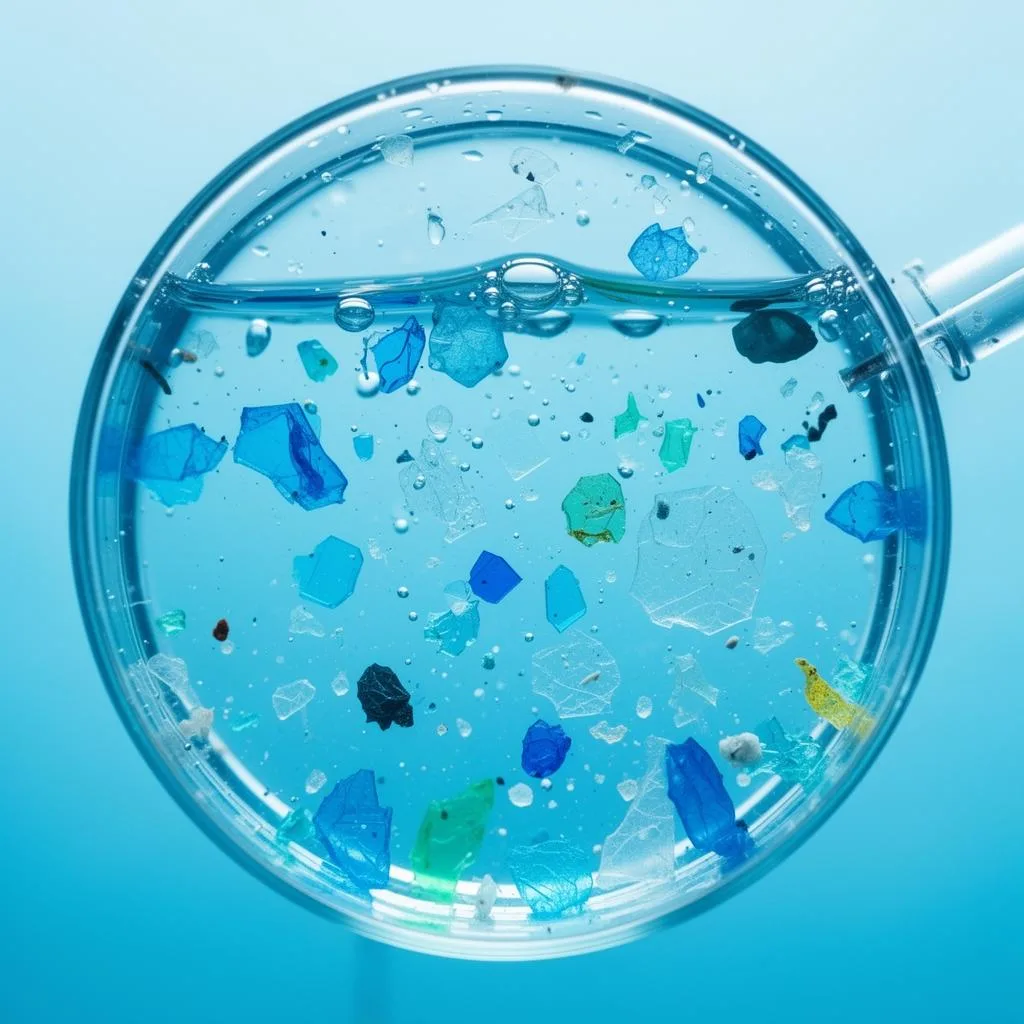
Recycled plastic does not automatically mean lower microplastic content. In some cases, the reprocessing steps and mechanical stress of manufacturing can increase particle shedding rather than reduce it. Deeply colored containers sometimes use color to mask imperfections in recycled feedstock, which says nothing about particle levels. Recycling remains valuable for reducing waste and resource use. It is not, however, a reliable signal about the amount of plastic particles that may move into what you are consuming or drinking from. A recycled-content claim and a plastic-particle-content claim answer different questions and should not be treated as interchangeable.
The Wellness Quality Institute uses the word “verification” because it describes a review of evidence, not a guarantee of an absolute state. A certification typically implies that a product meets a fixed standard completely and on an ongoing basis. The Wellness Quality Institute’s Plastic-Free Pathway Verification is an independent review of a company’s laboratory dataset against defined criteria, which produces either a Standard Met or Standard Not Met outcome. Standard Met means the dataset satisfied all applicable technical and data-quality requirements, and no reportable target plastic particles were detected within the tested particle-size range and approved reporting limits for that specific product, production period, and method. Unlike a certification that implies a guaranteed state, verification confirms that the dataset met defined criteria and does not claim that the product contains zero plastic across every particle size and plastic type.
The Wellness Quality Institute maintains a public registry for every product that receives a Standard Met outcome under its Plastic-Free Pathway Verification. Each entry records the verified party, the specific product and production period covered, the tested particle-size range, the plastic types screened, the analytical method and laboratory accreditation, the verification and expiration dates, a registry ID, and the current status, which may be Active, Suspended, Expired, or Withdrawn. Expired entries remain visible and clearly marked, so the record stays honest over time. Every public verification claim must include or link to the registry ID, which makes the claim independently checkable.
National Water Quality Month offers a clear moment to align daily habits with what current evidence supports. Practical steps include switching to reusable bottles, washing laundry in cooler, fuller loads, installing external microfiber filters, keeping heat away from plastic food and drink containers, joining targeted cleanups, and choosing products from brands whose datasets have been independently reviewed. Each action targets detectable plastic particles within validated testing ranges, which is the part of the plastic problem that current science can measure and that individual behavior can influence. For brands making plastic-reduction claims, the parallel responsibility is clear. A lab report becomes a defensible market claim only after an independent review against defined criteria, with a scope-locked outcome that any buyer or consumer can verify.
Start the verification process and turn your lab results into defensible market claims.
The Wellness Quality Institute’s Plastic-Free Pathway Verification does not certify that a product contains zero plastic, microplastics, or nanoplastics. It shows that the company is on a verified pathway toward plastic-free standards. Verification applies only to the reviewed products, submitted datasets, tested ranges, plastic panels, production or sampling periods, and supporting controls. The Wellness Quality Institute’s verification is not a California approval, government certification, or health or safety certification.
Water Quality

Learn how to test city or well water, read results, and spot microplastics. The Wellness Quality Institute helps brands verify plastic-related claims.
Read article
The Wellness Quality Institute explains California's microplastics rules—MCLs, notification levels & basin plans—to keep your claims defensible.
Read article
The Wellness Quality Institute helps brands verify water quality claims with independent testing. Build consumer trust with solid evidence. Start now.
Read article