
Home Water Testing: City, Well Water & Microplastics
Learn how to test city or well water, read results, and spot microplastics. The Wellness Quality Institute helps brands verify plastic-related claims.
Read articleThe Wellness Quality Institute verifies plastic-in-water claims so your August messaging is accurate, compliant, and registry-backed. Start today.

Written by: Scott Steveson, Specialist, Wellness Quality Institute
August is National Water Quality Month in the United States and focuses public and media attention on drinking water, water infrastructure, and contaminants in both tap and packaged water. For water and beverage brands, August creates a short period of intense consumer interest in water safety and sustainability. It also creates a spike in scrutiny on every claim that appears on packaging or in marketing during that time.
Water sustainability now covers the full lifecycle of water as a resource, including how it is sourced, treated, packaged, consumed, and what enters it at each stage. For beverage companies, sustainability claims now reach beyond water use and recycling rates to the chemical and physical content of the water itself. A 2018 peer-reviewed study by Kosuth, Mason, and Wattenberg in PLOS ONE found human-made particles in 81% of 159 tap water samples from five continents. A separate 2018 study led by Sherri Mason at the State University of New York at Fredonia, published in Frontiers in Chemistry, found microplastic contamination in 93% of 259 bottled water samples across eleven brands, at roughly twice the particle concentration of tap water, with polypropylene from bottle caps as the most common polymer.

These findings moved plastic and microplastic content into the center of sustainability conversations for brands. Rising consumer concern now aligns with regulatory activity. On April 2, 2026, the U.S. EPA proposed adding microplastics as a priority contaminant group to the Drinking Water Contaminant Candidate List 6 under the Safe Drinking Water Act, although this proposal does not yet create compliance duties. As of May 2026, greenwashing and microplastics claims remain the leading source of consumer class-action exposure in plastics litigation. Sustainability and water management now function as a single conversation for brands making plastic-related claims.
Many water and beverage companies already hold independent laboratory data on plastic and microplastic content. They commissioned the testing, paid for it, and made internal decisions based on the results. A laboratory report and a defensible market claim, however, are not the same thing.
A lab report describes what a laboratory found, within the limits of its method, on the lot it tested. It does not tell the market what that finding supports. Self-reported results, even when rigorous, read as marketing because the company interpreting its own data has a clear interest in the outcome. A July 2026 Morgan Lewis analysis warns that broad, unqualified claims such as “plastic-free” create significant litigation and regulatory exposure if not properly qualified, and recommends disclosures that specify scope, limitations, time period, geography, and whether the claim concerns the product, packaging, service, company, or business line.
The gap is technical as well as legal. Detection can show presence, but it cannot prove complete absence. A result reading “no microplastics detected” means no particles were found above that instrument’s detection floor, for the polymers it screened, in the lot it tested. The World Health Organization’s 2019 assessment, Microplastics in Drinking-Water reported low concern on limited evidence and stressed that this conclusion rests on incomplete information and that more research is urgently needed. No laboratory today can confirm the complete absence of plastic across every particle size, polymer type, and production lot. Any claim that implies complete absence carries real legal exposure.
Reducing plastic pollution in water requires action across the full supply chain. The ten approaches below give water and beverage companies, and consumers, practical options to consider.
The first step in turning laboratory data into a defensible claim is confirming that the laboratory is qualified and that the method fits the specific product being tested, often called the product matrix. Without this match, even expensive testing may not support a claim.
Wellness Quality Institute qualifies laboratories by accreditation tier rather than by name. The preferred tier is a state Environmental Laboratory Accreditation Program accreditation for the applicable state water board microplastics method. The accepted tier is ISO/IEC 17025 accreditation, which is the international standard for laboratory competence, with the specific microplastics method and the product matrix clearly listed in the accredited scope. A conditional tier covers other qualified independent laboratories, subject to documented method-equivalence review.
Method suitability matters because different analytical techniques have different detection ranges and strengths across products. Micro-FTIR spectroscopy detects particles roughly from 10 µm to 500 µm in clean water. Micro-Raman spectroscopy can reach down to about 1 µm in clean water. Pyrolysis-GC/MS can quantify plastic mass concentrations down to about 100 nm but does not provide direct particle size information unless cascade filtration is used beforehand. A method that works well for tap water may not suit a carbonated beverage or a product with high dissolved solids. Confirming suitability before you submit data avoids paying for testing that cannot support a verification decision.
A state water board’s drinking-water microplastics framework currently offers the most stringent public reference for this type of testing. Wellness Quality Institute uses this framework as a technical anchor. Verification is available to U.S. water and beverage companies nationally, and the state has not endorsed or approved WQI. The framework is used because it provides the most defensible criteria available today.
The framework defines microplastics in drinking water as solid polymeric material with particles that have at least three dimensions greater than 1 nanometer and less than 5,000 micrometers. Under this definition, two published analytical methods exist: one uses infrared spectroscopy and is validated for particles greater than 50 µm through 5,000 µm. The other uses Raman spectroscopy and is validated for particles greater than 20 µm through 5,000 µm. The particle-size range from 1 to 20 µm is not validated under either method, and everything below 1 µm, the nanoplastic range, currently sits beyond reliable commercial measurement.
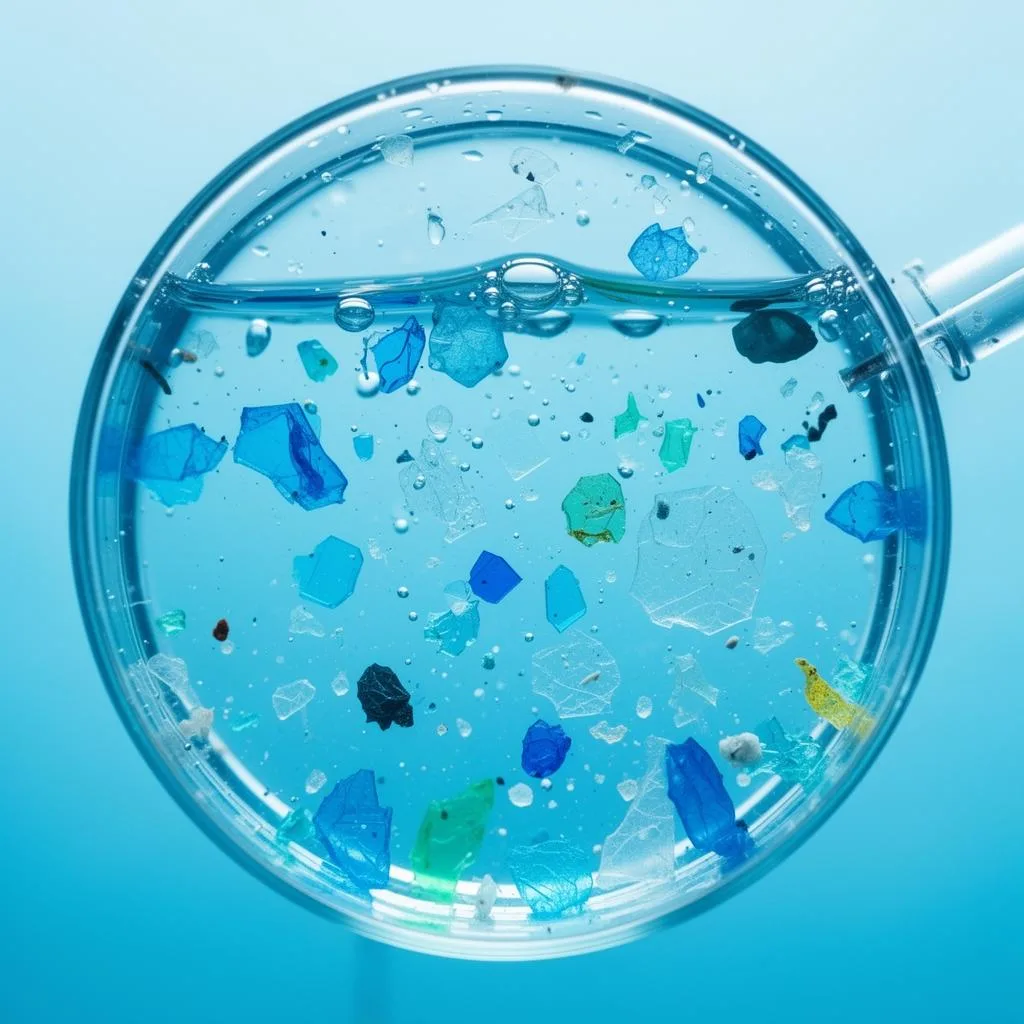
Mapping a dataset against this framework means identifying which particle-size fractions the testing covered, which polymer types it screened, and where the data stops. Wellness Quality Institute’s minimum required polymer panel includes polyethylene (PE), polypropylene (PP), polyethylene terephthalate (PET), polystyrene (PS), polyvinyl chloride (PVC), polyamide (PA, commonly called nylon), polycarbonate (PC), and polymethyl methacrylate (PMMA). Results must be reported by size fraction instead of a single combined figure. This mapping step sets the outer boundary of any claim the data can support.
A non-detect result, often written as “no microplastics found,” only has meaning if the reporting limit, which is the lowest concentration the method can reliably measure, is adequate. A “none detected” result above the required threshold means compliance cannot be determined and does not mean the product is clean.
Blank controls are samples that go through the full analytical procedure without containing the target substance. They show whether the laboratory environment, equipment, or reagents are adding contamination. A PNAS commentary critiquing a 2024 nanoplastics study found that the study’s procedural blanks appeared contaminated and that its quality control was inadequate. This example shows why blank data functions as a pass-or-fail criterion instead of a formality.
Defensible environmental data requires a continuous, fully traceable chain of custody from sample collection through analysis, with any break in documentation potentially making results unusable for regulatory or legal purposes. Chain-of-custody documentation, which tracks every handler, sample ID, collection time, matrix, and preservative, is a required part of a reviewable dataset.
Wellness Quality Institute’s review checks reporting limits, blank results, spike recoveries, which confirm that the method can detect a known quantity of the target substance, replicates, and chain of custody as part of the data-quality evaluation. Visual identification of particles alone never suffices. Counted particles, or an approved statistically valid subsample, must be chemically confirmed by spectroscopy.
Independent review converts a laboratory report into a defensible market claim. This distinction matters because buyers, retailers, and regulators routinely discount self-reported results, even when the underlying testing is strong. A “tested to standard” claim usually reflects a one-time lab result arranged and controlled by the brand, which may cover only parts of a standard, skip factory audits, and provide no ongoing re-testing or independent verification of marketing claims.

Wellness Quality Institute’s review follows WQI-CS-01, the published Plastic-Free Pathway Verification standard. The review examines laboratory qualification, analytical method, product matrix, sampling, tested particle-size range, target polymer panel, reporting limits, blank results, spike recoveries, replicates, chain of custody, data recency, product scope, and production or sampling period. Companies submit the datasets and supporting documents they already hold. Wellness Quality Institute does not run laboratory tests, and that separation keeps the review independent.
A Standard Not Met outcome stays private. It carries no public claim, no logo rights, and no registry listing, and it is never described as a failed product. It may reflect insufficient data, an unsupported method, or incomplete scope rather than a product problem. The company can resubmit corrected or additional information. Taking part in the review process carries no public downside risk.
A Standard Met outcome requires two conditions together. The dataset must satisfy all applicable technical and data-quality requirements, and no reportable target polymer particles can be detected within the tested particle-size range and approved reporting limits. A non-detect result alone does not qualify if the reporting limits fail to meet Wellness Quality Institute requirements.
Products that meet the standard receive a license to use the approved mark, “WQI Plastic-Free Pathway Verified,” together with claim language tied to the reviewed evidence. The mark may not appear as a standalone product claim and must link to or sit next to access to the Verification Scope record. It must not imply plastic-free, microplastic-free, nanoplastic-free, zero plastic, state approval, government certification, or health or safety certification. Rights apply only to the specific products that met the standard.
Every Standard Met product receives a public registry entry that records the verified party, product scope, matrix, production or sampling period, tested particle-size range, lower method limit, polymer panel, reporting limits, testing laboratory and its accreditation, verification date, expiration date, registry ID, approved result statement, and current status. A buyer, retailer, or journalist can check the scope of any claim without relying solely on the brand. The verification period lasts 24 months from the sampling date of the most recent accepted dataset. After that period, continued claim use requires re-verification with current data.
The table below maps three key dataset variables, method detection floor, polymer panel coverage, and data recency, against the claim language each combination can support. All figures reflect WQI-CS-01 requirements and a state water board’s validated method ranges.
| Method Detection Floor | Polymer Panel Coverage | Data Recency | Allowable Claim Language |
|---|---|---|---|
| ≥50 µm (infrared, validated range) | Full minimum panel: PE, PP, PET, PS, PVC, PA, PC, PMMA | Within 24 months of sampling date | “Dataset reviewed and accepted under WQI Plastic-Free Pathway Verification; no reportable target polymers detected within the tested particle-size range and approved reporting limits” (if Standard Met) |
| ≥20 µm (Raman, validated range) | Full minimum panel: PE, PP, PET, PS, PVC, PA, PC, PMMA | Within 24 months of sampling date | “Dataset reviewed and accepted under WQI Plastic-Free Pathway Verification; no reportable target polymers detected within the tested particle-size range and approved reporting limits” (if Standard Met) |
| ≥50 µm (infrared) | Partial panel, one or more anchor polymers missing | Within 24 months of sampling date | Standard Not Met, incomplete polymer analysis; no public claim available |
| Any validated floor | Full minimum panel | More than 24 months from sampling date | Standard Not Met, data recency requirement not satisfied; re-verification with current data required |
| Below 20 µm or nanoplastic range (<1 µm) | Not applicable | Not applicable | Not applicable, no validated commercial method exists for this range; no claim can be supported |
The table below separates claim language that WQI-CS-01 permits from language that it prohibits. Prohibited phrasing applies regardless of what a laboratory report says, because current science cannot support absolute claims about plastic absence.
| Claim Type | Permitted Phrasing | Prohibited Phrasing | Reason |
|---|---|---|---|
| Program mark | “WQI Plastic-Free Pathway Verified” | “Plastic-free verified,” “verified plastic-free,” “plastic-free certified” | Dropping “pathway” turns a progress claim into an absolute product claim that current science cannot support. “Certified” implies a guaranteed state. |
| Product status | “Dataset reviewed and accepted under WQI’s Plastic-Free Pathway Verification standard” | “Plastic-free,” “microplastic-free,” “zero plastic,” “100% plastic-free” | A July 2026 analysis lists “plastic-free” among high-risk terms that require legal review because of litigation and regulatory exposure. |
| Scope reference | “Verified for [specific product], [specific production period], within the tested particle-size range” | Any company-wide or product-line extension from a single dataset | Scope lock means one dataset supports one product’s claim only. |
| Authority reference | “Aligned with a state water board’s drinking-water microplastics reference framework” | “State-approved,” “government-certified,” “state-endorsed” | The state has not endorsed or approved Wellness Quality Institute, and no government certification exists for this claim type. |
| Health reference | “Studies suggest potential mechanisms of concern” (with named source and careful wording) | “Proven safe,” “non-toxic,” “healthier,” “protects against microplastics” | The World Health Organization’s 2019 assessment found no indication of health risk at current levels on limited evidence, and causation is not established. |
Several recurring issues appear when companies try to convert existing laboratory data into a reviewable dataset.
The laboratory used is not accredited for the method or matrix. Confirm accreditation tier before you commission new testing. Wellness Quality Institute accepts state ELAP-accredited laboratories as preferred, ISO/IEC 17025-accredited laboratories with the method and matrix explicitly in scope as accepted, and other qualified independent laboratories conditionally through documented method-equivalence review.
The dataset covers only part of the required polymer panel. A partial panel produces a Standard Not Met outcome. The minimum panel, PE, PP, PET, PS, PVC, PA, PC, and PMMA, must be covered, with required reporting categories for other confirmed polymers and for unidentified particles with no spectral match.
Blank data is missing or shows contamination. Data validation requires review of laboratory quality controls including method blanks, control samples, matrix spikes, and duplicates, plus preservation of all data qualifiers that change how results are interpreted. Missing blank data cannot be rebuilt later, so new testing with proper controls is required.
Results are reported as a single total count instead of by size fraction. Wellness Quality Institute requires counts reported by size fraction. Aggregate figures cannot be split after the fact. The laboratory must reprocess or reissue the data in the required format, or new testing is needed.
The dataset is more than 24 months old. Data recency is a firm requirement. Lot-to-lot variability means a result from a past production period does not represent current production. Re-verification needs current data from the production period being claimed.
Verification functions as an ongoing discipline rather than a one-time badge. The 24-month verification period reflects the fact that a result represents the production it came from, not all future production. Maintaining a defensible claim over time means treating documentation completeness as part of routine operations.
Documentation completeness means keeping current records of laboratory qualification and accreditation status, chain-of-custody forms for all submitted samples, blank and spike recovery data for each analytical run, confirmation of polymer panel coverage, and the production or sampling period for each dataset. Supporting documentation should include sample IDs, collection details, preservatives used, container types, field observations, and digital traceability records that can withstand audit, regulatory review, or legal scrutiny.
Re-verification readiness means knowing, at any point within the 24-month window, whether the current production period is covered by an active dataset and whether the laboratory relationship and method remain qualified. Companies that build this into their quality management calendar, instead of treating it as a last-minute task, are better positioned to maintain continuous claim use without gaps in registry status.
Expired registry entries remain publicly visible and marked “Expired,” so the record stays honest over time. A lapsed verification appears as a visible gap. Building re-verification into the production calendar, instead of reacting to expiration notices, offers a practical path to continuous claim integrity.
A scope-locked claim applies only to a specific product, dataset, tested particle-size range, polymer panel, and production period. It does not extend beyond that defined scope. Scope lock matters because a legitimate lab result often becomes a greenwashing risk through scope creep. A brand takes a result from one product, one lot, and one method and stretches it to a product line, a brand, or an unqualified “plastic-free” statement. A scope-locked claim prevents that extension by defining exactly what was reviewed and what the finding covers. For August messaging, this structure allows a brand to make a specific, defensible statement about a specific product without implying broader conclusions that the data does not support.
No. Current laboratory technology cannot confirm the complete absence of plastic across every particle size and polymer type. A state water board’s drinking-water definition reaches down to 1 nanometer, while the best validated analytical methods begin at 20 or 50 micrometers, which are thousands of times larger. Everything below those floors currently sits beyond reliable commercial measurement. Wellness Quality Institute Plastic-Free Pathway Verification confirms that a company’s laboratory dataset was independently reviewed against defined criteria and that no reportable target polymers were detected within the tested particle-size range and approved reporting limits for the specific product and production period reviewed. It is a statement about reviewed evidence, not a guarantee of a plastic-free product. The word “pathway” in the mark name signals progress toward a standard, not arrival at one.
Not always. Wellness Quality Institute reviews existing independent laboratory data, which sits at the core of the program. Whether existing data is sufficient depends on several factors. These include whether the laboratory qualifies under WQI’s accreditation tiers, whether the method fit the product matrix, whether the full minimum polymer panel was covered, whether blank and contamination control data is available, whether results are reported by size fraction, and whether the data falls within the 24-month recency window. Many companies discover through the review process that their existing data supports a narrower or a stronger claim than they expected. Where gaps exist, the review identifies them clearly, and the company can commission targeted additional testing before resubmitting.
A laboratory certification, such as NSF/ANSI certification for water treatment products, involves the certifying body testing the product itself, conducting factory audits, and re-testing market samples on an ongoing basis. Wellness Quality Institute does not test products. It reviews a company’s existing independent laboratory dataset against published criteria. WQI deliberately avoids the word “certification” for this program because certification implies a settled, guaranteed state that current science cannot support for plastic content. Verification describes what actually happens, an independent review of a dataset against a defined standard that produces a scope-locked finding with approved claim language.
The registry entry remains publicly visible but is marked “Expired.” Logo use rights and approved claim language lapse at expiration, and continued use of the mark after expiration is not permitted. Expired entries are not removed, because the record is designed to stay honest over time. A brand that has allowed its verification to lapse cannot present its product as currently verified. Re-verification requires submitting a current dataset that covers the active production period, going through the same review process against WQI-CS-01, and receiving a new verification decision. Building re-verification into the production calendar, instead of treating it as a reaction to expiration, supports continuous claim integrity.
Wellness Quality Institute verification does not replace legal, regulatory, or advertising-claims counsel, and it does not remove a company’s responsibility to review its own marketing claims. Companies remain responsible for ensuring that all product, packaging, and marketing claims are accurate and properly supported under applicable law, including the FTC’s Green Guides. Wellness Quality Institute provides an independent review of a dataset against defined criteria, approved claim language tied to the reviewed evidence, a public registry entry that makes the scope of the claim independently checkable, and clear guidance on prohibited phrasing, including a press kit with approved headlines, quotes, and badge language. The FTC Green Guides caution against broad, unqualified environmental benefit claims and favor clear, specific, and prominent qualifications. WQI’s scope-locked, registry-backed claim structure is designed to align with that principle, but brands should confirm compliance with their own legal counsel before publishing any environmental claim.
Water Quality

Learn how to test city or well water, read results, and spot microplastics. The Wellness Quality Institute helps brands verify plastic-related claims.
Read article
The Wellness Quality Institute explains California's microplastics rules—MCLs, notification levels & basin plans—to keep your claims defensible.
Read article
The Wellness Quality Institute helps brands verify water quality claims with independent testing. Build consumer trust with solid evidence. Start now.
Read article