
Microplastics Activities That Teach Water Science Honestly
The Wellness Quality Institute shares 12 activities teaching real microplastics science for Water Quality Month — honest, evidence-based education.
Read articleAugust is National Water Quality Month. The Wellness Quality Institute helps brands verify plastic-free claims—protect your water and your customers.

National Water Quality Month is an annual August observance that invites communities, households, and organizations to look closely at drinking water and take practical steps to protect it. It is not a regulatory deadline or compliance event. It is a prompt for informed, local conversations.
Microplastics now sit at the center of many of those conversations. Microplastics are tiny plastic pieces smaller than 5 millimeters that form as larger plastic items break down over time. Two peer-reviewed studies published in 2018 showed how widespread they are in drinking water. A study by Kosuth, Mason, and Wattenberg in PLOS ONE found human-made particles in 81% of 159 tap water samples from five continents. A separate study led by Sherri Mason at the State University of New York at Fredonia, published in Frontiers in Chemistry, found microplastic contamination in 93% of 259 bottled water samples across eleven brands.

The bottled water samples in that study contained roughly twice the particle concentration found in tap water. Polypropylene, the plastic used in many bottle caps, was the most commonly identified polymer.
These findings need context. The World Health Organization’s 2019 report, Microplastics in Drinking-Water, found no indication of health risk at current exposure levels based on the evidence available at that time. The WHO also stressed that the evidence base is limited and that more research is urgently needed. Detecting a particle is not the same as proving harm. The science is unsettled enough that neither alarm nor dismissal fits the facts.
Regulation of microplastics in drinking water is still taking shape. In April 2026, the EPA placed microplastics on its draft Contaminant Candidate List 6 for the first time, listing them among 88 unregulated contaminants proposed for evaluation in public drinking water supplies for possible future regulation. The EPA’s proposed UCMR 6 rule, published in the Federal Register on July 1, 2026, excluded microplastics from required monitoring because there is no consensus, validated drinking-water test method that public water systems can use reliably. As of August 2026, no national federal monitoring dataset exists for microplastics in US drinking water.
In the absence of federal standards, companies that want to make supportable claims about plastic content need independent verification of the lab data they already have. Learn how verification from the Wellness Quality Institute can help you make defensible claims while regulation catches up.
Individual choices affect water quality at the tap and in the wider environment. The steps below are evidence-based and realistic for most households.
Clear claims about microplastics start with clear limits on what testing can and cannot show. This applies to product labels, news stories, and scientific studies.
Two terms define the boundaries of any test. The detection floor, also called the reporting limit, is the smallest particle size a given instrument can reliably find. The polymer panel is the list of specific plastic types the test is set up to identify. A “none detected” result means no particles were found above the detection floor, for the polymers on the panel, in the lot that was tested. It does not mean the product contains no plastic.
The two most defensible validated methods in use today are Raman spectroscopy and infrared spectroscopy. Raman spectroscopy can detect particles above 20 micrometers (µm). Infrared spectroscopy applies to particles above 50 µm. Both methods reach up to 5,000 µm. No single analytical technique currently provides full microplastic characterization across all relevant particle sizes and water types, and interlaboratory studies highlight the lack of harmonized methods, especially for small microplastics and nanoplastics.
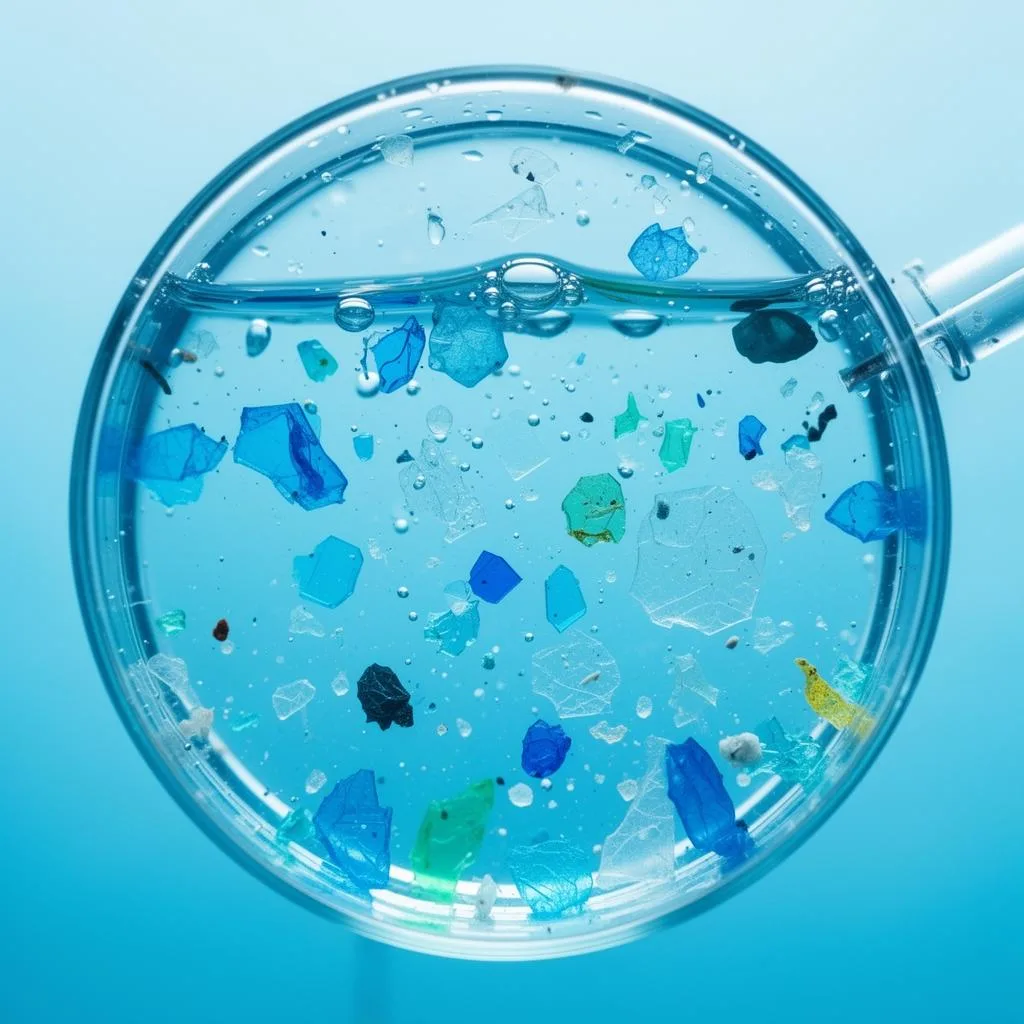
The particle-size range between 1 and 20 µm is not validated under either method. Nanoplastics, which are particles smaller than 1 micrometer, sit beyond the reliable reach of today’s commercial test methods. A sample can test negative because of method constraints such as mesh size cutoffs, fluorescence interference, or weak quality control, not only because microplastics are absent.
Detection proves presence. It cannot prove absence. Finding a particle takes one confirmed result. Proving that no plastic is present would require ruling out every particle below the detection floor, every polymer outside the panel, and every production lot that was not sampled. No laboratory can make that claim with current technology.
Many companies already hold lab data on the plastic content of their products. The real gap is the lack of independent review that turns a lab report into a clear, defensible market claim.
The Wellness Quality Institute (WQI) is an independent verification body that reviews a company’s existing third-party lab data on plastic and microplastic content against defined criteria. This process helps brands show real progress toward plastic-free standards instead of making absolute zero-plastic claims that science cannot support. WQI does not run laboratory tests. It reviews data produced by qualified independent laboratories.

WQI’s review standard, WQI-CS-01, aligns with the California State Water Board’s drinking-water microplastics reference framework, which is the most stringent credible public reference available for this type of testing. California serves as a technical reference point, not a geographic limit. Verification is available to US companies nationwide, not only those operating in California. California has not created, approved, authorized, or endorsed WQI or its standard.
Each review looks at the laboratory’s qualifications, the analytical method, the product matrix (what the product actually is), the tested particle-size range, the polymer panel, reporting limits, blank controls, chain of custody, and how recent the data is. The minimum polymer panel WQI requires includes polyethylene (PE), polypropylene (PP), polyethylene terephthalate (PET), polystyrene (PS), PVC, nylon (PA), polycarbonate (PC), and PMMA.
A review produces one of two outcomes. Standard Met means the dataset satisfies all technical and data-quality requirements and shows no reportable target polymer particles within the tested size range and approved reporting limits. Products that meet the standard receive a scope-locked license to use the mark “WQI Plastic-Free Pathway Verified”, a public registry listing, and approved claim language. Standard Not Met is private, carries no public claim, and does not label a product as failed. It can reflect limited data or an unsupported method, and companies may resubmit with updated information.
Verification applies only to the reviewed product, dataset, tested particle-size range, polymer panel, and production period. Companies may not extend one dataset to a company-wide or product-line claim. Every verified product receives a public registry entry with a registry ID that customers, retailers, and journalists can check.
The mark does not state that a product is plastic-free. It states that a company’s lab data has been independently reviewed against a defined standard and supports genuine progress toward plastic-free production. The word “pathway” matters, because it signals a verified direction of travel, not an absolute endpoint that current science cannot confirm.
WQI Plastic-Free Pathway Verification does not certify that a product contains zero plastic, microplastics, or nanoplastics. It shows that the company is on a verified pathway toward plastic-free standards. Verification applies only to the reviewed products, submitted datasets, tested ranges, polymer panels, production or sampling periods, and supporting controls. WQI verification is not a California approval, government certification, or health or safety certification.
Find out if your existing laboratory data qualifies for WQI Plastic-Free Pathway Verification.
National Water Quality Month takes place every August. It was founded in 2005 by the EPA and backed by the United Nations to promote awareness and encourage action to conserve and protect water sources. Its roots trace back to the Clean Water Act of 1972 and the Safe Drinking Water Act of 1974. The observance encourages community conversations about household and local steps to protect drinking water, not regulatory compliance.
No. “None detected” means no particles were found above that instrument’s detection floor, for the specific polymers the test was designed to identify, in the lot that was sampled. A method that starts at 50 micrometers cannot see anything smaller. A method that screens eight polymer types cannot identify a ninth. A result from one production lot does not guarantee the next lot. “None detected” is a bounded statement about what a specific method found under specific conditions, not a promise that a product is free of plastic. No laboratory today can make that promise, because current methods do not reach every particle size, polymer type, or production lot.
Plastic-Free Pathway Verification from the Wellness Quality Institute means the company’s existing third-party lab dataset was independently reviewed against defined criteria aligned with the California State Water Board’s drinking-water microplastics reference framework, and that dataset met those criteria. The verification is locked to the specific product, tested particle-size range, polymer panel, and production period. It does not mean the product is plastic-free, because that claim is not scientifically supportable with current methods. It means the company’s data supports genuine, independently reviewed progress toward plastic-free standards. Every verified product receives a public registry entry with a registry ID that anyone can check to see exactly what was reviewed and what the scope covers.
As of August 2026, there is no federal maximum contaminant level or national monitoring requirement for microplastics in US drinking water. The EPA placed microplastics on its draft Contaminant Candidate List 6 in April 2026, the first time they appeared on that list, but excluded them from the proposed UCMR 6 monitoring rule published in July 2026, citing the lack of a consensus validated analytical method for public water systems. The regulatory process is moving slowly, and no near-term federal requirement exists for utilities to test for microplastics. The California State Water Board’s drinking-water microplastics framework, which includes two published analytical methods, remains the most stringent credible public reference.
A brand with a Standard Met outcome may state that its dataset was reviewed and accepted under the Wellness Quality Institute’s Plastic-Free Pathway Verification standard. It may use the “WQI Plastic-Free Pathway Verified” mark for the specific products that met the standard and use approved result language tied to its Verification Scope. Every public claim must link to the registry ID so anyone can check the scope. The brand may not say “plastic-free,” “microplastic-free,” “zero plastic,” or “certified,” and may not extend a single product’s result to a product line or the entire company. WQI provides a press kit with approved headlines, quote templates, and badge language so the compliant version is straightforward to use.
National Water Quality Month in August offers a clear moment to review what we know about drinking water quality and where questions remain. Microplastics are present in tap and bottled water, as peer-reviewed research shows. The health implications are still under study. The WHO currently sees no indication of risk at today’s exposure levels, based on limited evidence, and calls for more research. Federal regulation of microplastics in drinking water is in early stages, and no national monitoring requirement exists yet.
For consumers, the most practical response is informed, proportional action. That includes choosing glass or stainless steel for hot liquids, reading labels for what they actually say, and treating absolute claims in either direction with healthy skepticism. For brands making or planning plastic-related claims, the most practical response is independent review of the data they already hold, so public statements stay within what the evidence supports.
The Wellness Quality Institute exists to close the gap between real laboratory data and defensible market claims for water and simple-liquid products in the US market. Its standard is designed to be honest about what current measurement methods can and cannot prove.
Contact the Wellness Quality Institute to discuss verification for your water or liquid products.
Water Quality

The Wellness Quality Institute shares 12 activities teaching real microplastics science for Water Quality Month — honest, evidence-based education.
Read article
The Wellness Quality Institute helps brands turn microplastics lab data into accurate, defensible claims. Avoid costly mistakes — get expert help.
Read article
Can labs prove "zero plastic" in water? The Wellness Quality Institute explains what microplastics data really shows and how brands stay defensible.
Read article